Applied Physics CSIE II: UNIT III: Nano Devices
Single Electron Phenomena
Theory, Condition, Rules
Single Electron Phenomena: Theory, Condition for single electron phenomena to occur, Rules for single electron phenomena to occur, Conditions for tunneling
SINGLE ELECTRON
PHENOMENA
Theory
In
electronics, the transistor is a king. Computers uses transistors to compute.
Also, transistors are used as tiny switches for tunning on and off. It is also
used in transferring and amplifying signals, making logical decisions, etc.
Today,
microchips have a billion transistors, each one turning on and off a billion
times every second. These chips require manufacturing processes with roughly
100‒nm resolution. Every year this resolution drops, manufacturing even small
transistors. Thus, each transistor is reduced to a few atoms or even a single
atom.
In
1970, silicon transistors required about 10 million electrons. Current
transistors requires closer to 10,000 electrons.
In
fact, we here already built single‒atom and single‒electron transistors. We can
use single‒electron transistors to make sensitive amplifiers, electrometers,
oscillators and other digital electron circuits. All these instruments will be
operated by using single electrons or quantum dots.
Condition for single electron phenomena to occur
For
single electron phenomena to occur, we have to keep the single electron or
quantum dot in isolation.
If
any electron on one side of the barrier could just junnel across it, there
would not be any isolation. The dot would not be a quantum dot because it would
still essentially be part of the bulk, so we need to control the addition and
subtraction of electrons.
Rules for single electron phenomena to occur
There
are two rules for preventing electrons from tunneling back and forth from a
quantum dot. When we follow these rules, they help to ensure that the dot
remains isolated and quantized.
The
rules are
Rule
1: The coulomb Blockaded
Rule
2: Overcoming uncertainty
Rule 1: The coulomb Blockade
We
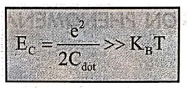
know that the coulomb blockade can prevent unwanted tunneling. Hence we can
keep the quantum dots isolated. The condition for this is given by
EC
= e2 / 2Cdot >>
KBT ... (1)
Rule 2: Overcoming uncertainity
For
the second condition, to keep quantum dots electronically isolated, we look to
the uncertainty principle.
According
to uncertainty principle
ΔΕC . Δt = h …………(2)
Energy
uncertainty
ΔΕC = h/Δt ………(3)
Here,
h is the Planck's constant and ∆t is the measurement time, quantum dot is a
tiny capacitor then the measurement time ∆t is capacitor's time constant.
The
time constant for a capacitor is RC, where R is the resistance and C is the
capacitance.
We can write the time constant as
Δt = RtCdot ……… (4)
Substituting
Eqn. (4) in Eqn (3), we et
ΔΕC = h / RtCdot ……… (5)
Where
Rt = tunneling resistance and
Cdot
= capacitance dot.
Our
aim is to keep electrons from tunneling freely back and forth to and from the
dot. To ensure this, the uncertainty of the charging energy must be less than
the charging energy itself.
For
maintaining electron isolation in quantum dot, we need
AEC
< EC …………(6)
Substituting
Eqn.(3) and Eqn. (1) in equation (6), we get 2
h/∆t < e2 / 2Cdot ... (7)
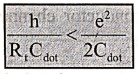
Substitute Eqn.(4) in Eqn.(7), we get
 ……….(8)
In
other word we can write the Eqn. (8) as
Rt >> h/e2 ………(9)
Substituting
the values for h = 6.625 × 10‒34 Js and E = 1.6× 10‒19 C,
we get
h/e2 = 25878 Ω is the resistance
quantum.
This
high resistance value is like a thick insulating material surrounding the
quantum dot.
Thus,
we keep the quantum dots electronically isolated.
Conditions for tunneling
The
two tunneling conditions are
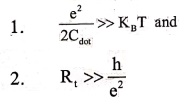
When these conditions are met and the voltage
accross the quantum dot is scanned, then the current jumps in increments everytime
the voltage changes by the value of equation ∆V= e / Cdot.
This
is called a coulomb blockade because the electrons are blocked from tunneling
except at the discrete voltage change positions.
The
two conditions or rules which explain the single electron phenomenon will help
to build a single electron transistor,
Applied Physics CSIE II: UNIT III: Nano Devices : Tag: Applied Physics : Theory, Condition, Rules - Single Electron Phenomena
Applied Physics CSIE II: UNIT III: Nano Devices
Under Subject
Applied Physics (CSIE) II
PH25C03 2nd Semester AIDS, CSE, IT, CSE(CY) Dept | 2025 Regulation | 2nd Semester 2025 Regulation
Related Subjects

English Essentials II
EN25C02 2nd Semester | 2025 Regulation | 2nd Semester 2025 Regulation

Tamils and Technology தமிழர்களும் தொழில்நுட்பமும்
UC25H02 2nd Semester | 2025 Regulation | 2nd Semester 2025 Regulation
Linear Algebra
MA25C02 2nd Semester | 2025 Regulation
Applied Physics (CSIE) II
PH25C03 2nd Semester AIDS, CSE, IT, CSE(CY) Dept | 2025 Regulation | 2nd Semester 2025 Regulation
Digital Principles and Computer Organization
CS25C06 2nd Semester AIDS, CSE, IT, CSE(CY) Dept | 2025 Regulation | 2nd Semester 2025 Regulation

Basic Electrical and Electronics Engineering
EE25C01 2nd Semester | 2025 Regulation | 2nd Semester 2025 Regulation

Python for Data Science
AD25201 2nd Semester AIDS Dept | 2025 Regulation | 2nd Semester 2025 Regulation

Re-Engineering for Innovation
ME25C05 2nd Semester | 2025 Regulation | 2nd Semester 2025 Regulation
Python for Data Science - Laboratory
AD25201 2nd Semester AIDS Dept | 2025 Regulation | 2nd Semester 2025 Regulation