Applied Physics CSIE II: UNIT III: Nano Devices
Single Electron Transistor [SET]
Definition, Working Principle
Definition, Difference between ordinary and single electron transistor, Working of SET, Working for single‒electron transistor (SET) in nutshell
SINGLE ELECTRON
TRANSISTOR [SET]
Definition
A
transistor made from a quantum dot that controls the current from source to
drain one electron at a time is called single electron transistor.
Difference between ordinary and single electron transistor
The
single electron transistor [SET] is built like a conventional FET. The
difference is that instead of a semiconductor channel between the source and
drain electrodes, there is a quantum dot.
This
dot can be a particle on an insulating surface, a disk sandwiched between
insulators or even just a section of semiconducting material where electric
fields effectively isolate electrons.
Working of SET
A
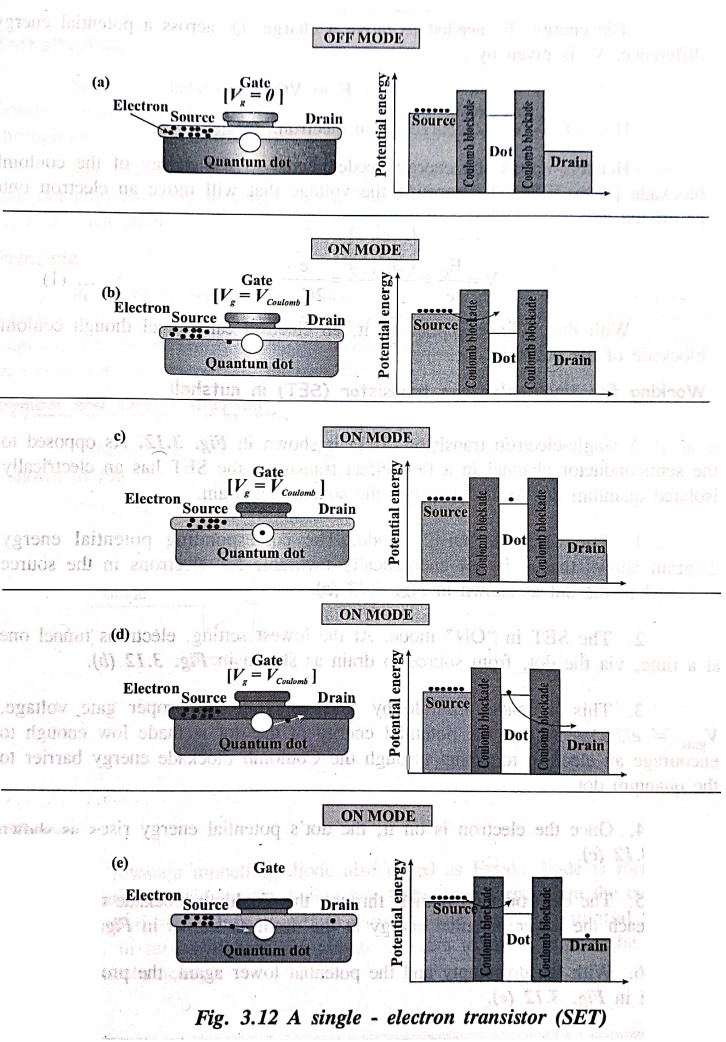
generalized schematic of such a device and its operation is shown in Fig 3.12.
1.
The purpose of SET is to individually control the tunneling of electrons into
and out of the quantum dot. To do this, we must first stop random tunneling by
choosing the right circuit geometry and materials. If an electron comes or goes
from the dot, it will on purpose.
2.
To control tunneling, we apply a voltage bias to the gate electrode. There is
also a voltage difference between the source and the drain that dictates the
direction for the current. Here we say that current and electron flow in the
same direction and we will consider the electrode from which the electrons orginate.
3.
This is similar to the working of an FET, where the gate voltage creates an
electric field that alters the conductivity of the semiconducting channel below
it, enabling current to flow in form source to drain.
4.
Applying a voltage to the gate in an SET creates an electic field and change
the potential energy of the dot with respect to the source and drain. This gate
voltage‒controlled potential difference can make electrons in the source
attracted to the dot and, simultaneously electrons in the dot attracted to the
drain.
For
current to flow, this potential difference must be atleast large enough to
overcome the energy of the coulomb blockade.
The
energy 'E' needed to move a charge, Q, across a potential energy difference, V,
is given by
E = VQ
Here
Q → e → charge of an electron.
Hence,
we get the energy needed equal to the energy of the coulomb blockade [E = Ec]
and determine the voltage that will move an electron onto or off the dot:
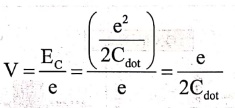
………….. (1)
With
this voltage applied to it, an electron can tunnel though coulomb blockade of
the quantum dot.
Working for single‒electron transistor (SET) in nutshell
A
single‒electron transistor (SET) is shown in Fig. 3.12. As opposed to the
semiconductor channel in a field‒effect transistor, the SET has an electrically
isolated quantum dot located between the source and drain.
1.
The SET in "OFF" mode. The corresponding potential energy diagram
shows that it is not energetically favorable for electrons in the source to
tunnel to the dot as shown in Fig. 3.12 (a).
2.
The SET in "ON" mode. At the lowest setting, electrons tunnel one at
a time, via the dot, from source to drain as shown in Fig. 3.12 (b).
3.
This is made possible by first applying the proper gate voltage, Vgate
= e / 2Cdot, so that the potential energy of the dot is made low
enough to encourage an electron to tunnel through the Coulomb blockade energy
barrier to the quantum dot.
4.
Once the electron is on it, the dot's potential energy rises as shown in Fig.
3.12 (c).
5.
The electron then tunnels through the Coulomb blockade on the other side to
reach the lower potential energy at the drain as shown in Fig. 3.16 (d).
6.
With the dot empty and the potential lower again, the process repeats as shown
in Fig. 3.12 (e).
Applied Physics CSIE II: UNIT III: Nano Devices : Tag: Applied Physics : Definition, Working Principle - Single Electron Transistor [SET]
Applied Physics CSIE II: UNIT III: Nano Devices
Under Subject
Applied Physics (CSIE) II
PH25C03 2nd Semester AIDS, CSE, IT, CSE(CY) Dept | 2025 Regulation | 2nd Semester 2025 Regulation
Related Subjects
English Essentials II
EN25C02 2nd Semester | 2025 Regulation | 2nd Semester 2025 Regulation
Tamils and Technology தமிழர்களும் தொழில்நுட்பமும்
UC25H02 2nd Semester | 2025 Regulation | 2nd Semester 2025 Regulation
Linear Algebra
MA25C02 2nd Semester | 2025 Regulation
Applied Physics (CSIE) II
PH25C03 2nd Semester AIDS, CSE, IT, CSE(CY) Dept | 2025 Regulation | 2nd Semester 2025 Regulation
Digital Principles and Computer Organization
CS25C06 2nd Semester AIDS, CSE, IT, CSE(CY) Dept | 2025 Regulation | 2nd Semester 2025 Regulation

Basic Electrical and Electronics Engineering
EE25C01 2nd Semester | 2025 Regulation | 2nd Semester 2025 Regulation
Python for Data Science
AD25201 2nd Semester AIDS Dept | 2025 Regulation | 2nd Semester 2025 Regulation

Re-Engineering for Innovation
ME25C05 2nd Semester | 2025 Regulation | 2nd Semester 2025 Regulation
Python for Data Science - Laboratory
AD25201 2nd Semester AIDS Dept | 2025 Regulation | 2nd Semester 2025 Regulation