Applied Physics CSIE II: UNIT III: Nano Devices
Tunneling
Nano Devices
The phenomena in which a particle, like an electron, encounters an energy barrier in an electronic structure and suddenly pentrates is known as Tunneling.
TUNNELING
Definition
The
phenomena in which a particle, like an electron, encounters an energy barrier
in an electronic structure and suddenly pentrates is known as Tunneling.
With
quantum dots, there are no physical electrical connections at all i.e., no
wires leading in or out. Quantum dots are islands.
As
practical example, we can see that Andaman & Nichobar is also an island,
surrounded by an ocean, where in people try to disconnect from the hustle and
bustle of the mainland. And yet there are thousands of cars on Andaman &
Nichobar. There is even traffic (making it more difficult to feel very
disconnected). Cars usually come and go from islands by boat.
Electrons Tunnel
The
insulating material that surrounds a quantum dot is an electrical barrier. If
electrons were conventional particles, they would hit such a barrier and bounce
off it, as if it were a wall.
But
electrons wave nature makes it possible for them to hit the barrier and all of
a sudden reappear on the opposite side. This phenomenon, called electron
tunneling, happens all the time. And it is due to the fact that electrons
occupy space in rippling patterns of probability.
When
a particle such as an electron is confined inside a potential energy well with
walls of a given height, the electron's wave function, Ψ, extends outside the
walls. Hence, the probability density, |Ψ|2, is used to find an
electron at a given location. This means there is a slim chance‒but a chance
nonetheless‒that the electron will be found outside the well.
In
a potential well which was infinitely high, and the wave function was constrained,
then both Ψ and |Ψ|2 values will be equal to zero.
The
outside of the well was mathematically off‒limits to the electron. This
situation is nearly achievable in real devices, and does well to model the
energy quantization of atoms and quantum devices.
However,
there is actually no way of making a potential barrier that is infinitely high.
Very, very, high‒yes. Infinitely high‒no.
The
wave functions and probability densities of an electron inside a potential well
of finite height are shown in Fig. 3.10.
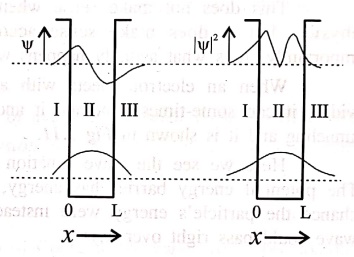
Fig 5.10 A particle in
a potential energy well of finite depth. Graphed here are the wave function Ψ
and probability distribution |Ψ|2 of the particle. The lowest two
energy states are shown. Both Ψ and are nonzero at the well's boundaries and
decay exponentially outside the well. The well's width is L.
The
width of the well is L wide, with x being the electron's location; the wave
functions shown are those of the two lowest energy states.
The
potential energy at the walls, while greater than the energy of the electron,
is not infinity. For this reason, the prior boundary condition is no longer in
effect: the wave function does not have to equal zero at the walls.
As
we can see, this changes both the wave function and the probability density,
enabling both of these functions to spill out the sides of the well.
There
are three regions of interest here namely, the two regions outside the well
boundaries (regions I and III) and the well itself (region II). The general
forms of the wave functions for these three regions are tabulated in Table 3.2.
Table
3.2: Wave functions in all three regions
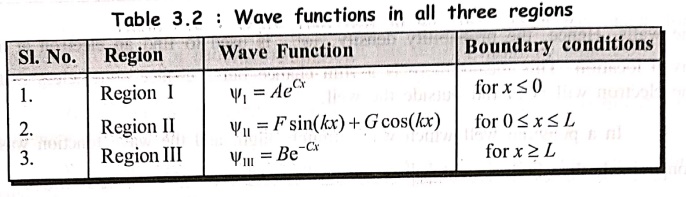
Here,
A, B, C, F, and G are constants. The variable k determines the wavelength λ of
the function in region II, such that k = 2π/λ.
The
wave function is sinusoidal within the well, as expected, and decays
exponentially beyond the walls. The probability density |Ψ|2 is also
nonzero outside the well's boundaries.
This
does not make sense when viewed through the lens of classical physics, but it
does make sense according to quantum mechanics. Most importantly, it is what
actually happens with electrons.
When
an electron meets with an energy barrier of finite height and width, it can
some‒times penetrate it and appear on the opposite side. This is tunneling and
it is shown in Fig 3.11.
Here
we see the wave function of a particle that has an energy, Ep. The
potential energy barrier has energy, EB, which is greater than Ep.
(If by chance the particle's energy were instead greater than that of the
barrier, the wave could pass right over it.)
As
it is, the wave function is incident on the barrier, then decays exponentially
while propagating through it. What we do know is that if the barrier is narrow
and low enough, the wave reappears on the other side.
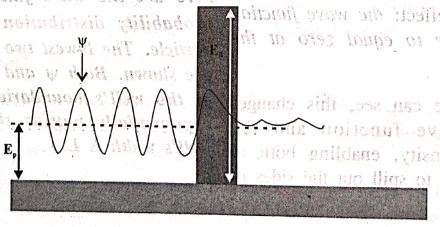
Fig 3.11 Tunneling. The
wave function Ψ of a particle with energy, Ep arrives at the left
side o a barrier with energy, EB. The function decays exponentially
while passing through the barrier by reemerging on the opposite side. In this
way, electrons "tunnel" across energy barriers that would otherwise
seem to prohibit passage.
Note:
In the case of a quantum dot, the barrier is the energy needed to pass across
the electrically Insulating material that surrounds long the dot. The physical
distance separating the bulk electrons from the isolated electrons in a dot is
often about a nanometer. A finite (and occasionally achievable) amount of
energy keeps the electrons from moving back and forth from the dot.
A
particularly innovative and useful application of electron tunneling is the
scanning tunneling microscope (STM).
Applied Physics CSIE II: UNIT III: Nano Devices : Tag: Applied Physics : Nano Devices - Tunneling
Applied Physics CSIE II: UNIT III: Nano Devices
Under Subject
Applied Physics (CSIE) II
PH25C03 2nd Semester AIDS, CSE, IT, CSE(CY) Dept | 2025 Regulation | 2nd Semester 2025 Regulation
Related Subjects

English Essentials II
EN25C02 2nd Semester | 2025 Regulation | 2nd Semester 2025 Regulation

Tamils and Technology தமிழர்களும் தொழில்நுட்பமும்
UC25H02 2nd Semester | 2025 Regulation | 2nd Semester 2025 Regulation
Linear Algebra
MA25C02 2nd Semester | 2025 Regulation
Applied Physics (CSIE) II
PH25C03 2nd Semester AIDS, CSE, IT, CSE(CY) Dept | 2025 Regulation | 2nd Semester 2025 Regulation
Digital Principles and Computer Organization
CS25C06 2nd Semester AIDS, CSE, IT, CSE(CY) Dept | 2025 Regulation | 2nd Semester 2025 Regulation

Basic Electrical and Electronics Engineering
EE25C01 2nd Semester | 2025 Regulation | 2nd Semester 2025 Regulation

Python for Data Science
AD25201 2nd Semester AIDS Dept | 2025 Regulation | 2nd Semester 2025 Regulation

Re-Engineering for Innovation
ME25C05 2nd Semester | 2025 Regulation | 2nd Semester 2025 Regulation

Python for Data Science - Laboratory
AD25201 2nd Semester AIDS Dept | 2025 Regulation | 2nd Semester 2025 Regulation