Applied Physics CSIE II: UNIT III: Nano Devices
Carbon Nanotubes [CNTS]
Definition, Types, Properties, Applications
The discovery of carbon leads to form stable, ordered structures other than graphite and diamond, which have stimulated the researchers worldwide to search for other new forms of carbon.
CARBON NANOTUBES [CNTS]
Introduction
The
discovery of carbon leads to form stable, ordered structures other than
graphite and diamond, which have stimulated the researchers worldwide to search
for other new forms of carbon. The search was given new impetus when it was
shown that C60 could be produced in a simple arc‒evaporation
apparatus. This C60 is very much useful in the production of carbon
nano tubes, so called CNT.
The
CNT have remarkable electronic properties and many other unique
characteristics. For these reasons they have attracted huge academic and
industrial interest.
Definition
Carbon
nanotubes (CNT) are molecular‒scale tubes of graphitic carbon with outstanding
properties. They are among the stiffest and strongest fibres researched till
date, with remarkable electronic properties and applications.
Types
Carbon
nano‒tubes are of two types. viz
(i)
(a) Single‒walled nano‒tubes (SWNTs)
(b)
Multi‒walled nano‒tubes (MWNTs)
(ii)
Single‒walled nano‒horns (SWNHs).
TYPES OF CARBON NANOTUBES
The
nano‒tubes possess atleast two layers, often many more, and ranged in outer
diameter from about 3 nm to 30 nm. The bonding in carbon nanotubes is sp2
hybridization, with each atom joined to three neighbours as in graphite. The
tubes can therefore be considered as rolled‒up graphene sheets (graphene is an
individual graphite layer). There are three distinct ways (Fig. 3.17) in which
a graphene sheet can be rolled into a tube, viz.,
(i)
Arm chair structure
(ii)
Zig‒zag structure and
(iii)
Chiral structure.
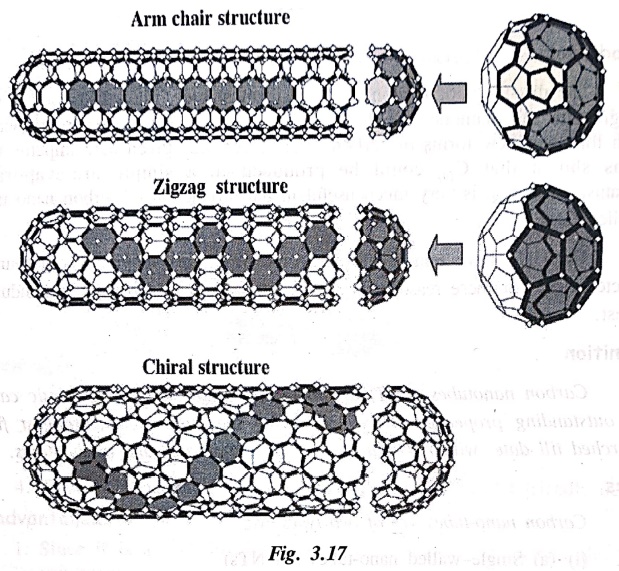
Here
the armchair structure and zig‒zag structure have a high degree of symmetry.
The terms "armchair" and "zig‒zag” refer to the arrangement of
hexagons around the circumference. The "chiral" term means that it
can exist in two mirror‒related forms.
The
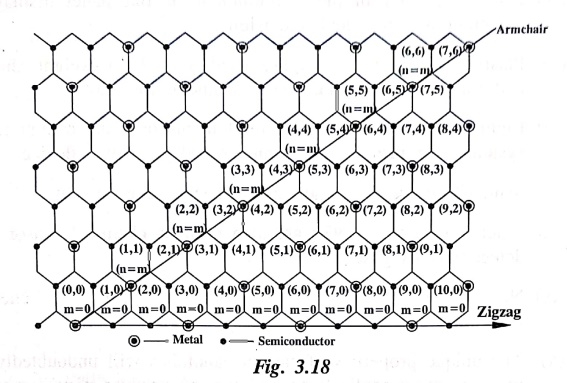
internal arrangements of atoms in the structure of a nanotube is as shown in
Fig. 3.18 The structure is specified by a vector, (n,m), which defines how the
graphene sheet is rolled up. The carbon nanotube can be produced with various
values of 'n' and 'm'.
For
example, to produce a nanotube with the indices (7, 6), the sheet has to be
rolled up in such a way that the atom labelled (0, 0) has to be superimposed on
the one labelled (7, 6). It can be seen from the figure that m = 0 for all zig‒zag
tubes, while n = m for all armchair tubes.
PROPERTIES OF CARBON NANOTUBES
(i)
CNTs have High Electrical Conductivity.
(ii)
CNTs have Very High Tensile Strength.
(iii)
CNTs are Highly Flexible (can be bent considerably without damage).
(iv)
CNTs are Very Elastic (18% elongation to failure).
(v)
CNTs have High Thermal Conductivity.
(vi)
CNTs have a Low Thermal Expansion Coefficient.
(vii)
CNTs are Good Electron Field Emitters.
(viii)
CNTs Aspect Ratio.
APPLICATIONS OF CARBON NANOTUBES
(i)
The carbon nanotubes are very light in weight, but they are very strong, hence
they are used in aerospace.
(ii)
They are used in constructing nanoscale electronic devices.
(iii)
Carbon nano‒tubes (CNTs) are used in battery electrodes, fuel cells,
reinforcing fibers etc.
(iv)
CNTs are used in the development of flat panel displays for computer monitors
and televisions.
(v)
Plastic Composite CNTs are used as a light weight shielding materials for
protecting electromagnetic radiation.
(vi)
Light weight CNTs are also used in military and communication systems, for
protecting computers and electronic devices.
(vii)
Semiconducting CNTs are used as switching devices.
(viii)
Semiconducting CNTs are also used as chemical sensors to detect various gases.
(ix)
Nano‒tubes can also serve as catalysts for some chemical reactions.
(x) The unique properties of carbon nanotubes will undoubtedly lead to many more applications in future to produce nano‒computers, plastic composites etc.
Applied Physics CSIE II: UNIT III: Nano Devices : Tag: Applied Physics : Definition, Types, Properties, Applications - Carbon Nanotubes [CNTS]
Applied Physics CSIE II: UNIT III: Nano Devices
Under Subject
Applied Physics (CSIE) II
PH25C03 2nd Semester AIDS, CSE, IT, CSE(CY) Dept | 2025 Regulation | 2nd Semester 2025 Regulation
Related Subjects

English Essentials II
EN25C02 2nd Semester | 2025 Regulation | 2nd Semester 2025 Regulation

Tamils and Technology தமிழர்களும் தொழில்நுட்பமும்
UC25H02 2nd Semester | 2025 Regulation | 2nd Semester 2025 Regulation
Linear Algebra
MA25C02 2nd Semester | 2025 Regulation
Applied Physics (CSIE) II
PH25C03 2nd Semester AIDS, CSE, IT, CSE(CY) Dept | 2025 Regulation | 2nd Semester 2025 Regulation

Digital Principles and Computer Organization
CS25C06 2nd Semester AIDS, CSE, IT, CSE(CY) Dept | 2025 Regulation | 2nd Semester 2025 Regulation

Basic Electrical and Electronics Engineering
EE25C01 2nd Semester | 2025 Regulation | 2nd Semester 2025 Regulation

Python for Data Science
AD25201 2nd Semester AIDS Dept | 2025 Regulation | 2nd Semester 2025 Regulation

Re-Engineering for Innovation
ME25C05 2nd Semester | 2025 Regulation | 2nd Semester 2025 Regulation

Python for Data Science - Laboratory
AD25201 2nd Semester AIDS Dept | 2025 Regulation | 2nd Semester 2025 Regulation