Applied Physics CSIE II: UNIT III: Nano Devices
Quantum Structures - Quantum Wells, Wells and Dots
Types, Definition, structure diagram, Construction, Explanation, Use
Volume is a three‒dimensional quantity. To reduce the volume of the box, we can shorten its length, its width or its height. The same is true for the region occupied by the electrons in a solid.
QUANTUM STRUCTURES‒QUANTUM
WELLS, WIRES AND DOTS
Volume
is a three‒dimensional quantity. To reduce the volume of the box, we can
shorten its length, its width or its height. The same is true for the region
occupied by the electrons in a solid.
There
are three dimensions to confine and achieving quantum confinement typically
requires confining at least one of these dimensions to less than 100nm
gaolovisword of or just a few nanometers.
A
quantum confined structure is one in
which the motion of the electrons or holes are confined in one or more
directions by potential barriers.
Based
on direction, a quantum confined structure will be classified into three
categories as quantum well, quantum wire and quantum dot. The classification of
quantum confined structures is shown in Table 3.1
Table 3.1 classification of quantum confined structures
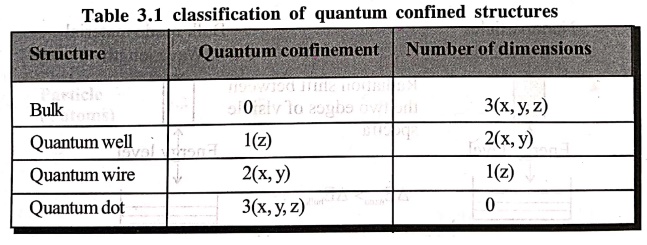
i) Quantum well (2 dimension)
Definition
When we constrain electrons inside a region of minimal width, we create a quanum well.
In
other words, if one dimension is reduced to the nano range while the other two
dimensions remain large, then we get a structure known as quantum well.
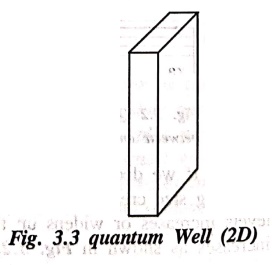
Fig.
3.3 shows a 2‒D structure or quantum well.
Construction
Quantum
wells are made from alternative layers of different semiconductors or by
deposition of very thin metal films.
Explanation
The
well is like a cage in which the carrier particles (the excitons) are trapped. These
trapped particles can be considered to be quantum confinement.
Due
to this quantum confinement, the motion of carriers is reduced. In a quantum
well, the excitons can move freely sideways in the plane of a thin layers, but
they might like to move in the forward and backward directions as well. Due to
the confinement of carriers, the structure quantum well has important
applications in making useful devices.
Use
Quantum
wells are now widely used to make semiconductor layers and other important
devices.
ii) Quantum wire (1 dimension)
Definition
If
we constrain width and depth of electron's domain, we create a quantum wire.
In
other words, if two dimensions are so reduced and one remains large, the
resulting structure is quantum wire.
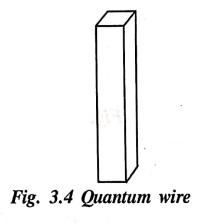
Fig.
3.4 shows a 1‒D structure or quantum wire.
Explanation
The
carriers trapped in such structures can be considered to be in 1‒D quantum
confinement. In this case, an exciton is only free to choose its trajectory
along the wire. However, for each motion of its movement, the exciton can have
various ways of being confined.
Example
Examples
of quantum wire structures are nanowires, nanorod and nanotube.
iii) Quantum Dots (0‒dimension)
Definition
When
all three dimensions are minimized the resulting structure is quantum dot.
The
dot can can be particle located inside a larger structure or on its surface. It
can also be a place where electrons have been trapped using electric fields.
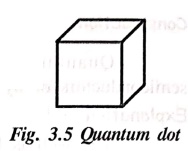
Fig.
3.5 shows a 0‒D structure or quantum dot.
Explanation
Hence,
in this situation, the exciton only has confined states i.e., there are no
freely moving excitons. Although a quantum dot has many thousands of atoms, but
due to its peculiar properties, it is considered more like a single atom rather
than many atoms.
Use
Quantom
dot may be used as a basic building block in making a quantum computer.
Fig.
3.6 and Fig. 3.7 illustrates the processes of diminishing the size for the case
of rectilinear geometry and curvilinear geometry, respectively.
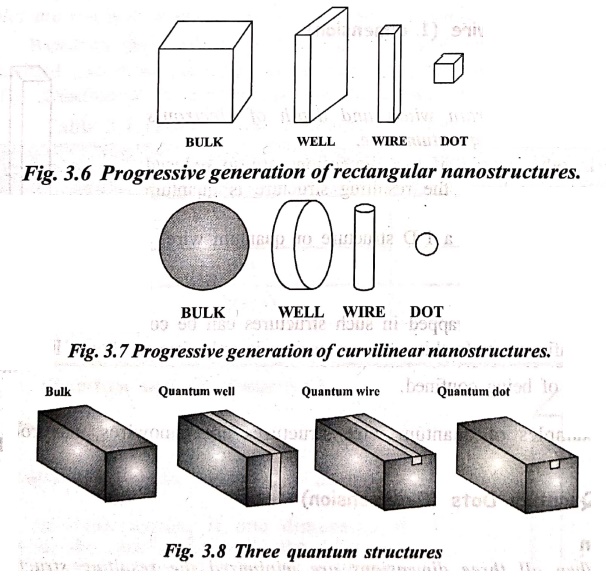
Fig
3.8 shows a comparison of three quantum confined structures with bulk material.
Applied Physics CSIE II: UNIT III: Nano Devices : Tag: Applied Physics : Types, Definition, structure diagram, Construction, Explanation, Use - Quantum Structures - Quantum Wells, Wells and Dots
Applied Physics CSIE II: UNIT III: Nano Devices
Under Subject
Applied Physics (CSIE) II
PH25C03 2nd Semester AIDS, CSE, IT, CSE(CY) Dept | 2025 Regulation | 2nd Semester 2025 Regulation
Related Subjects

English Essentials II
EN25C02 2nd Semester | 2025 Regulation | 2nd Semester 2025 Regulation

Tamils and Technology தமிழர்களும் தொழில்நுட்பமும்
UC25H02 2nd Semester | 2025 Regulation | 2nd Semester 2025 Regulation
Linear Algebra
MA25C02 2nd Semester | 2025 Regulation
Applied Physics (CSIE) II
PH25C03 2nd Semester AIDS, CSE, IT, CSE(CY) Dept | 2025 Regulation | 2nd Semester 2025 Regulation
Digital Principles and Computer Organization
CS25C06 2nd Semester AIDS, CSE, IT, CSE(CY) Dept | 2025 Regulation | 2nd Semester 2025 Regulation

Basic Electrical and Electronics Engineering
EE25C01 2nd Semester | 2025 Regulation | 2nd Semester 2025 Regulation

Python for Data Science
AD25201 2nd Semester AIDS Dept | 2025 Regulation | 2nd Semester 2025 Regulation

Re-Engineering for Innovation
ME25C05 2nd Semester | 2025 Regulation | 2nd Semester 2025 Regulation

Python for Data Science - Laboratory
AD25201 2nd Semester AIDS Dept | 2025 Regulation | 2nd Semester 2025 Regulation