Applied Physics CSIE II: UNIT III: Nano Devices
Size Dependence of Fermi Energy
In terms of the distribution of energy, solids have thick energy bands, whereas atoms have thin, discrete energy states.
SIZE DEPENDENCE OF
FERMI ENERGY
In
terms of the distribution of energy, solids have thick energy bands, whereas
atoms have thin, discrete energy states.
It
seems clear that to make a solid behave electronically more like an atom, we
need to make it about the same size as an atom.
The
electron density in a conductor at T = 0 K is
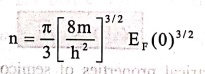
Rearranging
the Eqn. (1), we get
Fermi
energy of a conductor at T = 0 K
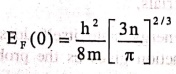
In
the above equation 'n' is the only variable.
Eqn.
(2) suggests that the Fermi energy of a conductor depends on the number of free
electrons 'N' per unit volume 'V'.
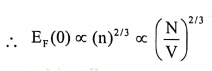
Hint
n = N/V
approximately
EF (0) ∝ N/V
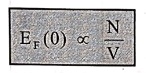 ...(3)
Since
electron density is the property of the material, the Fermi energy does not
vary with material's size.
EF
is the same for a particle of copper as it is for a brick of copper.
Hence,
we can say that the energy states will have the same range for small volume and
large volume of atoms. But for small
volume of atoms we get larger spacing between states.
This
is not only for conductors, but also for semiconductors and insulautors too.
Let
us consider that all states upto EF(0) are occupied by a total of
free electrons (N).
The
average spacing between energy states is given by
ΔΕ ≈ EF(0) / N ...(4)
From
Eqn. (3) and Eqn.(4) we get.
∆E ∝ 1/V ...(5)
Thus,
the spacing between energy states is inversely proportional to the volume of
the solid.
The
energy sublevel and the spacing between energy states within it will depend on
the number of atoms as shown in Fig. 3.1..
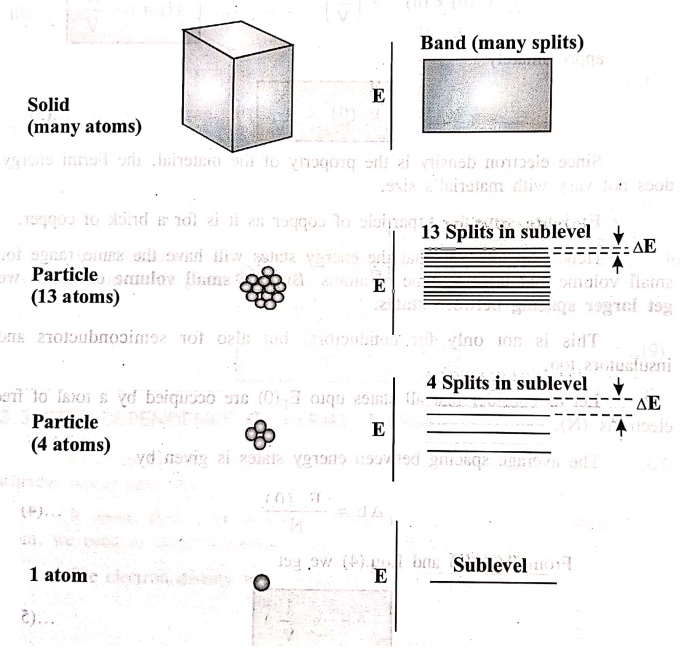
Fig.
3.1 The spacing between energy states gets larger as the volume gets smaller.
At the bottom, a single atom has just one energy state per sublevel. As atoms
group together to form particles, there are as many splits per sublevel as
there are many atoms in the particle. If the particle is small enough, we can
notice these splits within the sublevel. As the volume increases to the size of
a solid, the spacing between splits gets so tight that the sublevel is best
characterized as a band.
At one point, we know that an energy sublevel must be divided as many times as there are atoms in a solid, which eventually results too many splits to differentiate. Hence, we just refer to each sublevel as a solid energy band.
On the other hand, a single atom in the sublevel contain only one discrete energy state.
If we reduce the volume of a solid, the tiny piece of material behaves electronically like an artificial atom.
Applied Physics CSIE II: UNIT III: Nano Devices : Tag: Applied Physics : - Size Dependence of Fermi Energy
Applied Physics CSIE II: UNIT III: Nano Devices
Under Subject

Applied Physics (CSIE) II
PH25C03 2nd Semester AIDS, CSE, IT, CSE(CY) Dept | 2025 Regulation | 2nd Semester 2025 Regulation
Related Subjects

English Essentials II
EN25C02 2nd Semester | 2025 Regulation | 2nd Semester 2025 Regulation

Tamils and Technology தமிழர்களும் தொழில்நுட்பமும்
UC25H02 2nd Semester | 2025 Regulation | 2nd Semester 2025 Regulation

Linear Algebra
MA25C02 2nd Semester | 2025 Regulation
Applied Physics (CSIE) II
PH25C03 2nd Semester AIDS, CSE, IT, CSE(CY) Dept | 2025 Regulation | 2nd Semester 2025 Regulation
Digital Principles and Computer Organization
CS25C06 2nd Semester AIDS, CSE, IT, CSE(CY) Dept | 2025 Regulation | 2nd Semester 2025 Regulation

Basic Electrical and Electronics Engineering
EE25C01 2nd Semester | 2025 Regulation | 2nd Semester 2025 Regulation
Python for Data Science
AD25201 2nd Semester AIDS Dept | 2025 Regulation | 2nd Semester 2025 Regulation

Re-Engineering for Innovation
ME25C05 2nd Semester | 2025 Regulation | 2nd Semester 2025 Regulation
Python for Data Science - Laboratory
AD25201 2nd Semester AIDS Dept | 2025 Regulation | 2nd Semester 2025 Regulation