Python for Data Science: Chapter 4: Descriptive Analytics
Types of Variables
Descriptive Analytics

Questions: 1.Give one example each of a discrete and continuous variable from your daily life. 2. Why can't height be a discrete variable? 3.Give difference between qualitative and quantitative data.
Types of
Variables
In
data science, we collect data to understand the relationship, pattern or
trends. Each piece pot of data is called variable.
Definition of variable:
A characteristic, number or quantity that can change or take different values
is called variable.
For example ‒
A student's marks, height, customer ratings.
Variables
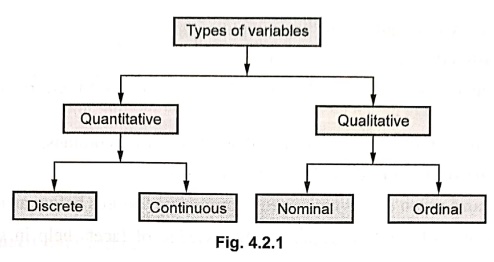
can be classified as shown in following Fig. 4.2.1.
1. Quantitative(Numerical) variables
■
These variables can be measured numerically. They represent quantities i.e.
something which we can measure. For example ‒ Age(years), Height(cm or feet),
Salary(in Rupees).
■
Quantitative variables can be further classified as (A) Discrete variables (B)
Continuous variables.
A. Discrete variables: The discrete
variables are those variables that can take only specific, countable
values(whole numbers). There are no fractions or decimals in this type of
variables.
For
example ‒ Number of students in a class(50), number of cars in Parking
slot(20).
B. Continuous variables:
These are the type of variables that can take any values within a range,
including fractions and decimals. They are measured not counted. For example ‒
height of a person(155.5 cm), Temperature(32 °C), Time taken (5 minutes and 20
seconds)
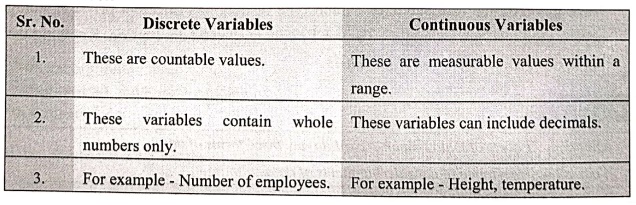
Difference between Discrete and Continuous Variables
Discrete Variables
1.These
are countable values.
2.These
variables contain whole numbers only.
3.
For example ‒ Number of employees.
Continuous Variables
1.
These are measurable values within a range.
2.
These variables can include decimals
3.
For example ‒ Height, temperature.
2. Qualitative(Categorical) variables
■
The qualitative variables are those variables that represent qualities or
characteristics. They are not numerical. These variables normally represent
categories or labels. Hence they are also called as categorical variables. For
example ‒ Blood Group (A, B, O, AB), Mobile brands(Samsung, OnePlus, Apple).
■
Qualitative variables can be further divided into two types ‒
A) Nominal variables :
These variables represent the categories with no natural order or ranking. For
example ‒ Color of Eyes (Black, Brown, Blue), Types of cars (SUV, Sedan)
These
are names or labels and all are different, none higher or lower.
B) Ordinal variables: These
variables represent the categories that have meaningful order or ranking, but
the difference between ranks is not measurable. For example ‒ Customer
satisfaction levels(Poor, fair, good, excellent). Or Education Level (Primary,
Secondary, Graduate and Post Graduate).
Difference between Nominal and Ordinal Variables
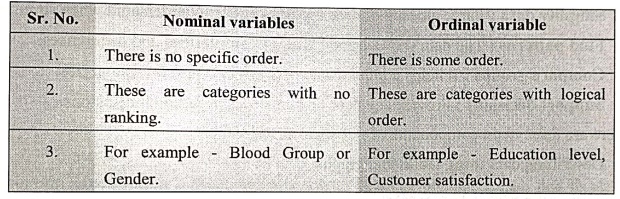
Nominal variables
1.There
is no specific order.
2.These
are categories with no ranking.
3.For
example ‒ Blood Group or Gender.
Ordinal variable
1.
There is some order.
2.
These are categories with logical order.
3.
For example ‒ Education level, Customer satisfaction.
Difference between Quantitative and Qualitative Variables
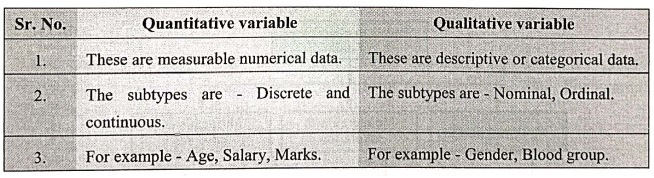
Quantitative variable
1.These
are measurable numerical data
2.The
subtypes are‒Discrete and continuous.
3.For
example ‒ Age, Salary, Marks.
Qualitative variable
1.
These are descriptive or categorical data.
2.
The subtypes are ‒ Nominal, Ordinal.
3.
For example ‒ Gender, Blood group.
Dependent and Independent Variables
When
we study relationships between variables, we usually have two main types of
variables.
a) Independent variable: These are the
variables that we change or control. It influences or causes changes in another
variable.
For
example ‒ Dose of Insulin given to the person.
b) Dependent variable:
This variable that we measure or observe. It changes because of the independent
variable. For example ‒ The blood sugar reading of the person (it depends on
the units of insulin given to the person).
Review Questions
1.Give one example
each of a discrete and continuous variable from your daily life.
2. Why can't height be
a discrete variable?
3.Give difference
between qualitative and quantitative data.
Python for Data Science: Chapter 4: Descriptive Analytics : Tag: Computer Programming, Python, Data Science : Descriptive Analytics - Types of Variables
Python for Data Science: Chapter 4: Descriptive Analytics
Under Subject
Python for Data Science
AD25201 2nd Semester AIDS Dept | 2025 Regulation | 2nd Semester 2025 Regulation
Related Subjects

English Essentials II
EN25C02 2nd Semester | 2025 Regulation | 2nd Semester 2025 Regulation

Tamils and Technology தமிழர்களும் தொழில்நுட்பமும்
UC25H02 2nd Semester | 2025 Regulation | 2nd Semester 2025 Regulation

Linear Algebra
MA25C02 2nd Semester | 2025 Regulation

Applied Physics (CSIE) II
PH25C03 2nd Semester AIDS, CSE, IT, CSE(CY) Dept | 2025 Regulation | 2nd Semester 2025 Regulation

Digital Principles and Computer Organization
CS25C06 2nd Semester AIDS, CSE, IT, CSE(CY) Dept | 2025 Regulation | 2nd Semester 2025 Regulation

Basic Electrical and Electronics Engineering
EE25C01 2nd Semester | 2025 Regulation | 2nd Semester 2025 Regulation
Python for Data Science
AD25201 2nd Semester AIDS Dept | 2025 Regulation | 2nd Semester 2025 Regulation

Re-Engineering for Innovation
ME25C05 2nd Semester | 2025 Regulation | 2nd Semester 2025 Regulation
Python for Data Science - Laboratory
AD25201 2nd Semester AIDS Dept | 2025 Regulation | 2nd Semester 2025 Regulation