Applied Calculus: UNIT III: Integral Calculus
Arc length
Integral Calculus
Explanation, Formula, Equation, Example and Solved Problems - Integral Calculus: Arc length
ARC
LENGTH
We know what is meant
by the length of a straight line segment, but without calculus, we have no
precise definition of the length of a general winding curve. If the curve is
the graph of a continuous function defined over an interval, then we can find
the length of the curve using a procedure similar to that we used for defining
the area between the curve and the x‒axis. This procedure results in a division
of the curve from point A to point B into many pieces and joining successive
points of division by straight line segments. We then sum the lengths of all
these line segments and define the length of the curve to be the limiting value
of this sum as the number of segments goes to infinity.
Length of a Curve y = f(x)
Suppose the curve whose
length we want to find is the graph of the function y = f(x) from x = a to x = b. In order to derive an integral formula
for the length of the curve, we assume that f
has a continuous derivative at every point of [a, b]. Such a function is called
smooth, and its graph is a smooth curve because it does not have any breaks,
corners, or cusps.
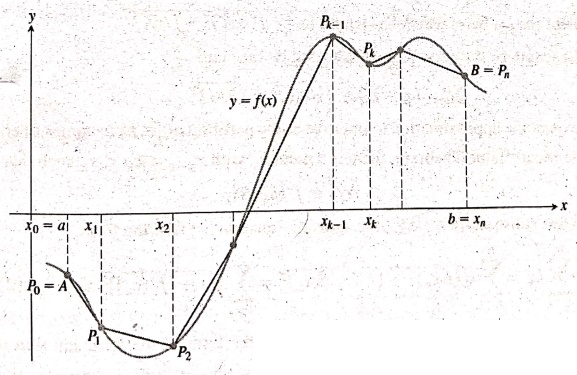
The length of the
polygonal path P0P1P2 ... Pn approximates
the length of the curve y = f(x) from
point A to point B.
We partition the
interval [a, b] into n subintervals
with a = x0 < x1 < x2 <…. < xa = b. If yk = f(xk) then the [a, b]
corresponding point Pk(xk, yk) lies on the
curve. Next we connect successive points Pk‒1 and Pk with
straight line segments that, taken together, form a polygonal path whose length
approximates the length of the curve. If ∆xk = xk ‒ xk‒1
and ∆yk = yk ‒ yk‒1, then a representative
line segment in the path has length.
Lk = √[(∆xk)2
+ (∆yk)2]
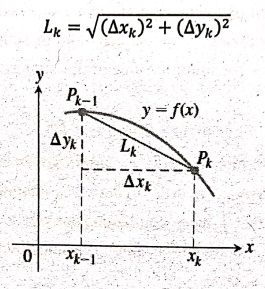
The arc Pk‒1Pk
of the curve y = f(x) is approximated
by the straight‒line segment shown here, which has length Lk = √[(∆xk)2
+ (∆yk)2].
So the length of the
curve is approximated by the sum
 ……….(1)
We expect the
approximation to improve as the partition of [a, b] becomes finer. Now by the
Mean Value Theorem, there is a point ck with xk‒1 < ck
< xk such that
∆yk = f '(ck)∆xk
With this substitution
for ∆yk, the sums in Equation (1) take the form
 ……….(2)
Because √[1+f '(x)] is continuous on [a, b] the
limit of the Riemann sum on the right‒hand side of Equation (2) exists as the
norm the partition goes to zero, giving

We define the value of
this limiting integral to be the length of the curve.
DEFINITION:
If f ' is continuous on [a, b], then
the length (arc length) of the curve y = f(x)
from the point A = (a, f(a)) to the point B = (b, f(b)) is the value of the integral
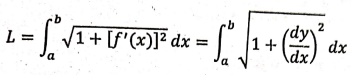 ……….(3)
Dealing with Discontinuities in dy/dx
At a point on a curve
where dy/dx fails to exist, dx/dy may exist. In this case, we may be able to
find the curve's length by expressing x as a function of y and applying the
following analogue of Equation (3).
Formula for the Length
of x = g(y), c ≤ y ≤ d
If g' is continuous on
[c, d], the length of the curve x = g(y) from the point A = (g(c), c) to B =
(g(d), d) is
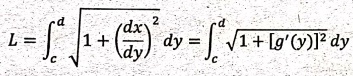 ……….(4)
Example
108. Find the length of the curve.
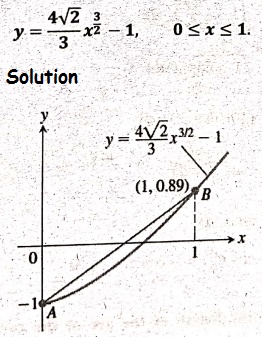
The length of the curve
is slightly larger than the length of the line segment joining points A and B.
We use Equation (3)
with a = 0, b = 1 and
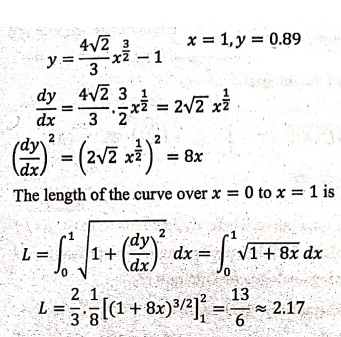
= 13/6 ~ 2.17
Example
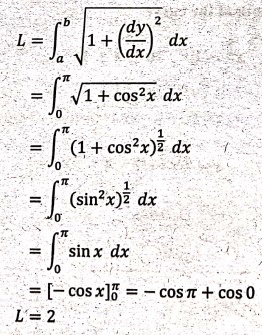
109. Set up an integral that represents the length of the curve. y = sinx: 0
< x < π.
Solution:
Given that We know is y
= sinx ⇒ dy/dx = cos x
We know that the arc
length is
Example
110. Find the length of the arc of the curve y = log(cos x) on [0,π/4]
Solution:
Given that y = log(cos
x)
dy / dx = 1/cosx(‒sinx) = ‒ sinx / cosx
The arc length formula
is given by
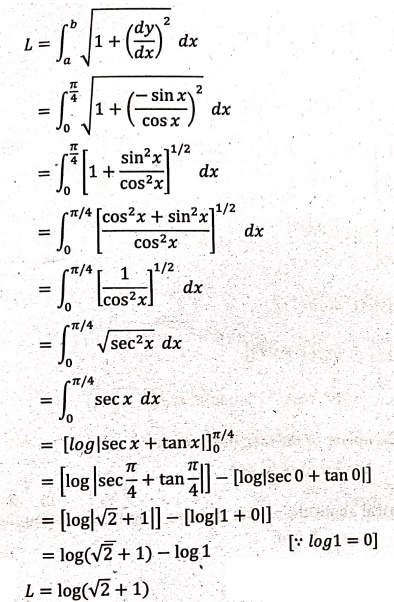
= log(√2+1) ‒ log 1
L = log(√2+1)
Example
111. Find the length of the arc of the parabola x2 = 4ay mensured from the vertex to one extremity of
the latus rectum.
Solution:
Let A be the vertex and
L an extremity of the latus‒rectum so that at A, x = 0 and at L, x = 2a
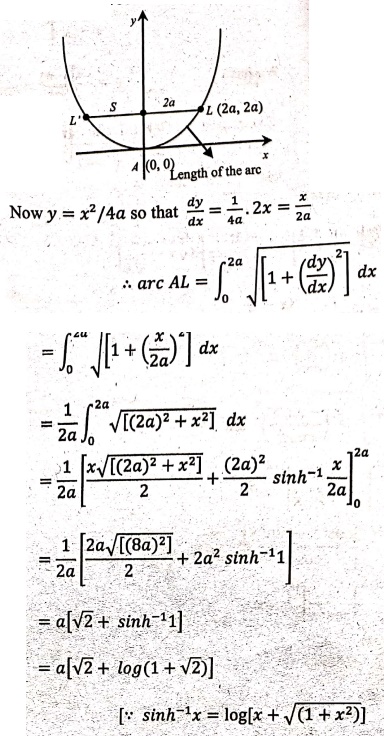
= a[√2 + sinh‒11]
= a[√2 + log(1 + √2)]
[ sinh‒1x= log[x + √(1+x2)]
Example
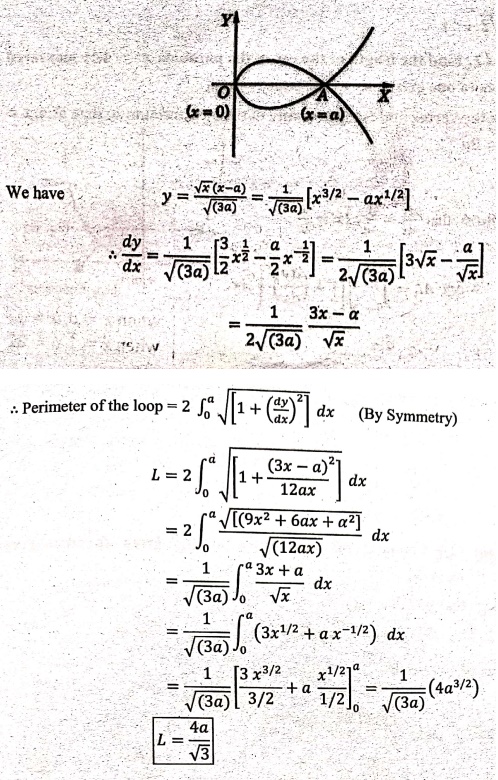
112. Find the perimeter of the loop of the curve
3ay2
= x(x ‒ a)2.
Solution:
The curve is
symmetrical about the x‒axis and the loop lies between the limits x=0 and x = a
Example
113. Find the length of the arc of the curve y = 1 + 6x3/2 0 ≤ x ≤ 1.
Solution:
Given that y = 1 + 6x3/2
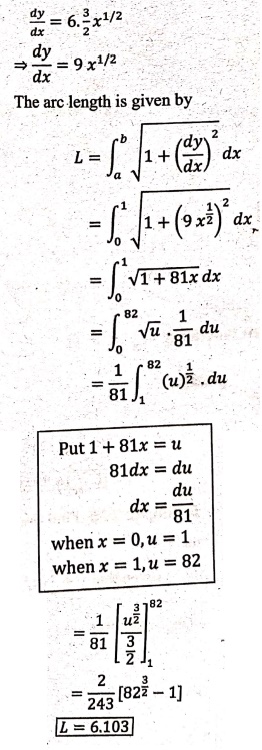
L= 6.103
Example
114. Compute the arc length of the given function f(x) = 2(x − 1)3/2 on [1, 5].
Solution:
Given that y = 2(x − 1)3/2
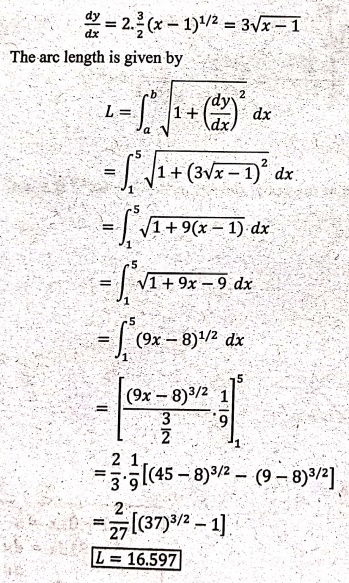
L = 16.597
Example
115. Find the arc length of the given function y = 2/3 (x2 + 1)3/2 on [1,4].
Solution:
Given that y = 2/3 (x2 + 1)3/2
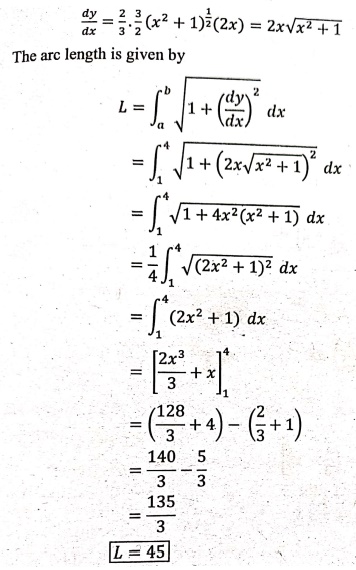
L= 45
Example
116. Find the arc length of the curve y = x3/6
+ 1/2x on [1,3].
Solution:
Given that y = x2/6 + 1/2x
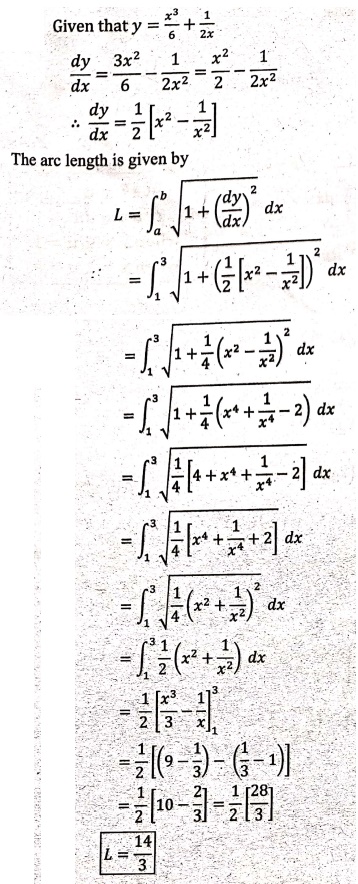
Example
117. Find the area of the surface generating by rotating the curve y=ex,
0 ≤x≤ 1, about the x‒axis.
Solution: Given
y = ex,
dy/dx = ex
The surface area is
given by
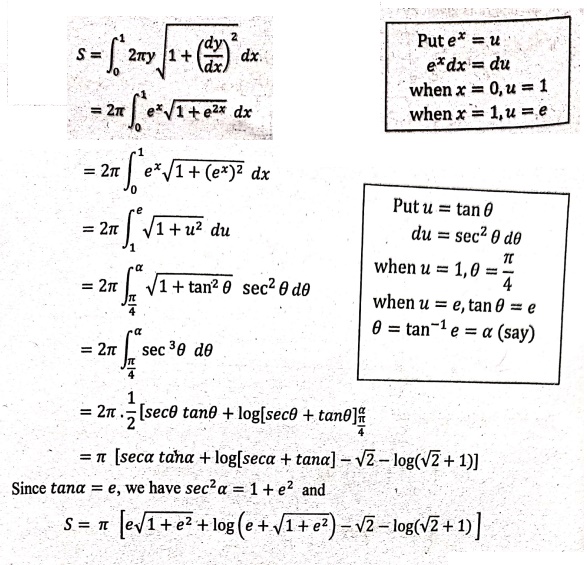
Example
118. Find the length of the curve y=(x/2)2/3 from x = 0 to x = 2.
Solution:
The derivative
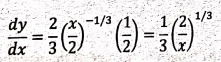
is not defined at x =
0, so we cannot find the curve's length.
We therefore rewrite
the equation to express x in terms of y.
y = (x/2)2/3
x = 2y3/2
From this we see that
the curve whose length we want is also the graph of x = 2y3/2 from y = 0 to y = 1. The graph of y = (x/2)2/3
from x=0 to x=2 is also the graph of x = 2y2/3 from y = 0 to y
= 1. The derivative
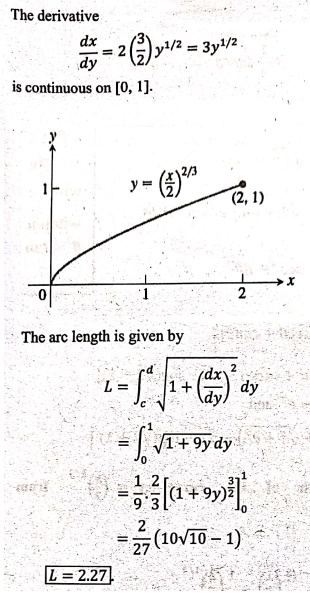
L=2.27
Example
119. Find the length of the arc of the parabola y2 = x from (0,0) to (1,1)
Solution:
Given that x = y2
⇒
dx/dy = 2y
We know that
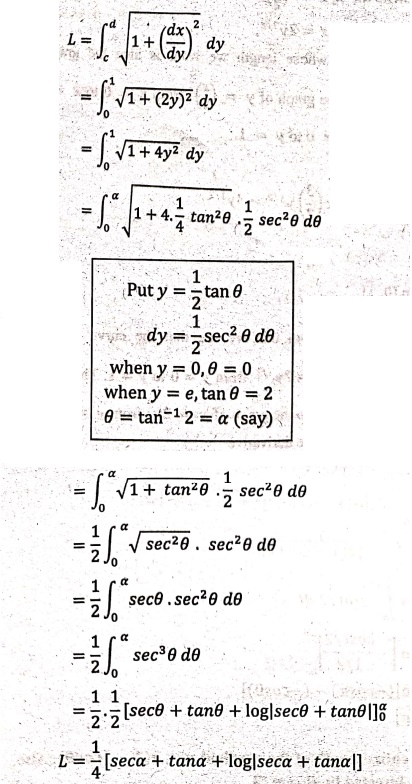
Since we have
considered tanα = 2
We have sec2α
= 1 + tan2α
⇒
sec2α = 1 + (2)2 = 5
secα = √5
Hence L = ¼ [ (√5. 2) +
log|√5+2| ]
= ¼2√5 + ¼log(√5+2)
L = ½ √5 + ¼log(√5+2)
Example
120. Find the length of one arch of the cycloid
x = a(t
− sint), y = a(1 ‒ cost)
Solution:
As a point moves from
one end 0 to the other end of its first arch, the parameter t increases from 0
to 2π..
Also dx/dt = a(1 ‒ cost), dy/dt = a sint
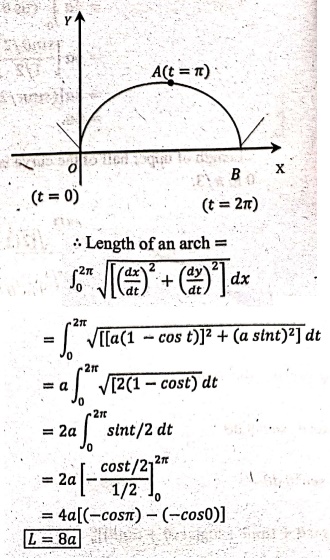
L = 8a
Example
121. Find the entire length of the cardioid r = a(1 + cosθ). Also show that the upper half is bisected by θ = π/3.
Solution: The
cardioid is symmetrical about the initial line and for its upper half, 6
increases from 0 to π.
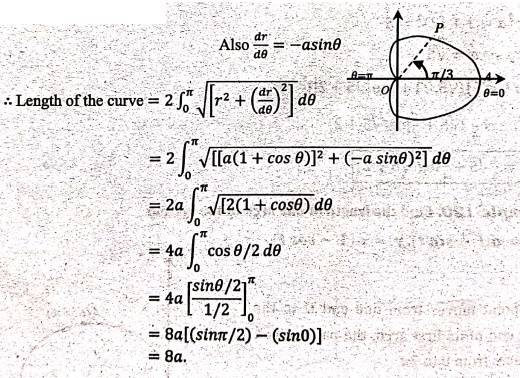
Length of upper half of
the curve is 4a. Also length of the arc AP from 0 to π/3.
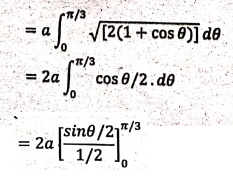
= 2a = half the length
of upper half of the cardioid.
EXERCISE
14. Find the length of
the arc of the parabola y2
= 4ax (i) from the vertex to one end of the latus‒rectum. (ii) cut off by the
line 3y = 8x.
15. Find the length of
the curve y2 = (2x‒1)3
cut off by the line x = 4.
(iii) x = cost + tsint, y = sint‒t cost, (‒π≤t≤π)
(iv) x = et(sint
+ cost), y = et(cost‒ sint) (3≤t≤4)
(v) x = etcost, y = etsint, (0 ≤ t ≤ π)
Applied Calculus: UNIT III: Integral Calculus : Tag: Applied Calculus : Integral Calculus - Arc length
Applied Calculus: UNIT III: Integral Calculus
Under Subject
Applied Calculus
MA25C01 Maths 1 M1 - 1st Semester | 2025 Regulation | 1st Semester 2025 Regulation
Related Subjects

English Essentials I
EN25C01 1st Semester | 2025 Regulation | 1st Semester 2025 Regulation

தமிழர் மரபு - Heritage of Tamils
UC25H01 1st Semester | 2025 Regulation | 1st Semester 2025 Regulation
Applied Calculus
MA25C01 Maths 1 M1 - 1st Semester | 2025 Regulation | 1st Semester 2025 Regulation

Applied Physics I
PH25C01 1st Semester | 2025 Regulation | 1st Semester 2025 Regulation

Applied Chemistry I
CY25C01 1st Semester | 2025 Regulation | 1st Semester 2025 Regulation

Makerspace
ME25C04 1st Semester | 2025 Regulation | 1st Semester 2025 Regulation

Computer Programming C
CS25C01 1st Semester | 2025 Regulation | 1st Semester 2025 Regulation

Computer Programming Python
CS25C02 1st Semester | 2025 Regulation | 1st Semester 2025 Regulation
Fundamentals of Electrical and Electronics Engineering
EE25C03 1st Semester | 2025 Regulation | 1st Semester 2025 Regulation

Introduction to Mechanical Engineering
ME25C03 1st Semester | 2025 Regulation | 1st Semester 2025 Regulation

Introduction to Civil Engineering
CE25C01 1st Semester Civil Department | 2025 Regulation | 1st Semester 2025 Regulation

Essentials of Computing
CS25C03 1st Semester - AID CSE IT Department | 2025 Regulation | 1st Semester 2025 Regulation

Applied Physics I Laboratory
PH25C01 1st Semester practical Laboratory Manual | 2025 Regulation | 1st Semester Laboratory 2025 Regulation

Applied Chemistry I Laboratory
CY25C01 1st Semester practical Laboratory Manual | 2025 Regulation | 1st Semester Laboratory 2025 Regulation

Computer Programming C Laboratory
CS25C01 1st Semester practical Laboratory Manual | 2025 Regulation | 1st Semester Laboratory 2025 Regulation

Computer Programming Python Laboratory
CS25C02 1st Semester practical Laboratory Manual | 2025 Regulation | 1st Semester Laboratory 2025 Regulation
Engineering Drawing
ME25C01 EEE Mech Dept | 2025 Regulation | 2nd Semester 2025 Regulation

Basic Electronics and Electrical Engineering
EE25C04 1st Semester ECE Dept | 2025 Regulation | 2nd Semester 2025 Regulation