Applied Calculus: UNIT III: Integral Calculus
The definite integral
Definition:, Theorem, Properties, Explanation, Formula, Equation, Example and Solved Problems - The definite integral | Integral Calculus
THE
DEFINITE INTEGRAL
We saw that a limit of
the form

arise when we compute
an area. We also saw that it arises when we try to find the distance travelled
by an object. It turns out that this same type of limit occurs in a wide
variety of situations even when f is
not necessarily a positive function. We will see that limits of the form in
above also arise in finding lengths of curves, volumes of solids, centres of
mass, force due to water pressure, and work, as well as other quantities. We
therefore give this type of limit a special name and notation.
Definition:
Let f be a function defined for a ≤ x ≤ b. We divide the interval [a, b]
into n sub‒intervals of equal width ∆x=(b‒a)/n.
Let x0 = a, x1,
x2, x3 … xn = b
be the end points of these sub‒intervals. Let x1*, x2*, x3*, ..., xn* be any sample points in these
sub‒intervals. So xi* lies in the ith sub‒interval [xi−1,xi]. Then the definite integral of f from a to b is given by

provided that this
limit exists and gives the same value for all possible points. If it exists,
then f is integrable on [a, b].
Note:
• The symbol ∫ was
introduced by Leibniz and is called an integral sign. It is an elongated S and
was chosen because an integral is a limit of sums. In the notation, a∫bf(x)dx, f(x)
is called the integrand and a and b
are called the limits of integration, a is the lower limit and b is the upper limit.
The symbol dx has no meaning by itself. a∫b f(x)dx is all one symbol. The dx
indicates that the independent variable is x. The procedure of calculating an
integral is called integration.
• The definite integral
a∫b f(x)dx is a
number. It does not depend on x. We
can use any letter in the place of x,
without changing the value of the integral.
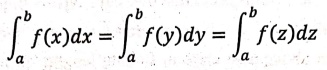
• The sum Σi=1∞f(xi*)∆x is called a Riemann sum after the German
Mathematician Bernhard Riemann. The definite integral at an integrable function
can be approximated to within any desired degree of accuracy by a Riemann sum.
If f is positive, then the Riemann
sum can be interpreted as a sum of areas of approximating rectangles. The
definite integral a∫b
f(x)dx is interpreted as the area under the curve y = f(x) from a to b. If f takes on both positive and negative
values, then the Riemann sum is the sum of the areas of the rectangles that lie
above x‒axis and the negatives of the areas of the rectangles that lie below
the x‒axis. A definite intégral can be interpreted as a net area, (i.e.,) a
difference of areas.
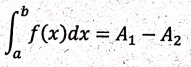
where A1 is
the area of the region above the x‒axis and below the graph of f, and A2 is the area of the
region below the x‒axis and above the graph of f.
• Although we have defined
a∫b f(x)dx by
dividing [a, b] into sub‒intervals of equal width, there are situations in
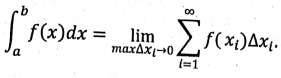
which it is useful to work with sub‒ intervals of unequal width. If the sub‒interval
widths are ∆x1, ∆x2,
..., ∆xn we have to ensure that all these widths approach 0 in the
limiting process. This happens if the largest width, max ∆xi,
approaches 0. So in these case the definition of a definite integral becomes
• We have defined the
definite integral for an integrable function, but not all functions are
integrable.
Theorem 1:
If f is continuous on [a, b] or if f
has only a finite number of discontinuities, then f is integrable on (a, b). (i.e.,) The definite integral a∫b f(x)dx
exists.
Theorem 2:
If f is integrable on [a, b], then

Properties of definite integral:
When we defined the
definite integral a∫b
f(x)dx, we assumed that a < b. But the definition as a limit of Riemann
sums makes sense even if a > b. If we reverse a and b, then ∆x changes from (b ‒ a/n) to (a – b/n)
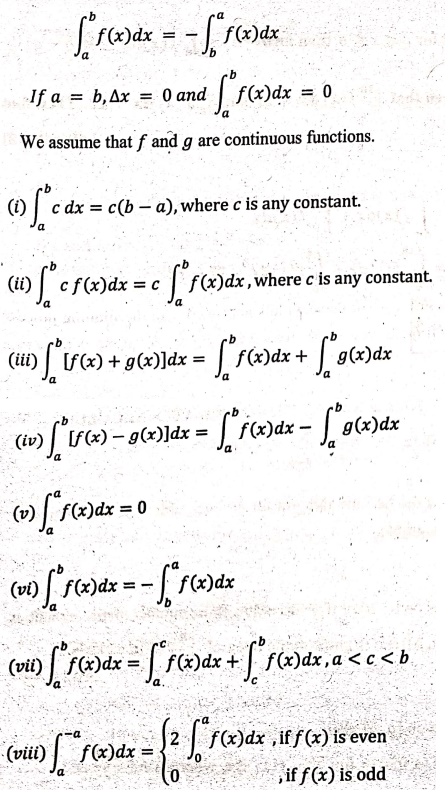
Also the comparison
properties of the integral are given as follows

Example
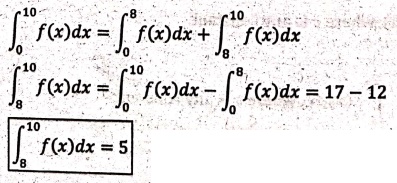
3. Given
that 0∫10 f(x) dx = 17 and so 0∫8 f(x) dx = 12. Then find 8∫10 f(x) dx.
Solution:
We know that
THE FUNDAMENTAL THEOREM OF CALCULUS
The Fundamental Theorem
of Calculus is appropriately named because it establishes a connection between
the two branches of calculus: differential calculus and integral calculus.
It gives the precise
invert relationship between the derivative and the integral
ANTIDERIVATIVE
A physicist who knows
the velocity of a particle might wish to know its position at a given time. An
engineer who can measure the variable rate at which water is leaking from a
tank wants to know the amount leaked over a certain time period. A biologist
who knows the rate at which a bacteria population is increasing might want to
deduce what the size of the population will be at some future time. In each
case, the problem is to find a function. F whose derivative is a known function
f. If such a function F exists, it is
called an anti‒derivative of f.
DEFINITION:
A function F is called
an antiderivative of f on an interval
I if F'(x) = f(x) for all x in I.
THEOREM:
If F is an
antiderivative of f on an interval I,
then the most general antiderivative of f
on I is
F(x)
+ C
where C is an arbitrary
constant.
Theorem
1: The Fundamental Theorem of Integral Calculus ‒ Part 1
If f is continuous on [a, b], then the function g defined by
g(x) = a∫x f(x) dx, a ≤ x ≤b
is continuous on [a, b]
and differentiable on (a, b) and g'(x) = f(x).
The second part of the
Fundamental Theorem of Calculus, which follows easily from the first part,
provides us with a much simpler method for the evaluation of integrals.
Theorem
2: The Fundamental Theorem of Integral Calculus‒Part 2
If f is continuous on [a, b], then
a∫b f(x) dx = F(b) ‒ F(a)
where F is anti
derivative of f, that is, a function
such that F' = f
Example
4. Find the derivative of the function g(x) = a∫x√[1+ t2]dt.
Solution:
By the fundamental theorem of calculus part I, we have
g(x) = ` a∫x f (t) dt, a≤ x ≤ b
g'(x) = f(x)
The given integral is
g(x) = a∫x √[t2
+ 1] dt
Here, f(t) = √[1 + t2] and f(x) = √[1 + x2].
Hence g'(x) = f(x) = √[1+x2].
Example
5. Find the derivative of the function using the fundamental theorem of
calculus g(s) = 5∫S
f(t ‒ t2)8 dt.
Solution:
By the fundamental theorem of calculus part I, we have
g(x) = a∫x f(t) dt, a≤ x ≤ b
g'(x) = f(x)
The given integral is
g(s) = 5∫S
(t − t2)8 dt.
Here f(t) = (t‒t2)8 and
f(s) = (s‒s2)8
g'(s) = f(s)
= (s‒s2)8.
Example
6. Find the derivative of F(x) =
x∫π √[1+ sect] dt
Solution:
By the fundamental
theorem of calculus part 1, we have
g(x) = a∫x f(t) dt, a≤ x ≤b
g'(x) = f(x)
The given function can
be rewritten as
F(x)
= ‒ π∫x √[ 1+ sect ] dt
F'(x) = ‒√[1+ sec x]
Example
7. Find the derivative of G(x) = x∫1 cos √t dt.
Solution:
By the fundamental theorem of calculus part I, we have
g(x)= a∫x
f(t) dt, a≤ x ≤b
g'(x) = f(x)
The given function can
be rewritten as
G(x) = ‒ 1∫x
cos √t dt.
G'(x) = ‒ cos √x
Example
8. Find d/dx 1∫x4 sect dt
Solution:
By the fundamental
theorem of calculus part I, we have
g(x) = a∫x
f(t) dt, a≤x≤b
g'(x) = f(x)
The given integral is

= sec x4 = sec x4 (4x3) = 4x3
sec x4.
Evaluate
1∫3 ex dx by fundamental theorem
Solution:
The function f(x) = ex is
continuous everywhere.
By the fundamental
theorem of calculus part II, F(x) = ex,
1∫3 ex
dx = F(3) − F(1) = e3 – e
Example
10. What is wrong with the calculation ‒1∫3 dx/x2
= ‒ 4/3.
Solution:
By property of definite integral,
a∫b
f(x) dx ≥ 0 ⇒ f(x) ≥ 0.
Here, f(x) = 1/x2 > 0 but ‒1∫3 dx/x2 =
‒ 4/3 < 0
The fundamental theorem
of calculus is applied to only continuous function. Here, f(x) = 1/x2 is not continuous on [‒1,3]. i.c., f(x) is discontinuous at x = 0.
So, ‒1∫3
dx/x2 does not exist.
Example
11. What is wrong with the calculation 0∫π sec2
x dx = 0.
Solution:
Here f(x) = sec2 x = 1 / cos2x 0≤x≤π
The fundamental theorem
of calculus applied to only continuous function. Here,
f(x)= sec2 x = 1 / cos2x is not continuous at x = π / 2, Since,
f(π/2) = 1 / cos2(π/2)
= 1/0 = ∞
At x = π/2 the function f(x)
= sec2x is discontinuous.
So, 0∫π
sec2x dx does not exist.
EXERCISE
5. What is wrong in the
integral ‒2∫1 dx/x4 = ‒ 3/8
Answer:
The
function f(x) = 1/x4 is
not continuous at x = 0
6. What is wrong in the
integral ‒1∫2 4/x3 dx = 3/2
Answer:
The
function f(x) = 4/x3 is
not continuous at x=0
7. What is wrong in the
integral π/3∫π secx tan x dx = ‒3
Answer:
The
function f(x) = secx tanx
is not continuous at x = π/2
Applied Calculus: UNIT III: Integral Calculus : Tag: Applied Calculus : - The definite integral
Applied Calculus: UNIT III: Integral Calculus
Under Subject

Applied Calculus
MA25C01 Maths 1 M1 - 1st Semester | 2025 Regulation | 1st Semester 2025 Regulation
Related Subjects

English Essentials I
EN25C01 1st Semester | 2025 Regulation | 1st Semester 2025 Regulation

தமிழர் மரபு - Heritage of Tamils
UC25H01 1st Semester | 2025 Regulation | 1st Semester 2025 Regulation
Applied Calculus
MA25C01 Maths 1 M1 - 1st Semester | 2025 Regulation | 1st Semester 2025 Regulation

Applied Physics I
PH25C01 1st Semester | 2025 Regulation | 1st Semester 2025 Regulation

Applied Chemistry I
CY25C01 1st Semester | 2025 Regulation | 1st Semester 2025 Regulation

Makerspace
ME25C04 1st Semester | 2025 Regulation | 1st Semester 2025 Regulation

Computer Programming C
CS25C01 1st Semester | 2025 Regulation | 1st Semester 2025 Regulation

Computer Programming Python
CS25C02 1st Semester | 2025 Regulation | 1st Semester 2025 Regulation

Fundamentals of Electrical and Electronics Engineering
EE25C03 1st Semester | 2025 Regulation | 1st Semester 2025 Regulation

Introduction to Mechanical Engineering
ME25C03 1st Semester | 2025 Regulation | 1st Semester 2025 Regulation

Introduction to Civil Engineering
CE25C01 1st Semester Civil Department | 2025 Regulation | 1st Semester 2025 Regulation

Essentials of Computing
CS25C03 1st Semester - AID CSE IT Department | 2025 Regulation | 1st Semester 2025 Regulation

Applied Physics I Laboratory
PH25C01 1st Semester practical Laboratory Manual | 2025 Regulation | 1st Semester Laboratory 2025 Regulation

Applied Chemistry I Laboratory
CY25C01 1st Semester practical Laboratory Manual | 2025 Regulation | 1st Semester Laboratory 2025 Regulation

Computer Programming C Laboratory
CS25C01 1st Semester practical Laboratory Manual | 2025 Regulation | 1st Semester Laboratory 2025 Regulation

Computer Programming Python Laboratory
CS25C02 1st Semester practical Laboratory Manual | 2025 Regulation | 1st Semester Laboratory 2025 Regulation

Engineering Drawing
ME25C01 EEE Mech Dept | 2025 Regulation | 2nd Semester 2025 Regulation

Basic Electronics and Electrical Engineering
EE25C04 1st Semester ECE Dept | 2025 Regulation | 2nd Semester 2025 Regulation