Applied Calculus: UNIT III: Integral Calculus
Improper integrals
Explanation, Formula, Equation, Example and Solved Problems - Improper Integral of Type 1, Type 2: Discontinuous Integrands | Integral Calculus
IMPROPER
INTEGRALS
An improper integral is
a definite integral that has either or both limits infinite or an integrand
that approaches infinity at one or more points in the range of integration.
Improper integrals cannot be computed using a normal Riemann integral.
Definition of an Improper Integral of Type 1:
(a) If 1∫t
f(x) dx exists for every number
t ≥ a, then
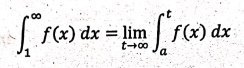
provided this limit
exists (as a finite number).
(b) If t∫b
f(x) dx exists for every number t ≤ b,
then

provided this limit
exists (as a finite number).
The improper integrals a∫‒∞f(x) dx and ‒∞∫b f(x) dx
are called convergent
if the corresponding limit exists and divergent
if the limit does not
exist.
(c) The improper
integral
‒∞∫∞f(x) dx is defined as

where a is any real number. It is said to converge if both terms converge and
diverge if either term diverges.
Example
86. Evaluate 1∫∞ 1/x dx if possible.
Solution:
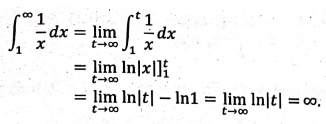
The limit does not
exists as a finite number and so the improper integral 1∫∞
1/x dx is divergent.
Example
87. Evaluate 4∫∞ 1/√x dx if possible.
Solution:

The limit does not
exist as a finite number and so the improper integral 4∫∞ 1/√x
dx is divergent.
Example
88. Evaluate 2∫∞ 1/x2 dx if possible.
Solution:

Example
89. : (p‒Test) For what values of p is 1∫∞ 1/xp
dx convergent?
Solution: We
know that if p = 1, then the integral is divergent,
so let's assume that p
≠ 1. Then

and so the integral
converges. On the other hand, if p < 1, then p−1 < 0 and so 1 / tp‒1
= t1‒p → ∞ as t→ ∞ and the integral diverges.
So, 1∫∞ 1/xP
dx is convergent if p > 1 and divergent if p ≤ 1.
Example
90. Determine whether each integral is convergent or divergent. Evaluate those
that are convergent.

Solution:

The integral 1∫∞ x dx is
divergent by the p‒test, since p = ‒1≤1. Therefore, ‒∞∫∞ x
dx is divergent.
(d) Applying
integration by parts, we have

Example
91. Determine if the following integral is convergent or divergent. If it is
convergent find its value.
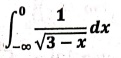
Solution:
There really isn't much
to do with these problems once you know how to do them. We'll convert the
integral to a limit/integral pair, evaluate the integral and then the limit.

So, the limit is
infinite and so this integral is divergent.
Example
92. Determine if the following integral is convergent or divergent. If it is
convergent find its value.

Solution:
In this case we've got
infinities in both limits. The process we are using to deal with the infinite
limits requires only one infinite limit in the integral and so we'll need to
split the integral up into two separate integrals. We can split the integral up
at any point, so let's choose x = 0 since this will be a convenient point for
the evaluation process. The integral is then,

We've now got to look
at each of the individual limits.

So, the first integral
is convergent. Note that this does NOT mean that the second integral will also
be convergent. So, let's take a look at that one.

This integral is
convergent and so since they are both convergent the integral we were actually
asked to deal with is also convergent and its value is,

Example
93. Determine if the following integral is convergent or divergent. If it is
convergent find its value.
‒2∫∞
sin(x) dx
Solution:
First convert to a
limit.

This limit doesn't
exist and so the integral is divergent
Type 2: Discontinuous Integrands
(1) If f is continuous on [a, b) and is
discontinuous at b, then
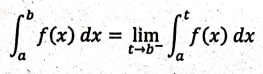
if this limit exists
(as a finite number).
(2) If f is continuous on (a, b] and is
discontinuous at a, then

if this limit exists
(as a finite number).
The improper integral a∫bf(x) dx is called convergent, if the
corresponding limit exists and divergent if the limit does not exist.
(3) If f has a
discontinuity at c, where a<c<b, then the improper integral a∫bf(x)dx is defined as

It is said to converge
if both terms converge and diverge if either term diverges.
Example
94. Evaluate 1∫2 [ dx / 1‒x] dx if possible.
Solution:
We first note that the given integral is improper because f(x) = 1/(1‒x) has
the vertical asymptote
x = 1. We have

= ‒ ∞ (divergent)
Example
95. Determine if the following integral is convergent or divergent. If it is
convergent find its value.

Solution:
We first note that the
given integral is improper because f(x)
= 1/√(3‒x) has the vertical asymptote x = 3. We have

= 2√3
The limit exists and is
finite and so the integral converges and the integral's value is 2√3.
Example
96. Determine if the following integral is convergent or divergent. If it is
convergent find its value ‒2∫3 1/x3 dx.
Solution:
This integrand is not
continuous at x = 0 and so we'll need to split the integral up at that point.

Now we need to look at
each of these integrals and see if they are convergent.
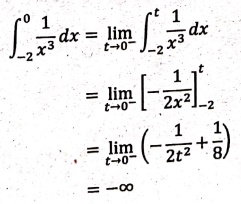
At this point we're
done. One of the integrals is divergent that means the integral that we were
asked to look at is divergent. We don't even need to bother with the second
integral.
Example
97. Determine if the following integral is convergent or divergent. If it is
convergent find its value.
0∫∞ 1/x2 dx

Solution:
This is an integral over an infinite interval that also contains a
discontinuous integrand. To do this integral we'll need to split it up into two
integrals so each integral contains only one point of discontinuity. It is
important to remember that all of the processes we are working with in this
section so that each integral only contains one problem point.
We can split it up
anywhere but pick a value that will be convenient for evaluation purposes.

In order for the integral
in the example to be convergent we will need BOTH of these to be convergent. If
one or both are divergent then the whole integral will also be divergent.
We know that the second
integral is convergent by the fact given in the infinite interval portion
above. So, all we need to do is check the first integral.

So, the first integral is divergent and so the whole integral is divergent.
Example
98. Evaluate 0∫3 [ dx / √9‒x2 ] if possible.
Solution:
We first note that the
given integral is improper because f(x)
= 1 / √9‒x2 has the
vertical asymptotes x = 3. We have

Example
99. Evaluate ‒1∫1 dx/x if possible.
Solution:
We first note that the
given integral is improper because f(x)
= 1/x has the vertical asymptote x = 0.
We have

it follows that ‒1∫1
dx/x is divergent.
Example
Evaluate  if possible.
Solution:

Applied Calculus: UNIT III: Integral Calculus : Tag: Applied Calculus : - Improper integrals
Applied Calculus: UNIT III: Integral Calculus
Under Subject
Applied Calculus
MA25C01 Maths 1 M1 - 1st Semester | 2025 Regulation | 1st Semester 2025 Regulation
Related Subjects

English Essentials I
EN25C01 1st Semester | 2025 Regulation | 1st Semester 2025 Regulation

தமிழர் மரபு - Heritage of Tamils
UC25H01 1st Semester | 2025 Regulation | 1st Semester 2025 Regulation
Applied Calculus
MA25C01 Maths 1 M1 - 1st Semester | 2025 Regulation | 1st Semester 2025 Regulation

Applied Physics I
PH25C01 1st Semester | 2025 Regulation | 1st Semester 2025 Regulation

Applied Chemistry I
CY25C01 1st Semester | 2025 Regulation | 1st Semester 2025 Regulation

Makerspace
ME25C04 1st Semester | 2025 Regulation | 1st Semester 2025 Regulation
Computer Programming C
CS25C01 1st Semester | 2025 Regulation | 1st Semester 2025 Regulation
Computer Programming Python
CS25C02 1st Semester | 2025 Regulation | 1st Semester 2025 Regulation
Fundamentals of Electrical and Electronics Engineering
EE25C03 1st Semester | 2025 Regulation | 1st Semester 2025 Regulation
Introduction to Mechanical Engineering
ME25C03 1st Semester | 2025 Regulation | 1st Semester 2025 Regulation

Introduction to Civil Engineering
CE25C01 1st Semester Civil Department | 2025 Regulation | 1st Semester 2025 Regulation
Essentials of Computing
CS25C03 1st Semester - AID CSE IT Department | 2025 Regulation | 1st Semester 2025 Regulation

Applied Physics I Laboratory
PH25C01 1st Semester practical Laboratory Manual | 2025 Regulation | 1st Semester Laboratory 2025 Regulation

Applied Chemistry I Laboratory
CY25C01 1st Semester practical Laboratory Manual | 2025 Regulation | 1st Semester Laboratory 2025 Regulation

Computer Programming C Laboratory
CS25C01 1st Semester practical Laboratory Manual | 2025 Regulation | 1st Semester Laboratory 2025 Regulation

Computer Programming Python Laboratory
CS25C02 1st Semester practical Laboratory Manual | 2025 Regulation | 1st Semester Laboratory 2025 Regulation
Engineering Drawing
ME25C01 EEE Mech Dept | 2025 Regulation | 2nd Semester 2025 Regulation

Basic Electronics and Electrical Engineering
EE25C04 1st Semester ECE Dept | 2025 Regulation | 2nd Semester 2025 Regulation