Applied Calculus: UNIT III: Integral Calculus
Integration of rational function by partial fractions
Explanation, Formula, Equation, Example and Solved Problems - Integration of rational function by partial fractions Integral Calculus - Applied Calculus
INTEGRATION
OF RATIONAL FUNCTION BY PARTIAL FRACTION
If the denominator can
be resolved in to rational factors of first or second Integration of rational functions by partial fractions.
In this section, we
show how to integrate any rational functions (a ratio of Polynomials) by
expressing it as a sum of simpler fractions, called partial fractions, that we
already know how to integrate to see how the method of partial fraction works
in general, let consider a rational functions f(x) = P(x)/Q(x) where P and Q are polynomial its possible to
express f as a sum of similar
fractions provided that the degree of P is less than the degree of Q such a
rational function is called proper. Recall that if P(x) anxn
+ an‒1xn−1 + … + a1x + a0 where a ≠
0, then the degree of P is n and we write deg(P) = n.
If f is improper that is deg(P) ≥ deg(Q), then we must take the
preliminary step of dividing P by Q (by long division) until a remember R(x) is
obtained such that deg(R) < deg(Q),
The division formula
statement is f(x) = P(x) / Q(x) = S(x)
+ [R(x)/Q(x)]
case (i) The denominator Q(x) is a product of district linear factors
This means that we can
write Q(x) = (a1x + b1)(a2x + b2) ... (akx + bk) where no factor is
repeated (and no factor is a constant multiple of other)
In this case the
partial fraction theorem states that there exits constant A1, A2,
... Ak such that
R(x) / Q(x) = A1/[a1x+b1]
+ A2/[a2x+b2] + …. + Ak/[akx+bk]

The constant can be
determined by multiplying both sides by Q(x) and by equating the coefficient of
xk, k = 1,2, ... and the constant terms
case (ii) Q(x) is a product of linear factors, some of which are repeated
Suppose the first
linear factor (a1x + b1) is repeated r times, that is (a1x + b1)r
occurs in the factorization of Q(x). Then the partial fractions can be written
as
R(x) / Q(x) = A1/[a1x+b1]
+ A2/[a2x+b2] + …. + Ak/[akx+bk]

case (iii) Q(x) is a contains a repeated irreducible quadratic factors
If Q(x) has the factor
(ax2 + bx + c)r,
where b2‒4ac < 0, then
the partial fraction contains the sum of the terms of the forms

occurs in the partial
fraction decomposition of R(x)/Q(x). Each of the terms in the partial fraction
can be integrated by using a substitution or by first completing the square if
necessary. If degree of the numerator is less than the degree of the
denominator, then the method of partial fraction is to be used.
Example
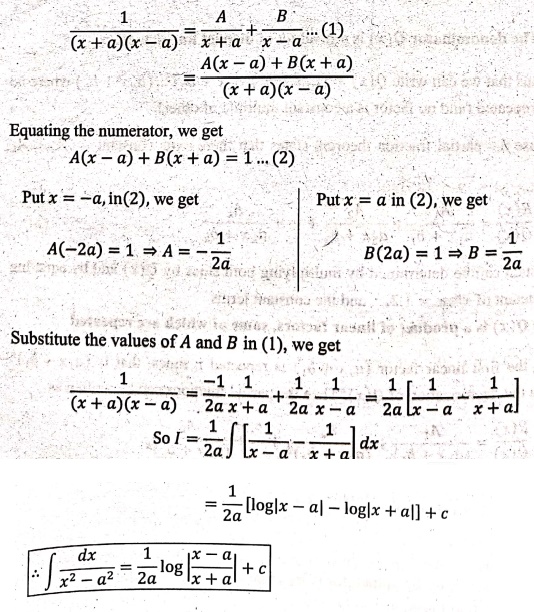
75. Evaluate ∫ dx / [x2‒a2]
Solution:
Let I = ∫ dx/√(x2‒a2) = ∫ dx /
[(x+a)(x‒a)]
Since the degree of the
numerator is less than the degree of the denominator, we don't need to divide.
Writing the function
using partial fraction, we have
Example
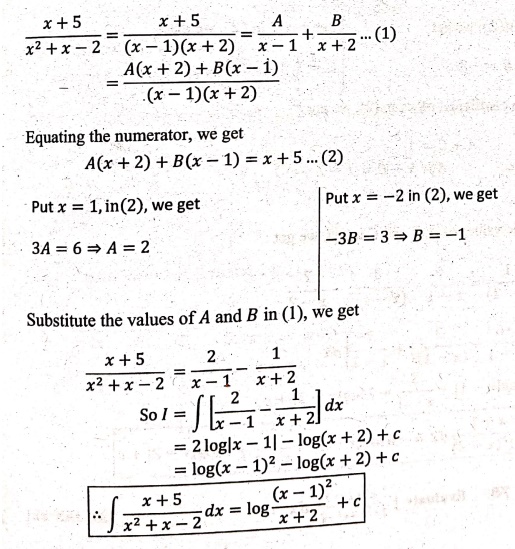
76. Evaluate ∫ [x+5 / x2+x‒2] dx
Solution:
Let I = ∫ [x+5 / x2+x‒2]
dx
Since the degree of the
numerator is less than the degree of the denominator, we don't need to divide.
Writing the function
using partial fraction, we have
Example
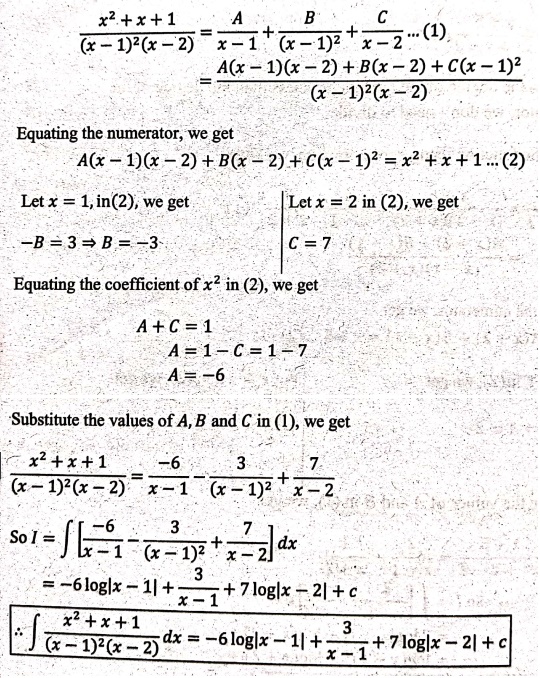
77. Evaluate 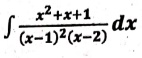
Solution:
Let I =
Since the degree of the
numerator is less than the degree of the denominator, we don't need to divide.
Writing the function
using partial fraction, we have
Example
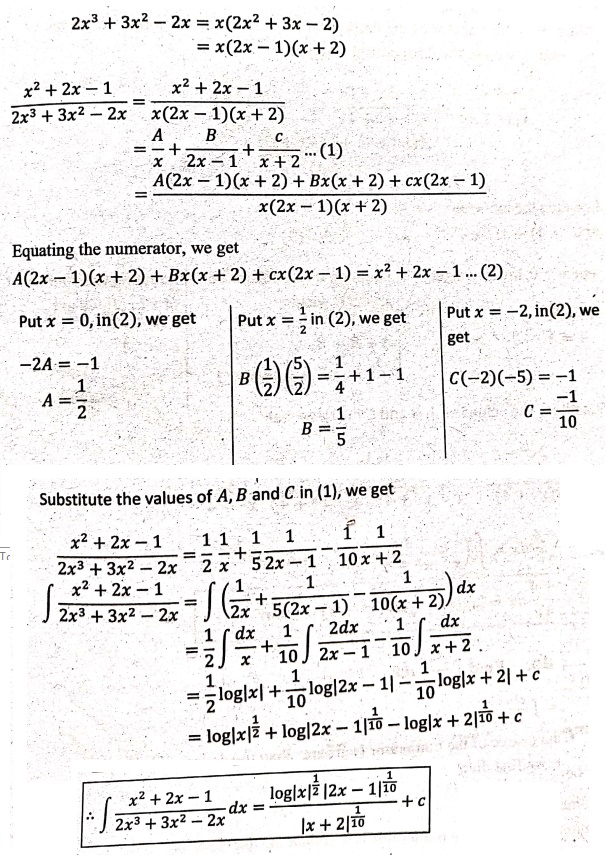
78. Evaluate 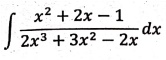
Solution:
Let I =
Since the degree of the
numerator is less than the degree of the denominator, we don't need to divide.
Writing the function
using partial fraction, we have
2x3 + 3x2
‒ 2x = x(2x2 + 3x‒2)
= x(2x‒1)(x+2)
Example
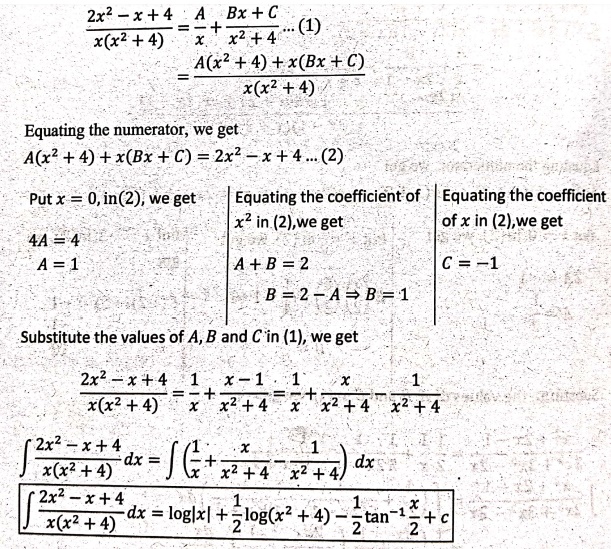
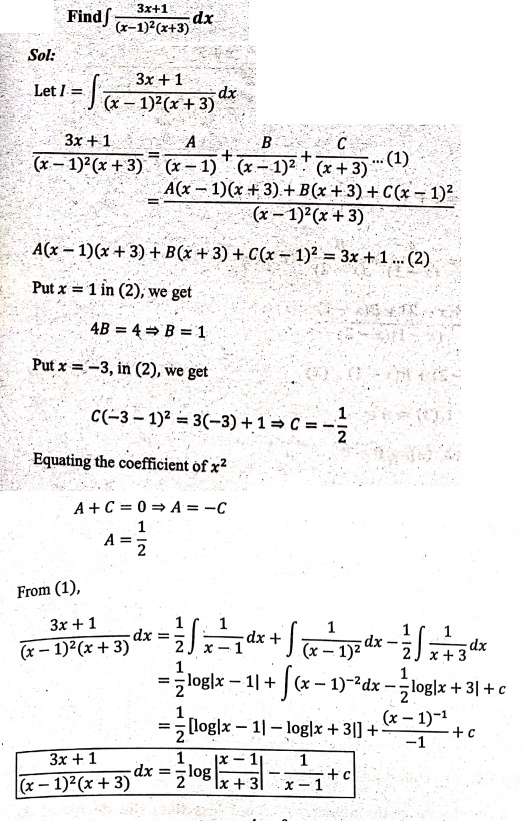
79. Find 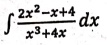
Solution:
Let 1 =
Since, the denominator
of the numerator is less than the denominator of the numerator, we use the term
partial fraction.
Example
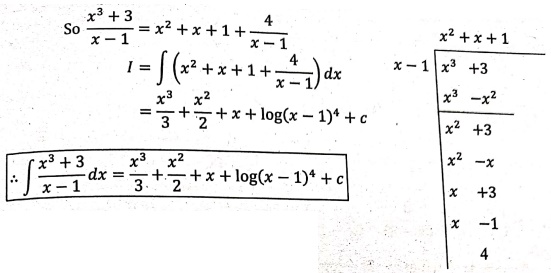
80. Find ∫ (x3+3) / (x‒1) dx
Solution:
Let I = ∫ (x3+3)
/ (x‒1) dx
Since the degree of the
numerator is greater than the degree of the denominator, we first divide x3 + 3 by x‒1.
Example
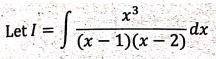
81. Find ∫ [x3 / (x‒1)(x‒2)] dx
Solution:
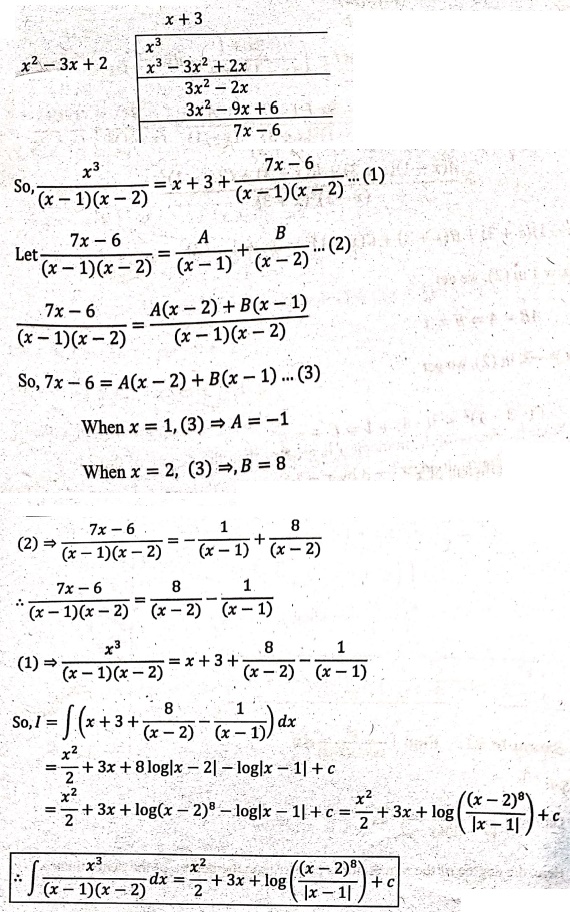
Here, the degree of the
numerator is greater than the degree of the denominator.
Example 82.
Example
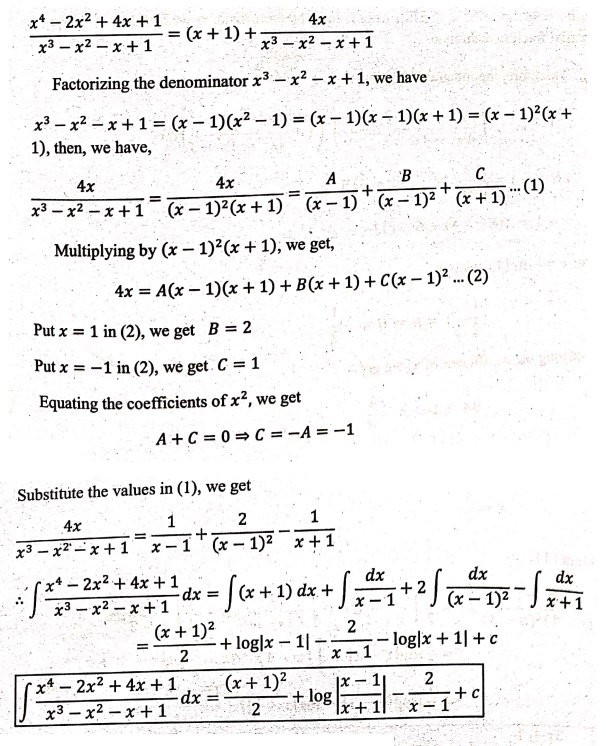
83. Evaluate ∫ (x4−2x2+4x+1)
/ (x3‒x2‒x+1) dx, by using partial fraction.
Solution:
Since the degree of the
numerator is higher than the degree of the denominator, first applying the long
division, we get
Example
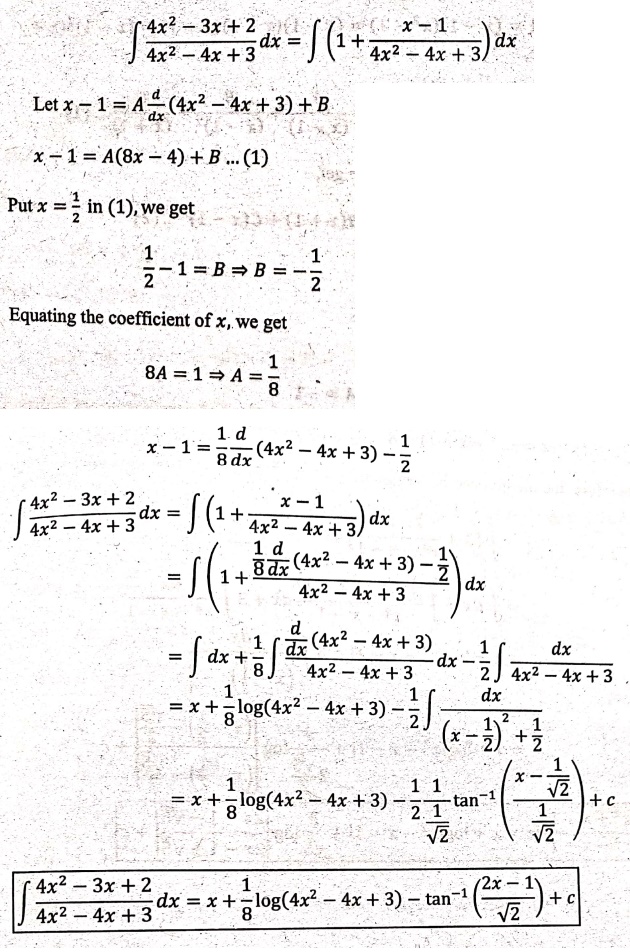
84. Evaluate 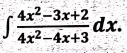
Solution:
Since the degree of the
numerator is not less than the degree of the denominator, we first divide and
obtain

Here the quadratic
equation 4x2 ‒ 4x + 3 is
irreducible because its discriminant is b2‒4ac
= ‒32 < 0. This mean it can't be factorized so we don't need to use the
partial fraction technique.
Therefore, the integral
is written as
Example
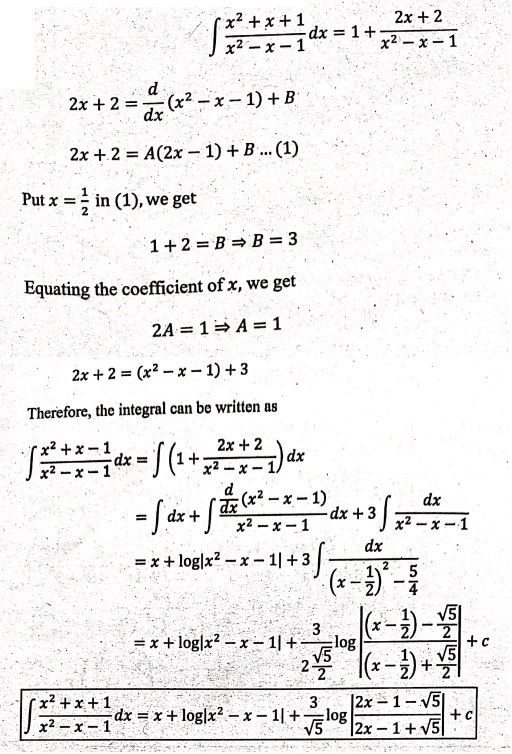
85. Evaluate ∫ (x2+x+1) /
(x2‒x‒1) dx
Solution:
Since the degree of the
numerator is equal to the degree of the denominator, we first divide and obtain
EXERCISE
12.
Evaluate the following integrals
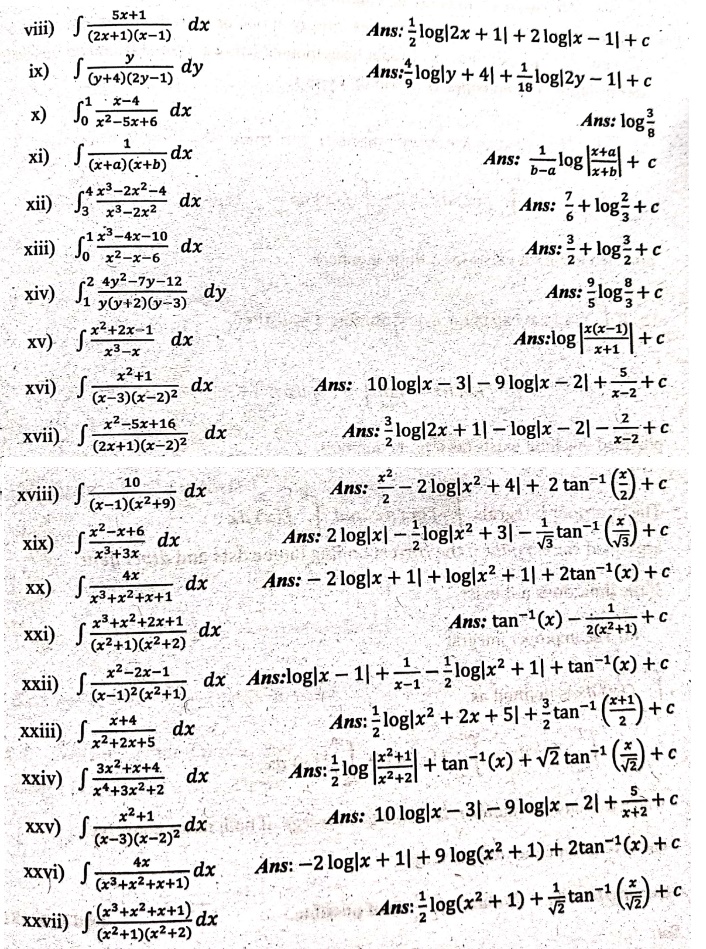
Applied Calculus: UNIT III: Integral Calculus : Tag: Applied Calculus : - Integration of rational function by partial fractions
Applied Calculus: UNIT III: Integral Calculus
Under Subject

Applied Calculus
MA25C01 Maths 1 M1 - 1st Semester | 2025 Regulation | 1st Semester 2025 Regulation
Related Subjects

English Essentials I
EN25C01 1st Semester | 2025 Regulation | 1st Semester 2025 Regulation

தமிழர் மரபு - Heritage of Tamils
UC25H01 1st Semester | 2025 Regulation | 1st Semester 2025 Regulation
Applied Calculus
MA25C01 Maths 1 M1 - 1st Semester | 2025 Regulation | 1st Semester 2025 Regulation

Applied Physics I
PH25C01 1st Semester | 2025 Regulation | 1st Semester 2025 Regulation

Applied Chemistry I
CY25C01 1st Semester | 2025 Regulation | 1st Semester 2025 Regulation

Makerspace
ME25C04 1st Semester | 2025 Regulation | 1st Semester 2025 Regulation

Computer Programming C
CS25C01 1st Semester | 2025 Regulation | 1st Semester 2025 Regulation

Computer Programming Python
CS25C02 1st Semester | 2025 Regulation | 1st Semester 2025 Regulation

Fundamentals of Electrical and Electronics Engineering
EE25C03 1st Semester | 2025 Regulation | 1st Semester 2025 Regulation

Introduction to Mechanical Engineering
ME25C03 1st Semester | 2025 Regulation | 1st Semester 2025 Regulation

Introduction to Civil Engineering
CE25C01 1st Semester Civil Department | 2025 Regulation | 1st Semester 2025 Regulation

Essentials of Computing
CS25C03 1st Semester - AID CSE IT Department | 2025 Regulation | 1st Semester 2025 Regulation

Applied Physics I Laboratory
PH25C01 1st Semester practical Laboratory Manual | 2025 Regulation | 1st Semester Laboratory 2025 Regulation

Applied Chemistry I Laboratory
CY25C01 1st Semester practical Laboratory Manual | 2025 Regulation | 1st Semester Laboratory 2025 Regulation

Computer Programming C Laboratory
CS25C01 1st Semester practical Laboratory Manual | 2025 Regulation | 1st Semester Laboratory 2025 Regulation

Computer Programming Python Laboratory
CS25C02 1st Semester practical Laboratory Manual | 2025 Regulation | 1st Semester Laboratory 2025 Regulation
Engineering Drawing
ME25C01 EEE Mech Dept | 2025 Regulation | 2nd Semester 2025 Regulation

Basic Electronics and Electrical Engineering
EE25C04 1st Semester ECE Dept | 2025 Regulation | 2nd Semester 2025 Regulation