Applied Calculus: UNIT III: Integral Calculus
Net Change Theorem
Integral Calculus
Explanation, Formula, Definition, Equation, Example and Solved Problems - Problems Under Net Change Theorem, Problems Under Indefinite Integrals Integration of Some Standard Functions, Exercise
NET
CHANGE THEOREM
Definition:
The integral of a rate
of change is the net change
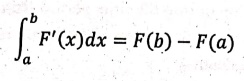
Notes:
I. If V(t) is the
volume of water in a reservoir at time t, then its derivative V'(t) is the rate
at which water flows into the reservoir at time t. So
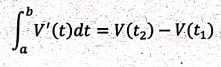
is the change in the
amount of water in the reservoir between time t1 and time t2.
2. If the mass of a rod
measured from the left end to a point x is m(x), then the linear density is ρ(x)
= m' (x). So

3. If [C](t) is the
concentration of the product of a chemical reaction at time t, then the rate of
reaction is the derivative d[C]/dt. So

the change in the
concentration of C from time t1 to time t2.
4. If C(x) is the cost
of producing x units of a commodity, then the marginal cost is the derivative
C'(x). So

is the increase is cost
when production is increased from x1 units to x2 units
5. If the rate of
growth of a population is dn/dt, then
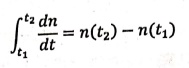
is the net change in
population during the time period from t1 to t2. (The
population increases when births happen and decreases when death occur. The net
change takes into account both births and deaths)
6. If an object moves
along a straight line with position function s(t), then its velocity is v(t) =
s'(t) so
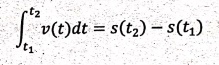
is the net change of
position, or displacement, of the particle during the line period from t1
to t2.
7. If we want to
calculate the distance the object travels during the time interval, we have to
consider the intervals when v(t) ≥ 0 (the particle moves to the right) and also
the intervals when v(t) ≤ 0 (the particle 'moves to the left). In both cases
the distance is computed by integrating |v(t)|, the speed. Therefore
t2∫t2|v(t)|dt = total
distance travelled
8. The acceleration of
the object is a(t) = v'(t) so

is the change in
velocity from time t1 to time t2.
PROBLEMS UNDER NET CHANGE THEOREM
Example
12. A particle moves along a line so that its velocity at time t is v(t) = 3t −
5, 0 ≤ t≤ 3 (measured in meters per second). Find (1) Net Change of position
(2) total distance travelled.
Solution: (1)
We know that,
If an object moves
along a straight line with position function s(t), then its velocity is v(t) =
s'(t) so
is the net change of
position, or displacement, of the particle during the time period from t1
to t2
Here, the net change of
position is

= ‒1.5 m
This means that the
particle moved 1.5 m toward left.
(2) To find the total
distance travelled
Given: v(t) = 3t‒5 on 0
≤ t≤3.
Let v(t) = 0
3t‒5= 0;
t = 5/3
∴the
velocity is negative on [0,5/3) and positive on (5/3,3]
The total distance
travelled is given by

= 41/6 = 6.83
Example
13. A particle moves along a line so that its velocity at time t is v(t) = t2
‒ 2t ‒8, 1 ≤t ≤6 (measured in meters per second). Find (1) Net Change of
position (2) total distance travelled.
Solution: (1)
We know that,
If an object moves
along a straight line with position function s(t), then its velocity is v(t) =
s' (t) so
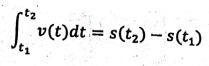
is the net change of
position, or displacement, of the particle during the time period from t1
to t2
Here, the net change of
position is

This means that the
particle moved 3.33 m toward left.
(2) Given: v(t) = t2‒2t‒8
= (t ‒ 4)(t + 2) on 1 ≤ t≤ 6.
Let v(t) = 0
(t‒4)(t+2) = 0;
t = 4 or ‒2
t = ‒2 is not possible.
∴
the
velocity is negative on [1,4) and positive on (4, 6].
The total distance
travelled is given by

= 32.67
Example
14. A particle moves along a line so that its velocity at time t is v(t) = t2
− t − 6 (measured in meters per second)
(1)
Find the displacement of the particle during the time period 1 ≤ t ≤ 4
(2)
Find the distance traveled during this time period
Solution: We
know that,
If an object moves
along a straight line with position function s(t), then its velocity is v(t) =
s'(t) so
is the net change of
position, or displacement, of the particle during the time period from t1
to t2
(1) Here, the
displacement is

= ‒45
This means that the
particle moved 4.5 m toward left.
(2) Given: v(t) = t2‒t‒6
= (t‒3)(t+2) on 1 ≤ t ≤ 4.
Let v(t) = 0
(t − 3)(t + 2) = 0;
t =3
or 2
t = ‒2 is not possible.
the velocity is
negative on [1,3) and positive on (3,4].
The total distance
travelled is given by
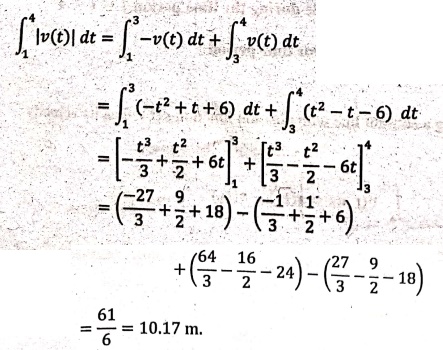
= 10.17 m.
Example
15. Andrew is an intermediate iceboater, though, so he attains speeds equal to
only twice the wind speed. Suppose Andrew takes his iceboat out one morning
when a light ‒mph breeze has been blowing all morning. As Andrew gets his
iceboat set up, though, the wind begins to pick up. During his first half hour
of iceboating, the wind speed increases according to the function v(t) = 20t + 5.
For the second half hour of Andrew's outing, the wind remains steady at 15 mph.
In other words, the wind speed is given by

Recalling
that Andrew's iceboat travels at twice the wind speed, and assuming he moves in
a straight line away from his starting point, how far is Andrew from his
starting point after 1 hour?
Solution: To
figure out how far Andrew has traveled, we need to integrate his velocity,
which is twice the wind speed. Then
Distance = 0∫12v(t)dt.
Substituting the
expressions we were given for v(t), we get
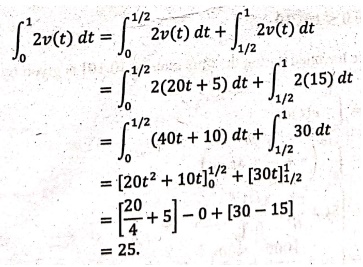
= [20/4 + 5] ‒ 0 + [30 ‒
15]
= 25
Andrew is 25 mi from
his starting point after 1 hour.
Example
16. The acceleration function (in m/s2) and the initial velocity are
given for a particle moving along a line. Find
(1)
the velocity at time t and
(2)
the distance travelled during the given time interval a(t) = t + 4, v(0) = 5,0 ≤ t ≤ 10
Solution: (1)
If a(t) = t + 4 is acceleration and v(0) given, then
v(t) = v(0) + 0ʃ4a(t)
dt ... (1)
and position change
(displacement) on [0,T) is
s = 0∫T
v(t) dt (So split where v(0) = 0)

Check sign of v in 0 ≤ t ≤ 10
Solve: t2/2
+ 4t + 5 = 0
⇒
t = −4±√6 both negative.
So, v(t) > 0 in 0 ≤
t≤ 10
(b) The distance
travelled during the time interval [0,10] is given by

= 1250/3 m
So, the distance
traveled = 1250/3 m ≈ 416.67m
Example
17. The acceleration function (in m/s2) and the initial velocity are
given for a particle moving along a line. Find
(a)
the velocity at time t and
(b)
the distance traveled during the given time interval a(t) = 2t+3, v(0) = − 4, 0
≤ t ≤ 3
Solution: (a)
If a(t) = 2t + 3 is acceleration and v(0) given, then
v(t) = v(0) + 0∫t
a(s) ds

(b) Check sign of v in
0 ≤ t ≤ 3
Solve: t2+3t‒4
= 0
t = 1,‒4
So, v(t) < 0 on
[0,1)
v(t)> 0 on (1,3]
S = 0∫3 v(t) dt
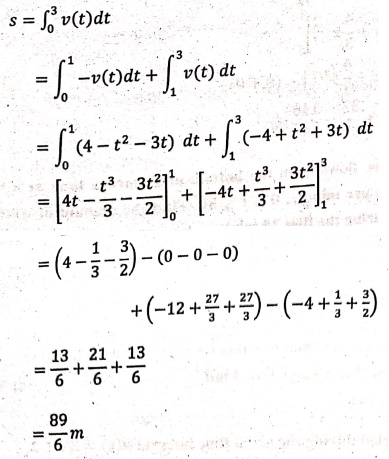
So, the distance
traveled= 89/6 m ≈ 14.83 m
Example
18. The linear density of a rod of length 4m is given by p(x) = 9 + 2√x
measured in kilograms per meter, where x is measured in meters from one end of
the rod. Find the total mass of the rod.
Solution:
The Net change theorem
says
Total change in
quantity = a∫b rate of change dx
Here the quantity is
mass, the rate of change is linear density ρ(x) in kg/m.
So mass = 0∫4
ρ(x) dx

Example
19. Water flows from the bottom of a storage tank at a rate of r(t) = 200‒4t
liters per minute, 0 ≤ t ≤ 50. Find the amount of water that flows from the
tank during the first 10 minutes.
Solution:
Given: Rate of flow
r(t) = 200 ‒ 4t, 0 ≤ t ≤ 10
Net change theorem
Amount of water out
flow = 0∫10 r(t) dt
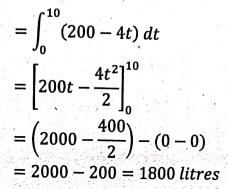
1800 litres of water flows out in the first 10
minutes.
Example
20. The marginal cost of manufacturing x meters of a certain fabric is C'(x) =
3 ‒0.01x + 0.000006x2 (in
dollars per meter). Find the increase in cost is the production level is raised
from 2000 meters to 4000 meters.
Solution:
Given: C'(x) = 3 ‒ 0.01x
+ 0.000006x2
We want to increase in
cost
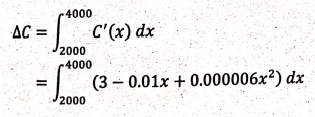
Find an antiderivative
F(x)
= 3 ‒ 0.05x2 + 0.000002x3
F(4000)
= 3(4000) ‒ 0.005(4000)2 + 0.000002(4000)3
= 60,000
F(2000)
= 3(2000) ‒ 0.005(2000)2 + 0.000002(2000)3
= 2000
∆C = F(4000)
– F(2000)
= 60000 ‒ 2000 = 58000
The cost increases by
$58,000
EXERCISE
8. Andrew is an
intermediate iceboater, though, so he attains speeds equal to only twice the
wind speed. Suppose Andrew takes his iceboat out one morning when a light ‒mph
breeze has been blowing all morning. As Andrew gets his iceboat set up, though,
the wind begins to pick up. The wind speed is given by

Under these conditions,
how far from his starting point is Andrew after 1 hour?
Ans:
17.5 mi
9. Find the net
displacement and total distance traveled in meters given the velocity function f(t) = ½ et ‒ 2 over the
interval [0,2].
Ans:
‒0.8055 m, 1.74 m
PROBLEMS UNDER INDEFINITE INTEGRALS INTEGRATION OF SOME STANDARD FUNCTIONS
(i) ∫dx = x + c
(ii) ∫ xn dx
= (xn+1 / n+1) + c (n≠‒1)
(iii) ∫ dx/x = logx + c
(iv) ∫ ex dx
= ex + c
(v) ∫ ax dx =
ax loga + c
(vi) ∫ sinx dx = −cosx + c
(vii) ∫ cosx dx = sinx + c
(viii) ∫ sec2x
dx = tan x + c
(ix) ∫ secx tanx
dx = secx + c
(x) ∫ cosec2
x dx = ‒ cot x + c
(xi) ∫ cosecx cotx
dx = ‒cosec x + c
(xii) ∫ tanx dx = log secx + c
(xiii) ∫ secx dx = log |secx + tan x| + c
(xiv) ∫ cotx dx = log sin x + c
(xv) ∫ cosec x dx = log |cosecx ‒ cotx| + c
(xvi) ∫ dx / [1+x2] = tan‒1x + c
(xvii) ∫ dx / √[1‒x2] = sin‒1x + c
Example
21. Evaluate ʃ (10x4 ‒ 3sec2x)dx
Solution:
Let I = ∫(10x4 ‒ 3sec2x) dx
= 10∫x4dx ‒3∫sec2xdx
= 10 (x5/5)
‒ 3tanx + c
I = 2x5
‒ 3tanx + c
Example
22. Evaluate ∫ ( [x3 ‒ 2√x]
/ x ) dx
Solution:
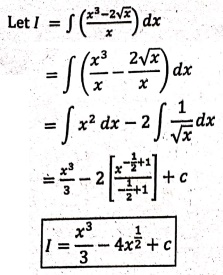
Example
23. Evaluates, 1∫9
( [2t2 + t2√t ‒ 1] / t2 ) dt

Example
24. Evaluate ∫ ( cosθ / sin2θ
) dθ
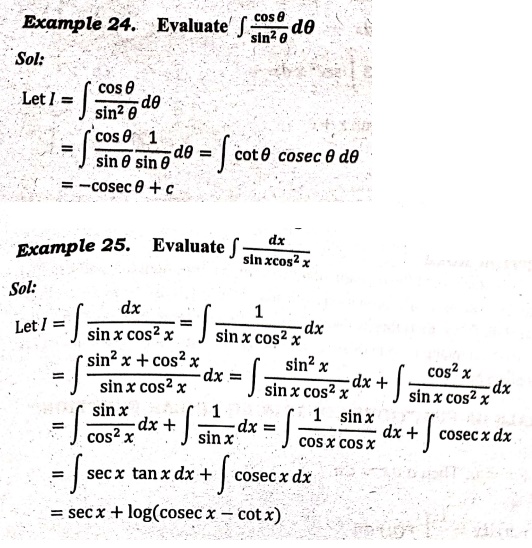
= secx
+ log(cosec x ‒ cot x)
EXERCISE
10. Evaluate the
following

Applied Calculus: UNIT III: Integral Calculus : Tag: Applied Calculus : Integral Calculus - Net Change Theorem
Applied Calculus: UNIT III: Integral Calculus
Under Subject

Applied Calculus
MA25C01 Maths 1 M1 - 1st Semester | 2025 Regulation | 1st Semester 2025 Regulation
Related Subjects

English Essentials I
EN25C01 1st Semester | 2025 Regulation | 1st Semester 2025 Regulation

தமிழர் மரபு - Heritage of Tamils
UC25H01 1st Semester | 2025 Regulation | 1st Semester 2025 Regulation
Applied Calculus
MA25C01 Maths 1 M1 - 1st Semester | 2025 Regulation | 1st Semester 2025 Regulation
Applied Physics I
PH25C01 1st Semester | 2025 Regulation | 1st Semester 2025 Regulation

Applied Chemistry I
CY25C01 1st Semester | 2025 Regulation | 1st Semester 2025 Regulation

Makerspace
ME25C04 1st Semester | 2025 Regulation | 1st Semester 2025 Regulation

Computer Programming C
CS25C01 1st Semester | 2025 Regulation | 1st Semester 2025 Regulation

Computer Programming Python
CS25C02 1st Semester | 2025 Regulation | 1st Semester 2025 Regulation

Fundamentals of Electrical and Electronics Engineering
EE25C03 1st Semester | 2025 Regulation | 1st Semester 2025 Regulation

Introduction to Mechanical Engineering
ME25C03 1st Semester | 2025 Regulation | 1st Semester 2025 Regulation

Introduction to Civil Engineering
CE25C01 1st Semester Civil Department | 2025 Regulation | 1st Semester 2025 Regulation

Essentials of Computing
CS25C03 1st Semester - AID CSE IT Department | 2025 Regulation | 1st Semester 2025 Regulation

Applied Physics I Laboratory
PH25C01 1st Semester practical Laboratory Manual | 2025 Regulation | 1st Semester Laboratory 2025 Regulation

Applied Chemistry I Laboratory
CY25C01 1st Semester practical Laboratory Manual | 2025 Regulation | 1st Semester Laboratory 2025 Regulation

Computer Programming C Laboratory
CS25C01 1st Semester practical Laboratory Manual | 2025 Regulation | 1st Semester Laboratory 2025 Regulation

Computer Programming Python Laboratory
CS25C02 1st Semester practical Laboratory Manual | 2025 Regulation | 1st Semester Laboratory 2025 Regulation
Engineering Drawing
ME25C01 EEE Mech Dept | 2025 Regulation | 2nd Semester 2025 Regulation

Basic Electronics and Electrical Engineering
EE25C04 1st Semester ECE Dept | 2025 Regulation | 2nd Semester 2025 Regulation