Tamils and Technology: Unit III: Manufacturing Technology
Archaeology
Tamils and Technology
Tamils and Technology: 1. Archaeology - Definition 2. Purpose of Archaeology 3. Archaeological Evidences 4. Uses of Archaeological Surveys
ARCHAEOLOGY
1. Archaeology - Definition
Archaeology
is the study and interpretation of human history through its physical remains
and material and culture. Houses, cities, food, clothing and even human remains
are carefully studied to learn more about the past humans. Alexander Cunningham
is hailed as the Father of Indian Archaeology.
Excavation
The
most important activity in archaeology is excavation. During excavation, the
earth is dug and the artefacts found there are collected and examined. At the
end of the study, the findings are recorded.
2. Purpose of Archaeology
Earlier,
archaeology was considered only as a task of listing out the artefacts. But,
its real purpose was
1.
Documenting and explaining the origin and development of prehistoric and
historic human culture.
2.
Understanding cultural history.
3.
Sequencing the cultural process of development period.
4.
The study of human behaviour.
5.
Similar objects have been found in other areas and through them they can
predict the lifestyle of the people who used them and determine the period.
3. Archaeological Evidences
Archaeology
or archaeological evidences are the physical remains and artefacts left behind
by the people who lived in the past. It is the main way of studying people who
lived before humans started keeping written records. It also helps to provide
more illuminating information on periods for which historical records exist.
Major Archaeological Evidences
1. Puhar (Poombuhar) (Kaveripattinam)
It
was a major port city of the early Chola Kingdom, at the estuary of Cauvery
river. It was destroyed hundreds of years ago by the raging sea. Today, after
several rounds of painstaking excavations, the history of this 2000 year
ancient commercial town of Poombuhar port is being resurrected.
In
1910, archaeologists discovered the remains of the port and rediscovered the
old port. Later, other harbours made of burnt breaks, with a platform supported
by wooden posts to handle the flow of water and cargo were found out.
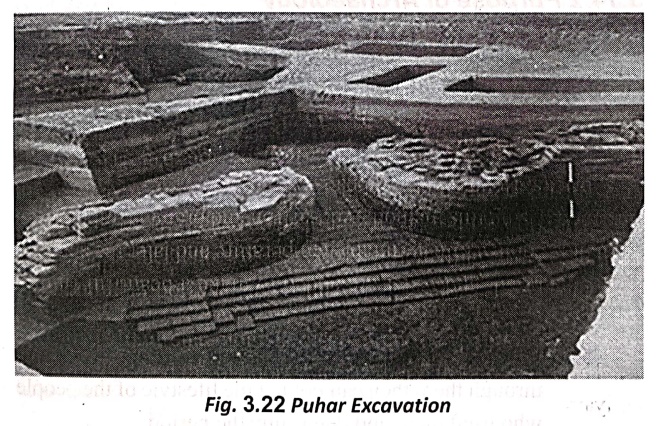
Subsequent
excavations in 1971-74 yielded square copper coins with the tiger symbol, semi
precious stones and fragments of a Roman pottery amphora.
An
underwater excavation in 1981 uncovered stone structures representing an
ancient harbour and temples. It was confirmed as the ancient Puhar City.
2. Adhichanallur
Adhichanallur
is situated on the bank of the river Thamiraparani in Thiruvaikundam circle of
Thoothukudi district.
Alexandria
was the major excavator of this archaeological site in 1903-1904. He found and
displayed more than 4000 items. This includes many burial urns.
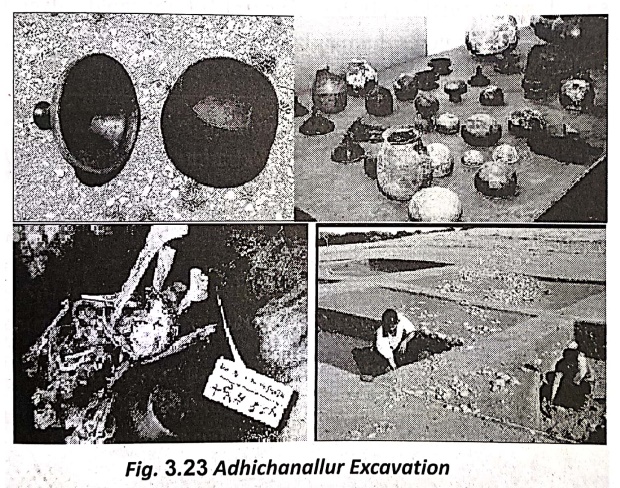
Then
after 100 years in 2004-2005, under the leadership of Mr. Sathiyamurthy four
phase survey was conducted. In that, bronze and iron objects were excavated.
Two objects found in this were subjected to find out the period at the
archaeological laboratory in America. One object was dated to 905 BC and the
other one was as 791 BC.
3. Kodumanal
Kodumanal
is located on the north bank of the Noyyal river in Perundurai circle, Erode
district. It is considered to be the most important worldwide excavation ever
undertaken.
Excavations
were carried out at two types of sites, the people who lived in the Kodumanal
area and the burial ditch (Eemakuzhi). Archaeologists consider them to be the
people of great culture because of their use of large slabs and long stones.
In
this excavation, many items such as iron tools like knife, sword, spear,
shield, bells, horse's extra fittings, gold, silver, lead bangles, sports
items, human bones in burial diches and animal skeletons have been found in the
excavation.
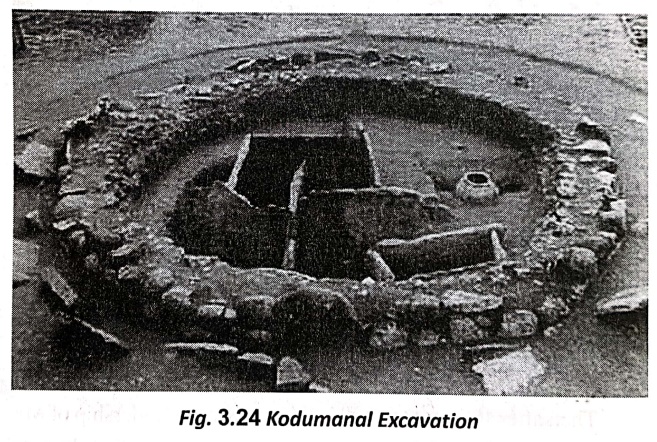
A
brick building and three burial urns have been found in the ongoing excavation.
Here alone, more than 1000 engravings have been found on the clay chips.
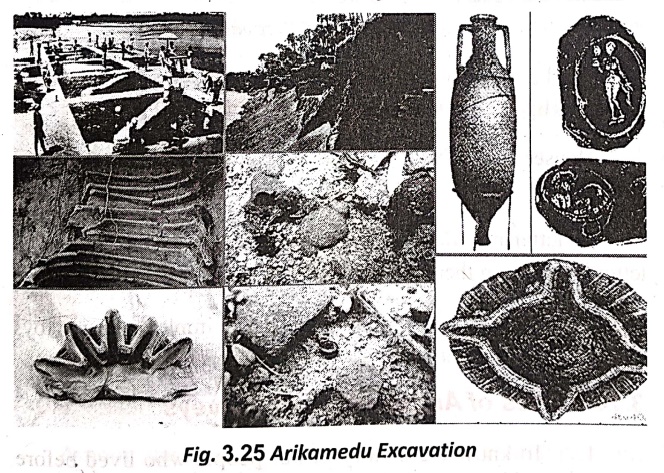
4. Arikamedu
Arikamedu
is in Kakayan thopu, Ariyangkuppam in Puducherry Street. In 1945,
archaeological excavations by Sir Mortimer Willer and June-Marie identified
Arikamedu as a great port site. Roman lamps, glassware and stoneware have been
excavated here. Arikkamedu is a Greek trading centre. It is certain that it
traded with Rome.
Further
excavations revealed the presence of dye tanks.
Pink
amphora jars used to store oil and jars with two handles and a yellow slip for
keeping wine are found in all layers of the excavation. A brick structure with
a lime coating system is found with a split wall. It is a 45 m oblong shape
structure.
5. Keezhadi
Keezhadi
village is in Thirupuvanam circle of Sivagangai district. It is located on the
south bank of the Vaigai river. Keezhadi is the major excavation in Tamilnadu.
More than 40 pits have been dug here.
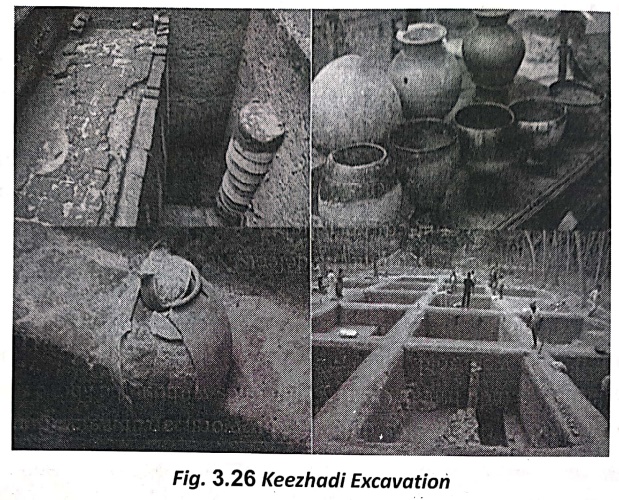
Pearl
beads, women's head pins, dices, chess coins, flint toys, chips, takli, etc.,
are found here.
Houses
built of baked bricks, flint wells, bathrooms are found here.
13
letter pot tiles, black and red pottery tiles with 1 to 13 letters written on
them are found.
Gold
ornaments, ivory ornaments, iron implements and toys in human and animal forms
are also present.
4. Uses of Archaeological Surveys
1.
To know the history of our people who lived before the Sangam period (stone
age) where there is reason no written evidence. Archaeology is used to dig up
the places where the ancient people lived and to find the ibnikond artefacts
they used to know about their lifestyle.
2.
The Indus Valley Civilization came to be known to the world through archaeology
(excavation).
3.
Ancient peoples way of burning the dead, the way they erected Hero stones and
the way they worshipped them can be known through archaeology.
4.
Stone age man gave up pastrolism. They shifted to agriculture. They made
pottery to store grains. All these can be known through archaeology.
5.
Home appliances, war implements, usage of metals such as copper, iron, steel,
etc., were understood through archaeology. We also learn about their hunting
tools.
6.
From the coins found in archaeological research, it is possible to know how
ancient Tamils had trade relations with the foreign countries, especially with
Rome.
Tamils and Technology: Unit III: Manufacturing Technology : Tag: Tamil : Tamils and Technology - Archaeology
Tamils and Technology: Unit III: Manufacturing Technology
Under Subject
Tamils and Technology தமிழர்களும் தொழில்நுட்பமும்
UC25H02 2nd Semester | 2025 Regulation | 2nd Semester 2025 Regulation
Related Subjects
English Essentials II
EN25C02 2nd Semester | 2025 Regulation | 2nd Semester 2025 Regulation
Tamils and Technology தமிழர்களும் தொழில்நுட்பமும்
UC25H02 2nd Semester | 2025 Regulation | 2nd Semester 2025 Regulation
Linear Algebra
MA25C02 2nd Semester | 2025 Regulation
Transforms and its Applications
MA25C03 2nd Semester EEE Dept | 2025 Regulation | 2nd Semester 2025 Regulation

Applied Physics (CE) II
PH25C02 2nd Semester Civil, Agri Depts | 2025 Regulation | 2nd Semester 2025 Regulation
Applied Physics (CSIE) II
PH25C03 2nd Semester AIDS, CSE, IT, CSE(CY) Dept | 2025 Regulation | 2nd Semester 2025 Regulation
Applied Physics (EE) II
PH25C04 2nd Semester EEE Dept | 2025 Regulation | 2nd Semester 2025 Regulation

Applied Physics (ME) II
PH25C05 2nd Semester Mechanical Dept | 2025 Regulation | 2nd Semester 2025 Regulation
Applied Chemistry (CE) II
CY25C02 2nd Semester Civil Dept | 2025 Regulation | 2nd Semester 2025 Regulation

Applied Chemistry (ME) II
CY25C03 2nd Semester Mechanical Dept | 2025 Regulation | 2nd Semester 2025 Regulation

Electron Devices
EC25C01 2nd Semester ECE Dept | 2025 Regulation | 2nd Semester 2025 Regulation
Digital Principles and Computer Organization
CS25C06 2nd Semester AIDS, CSE, IT, CSE(CY) Dept | 2025 Regulation | 2nd Semester 2025 Regulation

Basic Electrical and Electronics Engineering
EE25C01 2nd Semester | 2025 Regulation | 2nd Semester 2025 Regulation

Basic Civil and Mechanical Engineering
GE25C01 2nd Semester EEE Dept | 2025 Regulation | 2nd Semester 2025 Regulation
Data Structures using CPlusPlus
CS25C05 2nd Semester ECE Dept | 2025 Regulation | 2nd Semester 2025 Regulation
Engineering Drawing
ME25C01 EEE, Mech, Agri, EEE Depts | 2025 Regulation | 2nd Semester 2025 Regulation
Data Structures and Algorithms
CS25C04 2nd Semester EEE Dept | 2025 Regulation

Circuits and Network Analysis
EC25C02 2nd Semester ECE Dept | 2025 Regulation | 2nd Semester 2025 Regulation

Engineering Mechanics
ME25C02 2nd Semester Mech, Civil, Agri Depts | 2025 Regulation | 2nd Semester 2025 Regulation
Object Oriented Programming (OOPs)
CS25C07 2nd Semester CSE, CSE(CY) Depts | 2025 Regulation | 2nd Semester 2025 Regulation