Tamils and Technology: Unit III: Manufacturing Technology
Copper and Gold Coins and Historical Evidences
Tamils and Technology
1. Metals used for Coins 2. Forms of Coins 3. Parts of a Coin 4. Images on Coins 5. Coins Expressing Religious Unity and Tolerance 6. Brahmi Characters on Coins 7. Miscellaneous Coins
COPPER AND GOLD COINS
AND HISTORICAL EVIDENCES
Coin
is 'unit of exchange' for exchanging goods and services. Money is a medium of
exchange and currency is a form of money.
'Coin'
(or) 'Kasu' is mentioned in Sangam literature as 'manikasu', 'ponsei kasu',
'polan kasu'. Generally, they were used to denote ornaments. The words 'pon'
and 'kanam' meaning money are found in Sangam period verses.
Proofs
i)
Kurunthogai 67:4
ii)
Nartinai 724:4
Coins
were used in ornaments and for trade during the Sangam period. It is mentioned
in Sangam literature that these 'Kasus' were like neem fruit and gooseberry,
small and spherical in shapes.
Coins
of Moovender stamps issued during the Sangam period and coins of Pandyan Kings
like Peruvaluthi Coins and Chezhiyan coins are the major contributors. The
history and economy Tamil Nadu can be learned through the coins issued by
Moovender regional kings and the Indian economic imbalances can be seen through
the coins of other country kings found in Tamil Nadu.
1. Metals used for Coins
The
kings coined gold, silver, bronze, iron and copper to suit their economic
status. The coins used by various kings of Tamil Nadu were made of gold, silver
and copper.
2. Forms of Coins
Coins
found in the Sangam period are in square, oblong and round.
Square Copper Coins
In
the 18th Century, some square shaped coins dating back to the 4th and 5th
Century BC were found in Tamil Nadu. It has the image of an elephant on the
front and the image of a bow and arrow on the back. These coins might have been
used by the citizens who considered bow as their family symbol.
3. Parts of a Coin
Similar
to that of today's coin, the coins of Sangam era have two parts namely head and
flower. One side of these is engraved with a symbol and the other side with
another symbol. Especially, the coins of the Pandyan Kings have a fish symbol
on one side and an elephant or ox symbol on the other side. These belong to the
period 5th Century BC to 2nd Century AD.
Evidences
1.
BC coins inscribed with symbols dating back to the first Century have been
found in the tombs at Pallalur in Coimbatore district. An elephant symbol is
engraved on o its head.
2.
Rajasimhan II's title Srinidhi is found on one side of the Pallavar coins and
the bull symbol on the other side found at Kanchipuram.
3.
Some coins have a fish symbol on one side and one of Chakra, crescent moon,
Chaithya tower and umbrella on the other side.
4. Images on Coins
Images
of the king and deities are also engraved on the coins. Religious symbols are
also found in them. These help to know the arts and religions of that time. All
the kings who ruled in Tamil Nadu have given importance to the mother tongue
and have issued coins with tiger, fish, horse, bull, lion, animal, bird and
religious motifs; as well as wood and elephant engraved in square coins.
Evidences
1.
More than 10,000 coins have been recovered from the guarders of soil erosion
along the banks of Vaigai, Thenpennai, Tamirabarani, Bhavani and Cauvery
rivers. Different figures have been engraved on both sides of these coins.
2.
Coins of the Roman emperor Augustus Typees (40 BC) have been found in Andhra.
5. Coins Expressing Religious Unity and Tolerance
*
Coins issued during the reign of Mughal Emperor Akbar had images of Rama and
Sita engraved on them.
*
During the reign of Nawab of Arcot, many Saiva "and Vaishnava deities like
Shiva, Vishnu, Ganapathi, Murugan and Hanuman were issued.
*
During the reign of Hydhar Ali and Tippu Sultan coins with Shiva-Parvathi images
were issued.
From
this, there is proof of religious unity and tolerance during their reign.
Proof:
When the poets and minstrels sang in praise of the king, the king gave them
gold coins.
6. Brahmi Characters on Coins
Coins
of gold, silver and copper used during the Sangam period are found with Brahmi
characters such as Thinnan, Ethiran and Senthan. We can know about Senthan in
the Agananooru song.
7. Miscellaneous Coins
1. Stamp Coin
Stamp
coins were in use from the 5th Century BC to the 2nd Century BC. Pandyas were
the first to issue stamp coins.
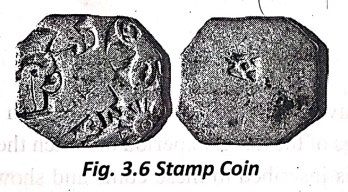
Evidence
It
is noteworthy that casting nests used for issuing stamps have been found in
Tamil Nadu.
2. Pandiya Coins
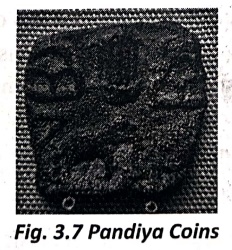
Pandiyas
issued copper coins followed by stamp coins. This copper coin is square shaped.
In the front part, there is a horse standing to left, under whose are tortoises
in two tanks. There is a fish in the background. The name Peruvazhuthi is
inscribed in the form of a Tamil-Brahmi line. It dates back to the 3rd Century
BC and tortoise found in it reveals the 'Pandiyas' attachment to velvi.
3. Peruvazhuthi Coins
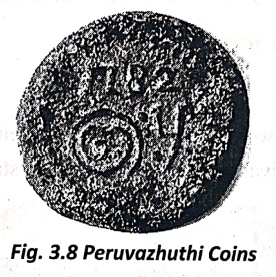
The
Peruvazhuthi coin is a copper coin issued by the Pandiyan Kings of the Sangam
period of which the Pandiyas' title Peruvazhuthi is inscribed in these coins
and shows that they are 2300 years old.
4. Chola Coins of the Sangam Period
In
Tamilnadu coins found are ancient Rajarajan period coins.
The
Chola coins of the Sangam period have a standing bull on the obverse and a
tiger drawn with lines on the reverse. These are made of oblong square shaped
copper cast. This coin has been made mixing the casting method and stamping
method; It was around the 3rd Century BC that Tamils had known how to make and
use coins by casting.
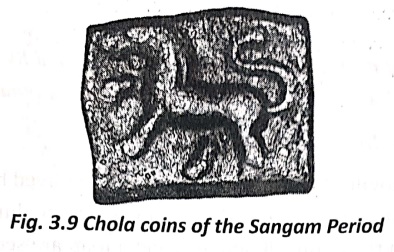
Evidence
A
Sangam Chola coin has been found in the Amaravathi river basin. Archaeologists
like Arumuga Sitharaman consider its period to be the later part of the 3rd
Century BC.
5. Chera Coins of Sanga Period
The
Chera coins of the Sangam era are found to be inscribed with bow and some coins
have king's head and his name engraved on them.
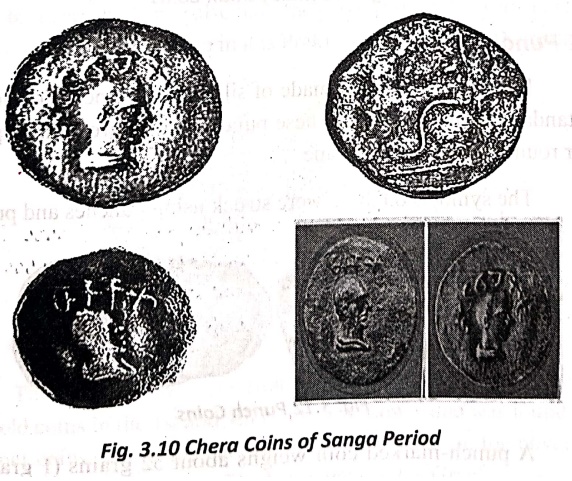
Evidence
Coins
of the Chera kings of the Sangam period like Cheraman Kottam Palathu Thunjiya
Makothai and Kuttuvan Kothai.
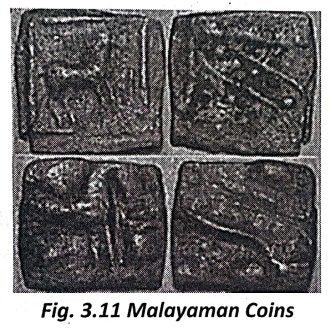
6. Malaiyaman Kasugal
Thirukovilur
Malayaman, a regional king lived between AD 100 - 300. In the coins issued by
them, Thirukovilur, the region they ruled, a river, three mountains and a road
are seen.
7. Punch Coins
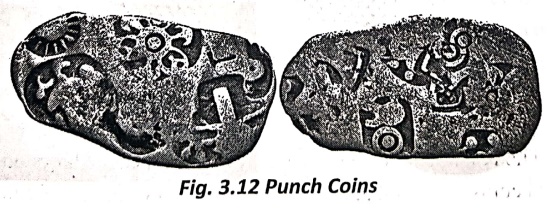
Punch-marked
coins made of silver and copper became the standard form of coinage. These
punched coins are either square or round or rectangular shape.
The symbols on these were struck using punches and prints.
A
punch-marked coin weighs about 52 grains (1 grain = 64.79 mg.)
8. Coins of Mauriyas
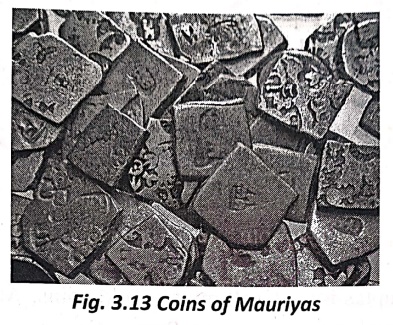
Historical
evidences from the Sangam period suggest that the Mauriyas used silver and
copper metals and used punch or punch-marked coins.
9. Coins of the Indo-Greeks
These
coins were issued between 2nd and 1st Century BC. Mostly, they are made of
silver. Usually, some are rectangular and circular in shapes. They also have
the name of the ruler who depicts the puranas. The language in it is Prakrit
and the script in Karoshti.
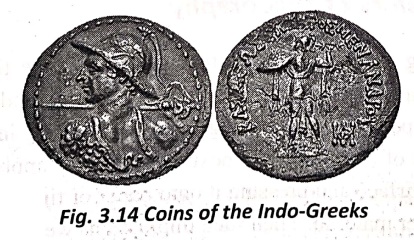
10. Kushana Type Coins
The
Kushanas were the first dynasty to issue a large number of gold coins in the
1st and 4th Centuries. Low value was found in copper coins. The coins had the
image and name on the obverse and deities on the reverse. The language used is
Greek.
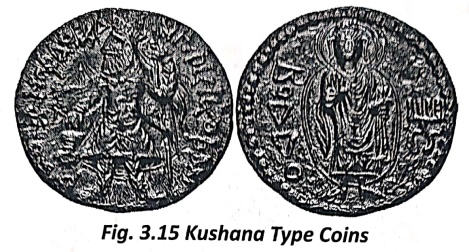
11. The coins of the Guptas
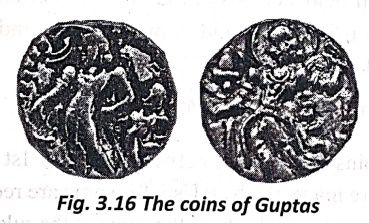
The
Guptas issued well-minted gold coins. At the top, the kings are found in
various guises. Some coins show playing.
Tamils and Technology: Unit III: Manufacturing Technology : Tag: Tamil : Tamils and Technology - Copper and Gold Coins and Historical Evidences
Tamils and Technology: Unit III: Manufacturing Technology
Under Subject
Tamils and Technology தமிழர்களும் தொழில்நுட்பமும்
UC25H02 2nd Semester | 2025 Regulation | 2nd Semester 2025 Regulation
Related Subjects
English Essentials II
EN25C02 2nd Semester | 2025 Regulation | 2nd Semester 2025 Regulation
Tamils and Technology தமிழர்களும் தொழில்நுட்பமும்
UC25H02 2nd Semester | 2025 Regulation | 2nd Semester 2025 Regulation
Linear Algebra
MA25C02 2nd Semester | 2025 Regulation
Transforms and its Applications
MA25C03 2nd Semester EEE Dept | 2025 Regulation | 2nd Semester 2025 Regulation

Applied Physics (CE) II
PH25C02 2nd Semester Civil, Agri Depts | 2025 Regulation | 2nd Semester 2025 Regulation
Applied Physics (CSIE) II
PH25C03 2nd Semester AIDS, CSE, IT, CSE(CY) Dept | 2025 Regulation | 2nd Semester 2025 Regulation
Applied Physics (EE) II
PH25C04 2nd Semester EEE Dept | 2025 Regulation | 2nd Semester 2025 Regulation

Applied Physics (ME) II
PH25C05 2nd Semester Mechanical Dept | 2025 Regulation | 2nd Semester 2025 Regulation
Applied Chemistry (CE) II
CY25C02 2nd Semester Civil Dept | 2025 Regulation | 2nd Semester 2025 Regulation

Applied Chemistry (ME) II
CY25C03 2nd Semester Mechanical Dept | 2025 Regulation | 2nd Semester 2025 Regulation

Electron Devices
EC25C01 2nd Semester ECE Dept | 2025 Regulation | 2nd Semester 2025 Regulation
Digital Principles and Computer Organization
CS25C06 2nd Semester AIDS, CSE, IT, CSE(CY) Dept | 2025 Regulation | 2nd Semester 2025 Regulation

Basic Electrical and Electronics Engineering
EE25C01 2nd Semester | 2025 Regulation | 2nd Semester 2025 Regulation

Basic Civil and Mechanical Engineering
GE25C01 2nd Semester EEE Dept | 2025 Regulation | 2nd Semester 2025 Regulation
Data Structures using CPlusPlus
CS25C05 2nd Semester ECE Dept | 2025 Regulation | 2nd Semester 2025 Regulation
Engineering Drawing
ME25C01 EEE, Mech, Agri, EEE Depts | 2025 Regulation | 2nd Semester 2025 Regulation
Data Structures and Algorithms
CS25C04 2nd Semester EEE Dept | 2025 Regulation

Circuits and Network Analysis
EC25C02 2nd Semester ECE Dept | 2025 Regulation | 2nd Semester 2025 Regulation

Engineering Mechanics
ME25C02 2nd Semester Mech, Civil, Agri Depts | 2025 Regulation | 2nd Semester 2025 Regulation
Object Oriented Programming (OOPs)
CS25C07 2nd Semester CSE, CSE(CY) Depts | 2025 Regulation | 2nd Semester 2025 Regulation