Tamils and Technology: Unit III: Manufacturing Technology
Smelting Iron, Steel Manufacturing Technology
Tamils and Technology
Tamils and Technology: 1. Flint Pipes 2. Chennakuzhi Fire Furnace 3. Secondary Casting Plants 4. Comparison of Sangam Smelting with Modern Smelting
SMELTING IRON, STEEL
Tamilians
had known the use of iron before the rest of the world knew it. They also had
widespread access to the technology of extracting and tooling iron from the
natural sources. They might have smelted iron and made weapons wherever
necessary as a cottage industry. Such items are found here.
By
the early 13th Century BC, iron smelting was practised on a large scale in
India. It suggests that the technology might have originated as early as the
16th Century BC.
Evidence - Radio Carbon Dating
Some
of the earliest iron objects found in India have been proved to be earlier than
1400 BC by Radio Carbon Dating Method.
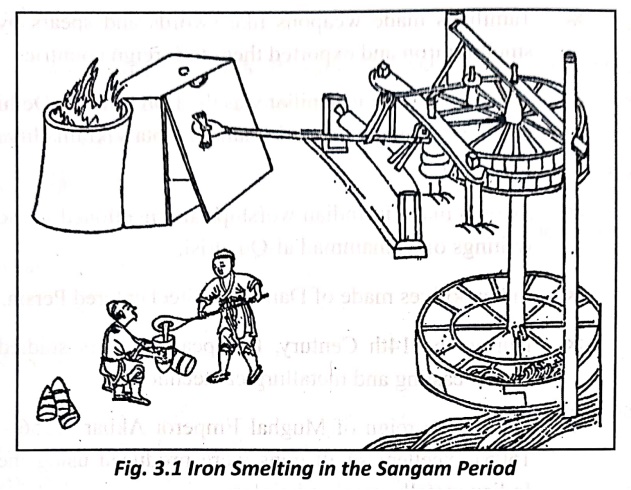
Iron Furnaces at Kalayar Koil
In
the following lyrics, Iyur Moolangkizhar says that king Venkai Marban, after
being defeated by Ukrap Peruvazhuthi, regretted that saving his town was a rare
act like saving water spilt on iron in a furnace. From this, it is understood
that there is evidence of an iron smelting factory during the Sangam period.
Proof:
Purnanooru 21
1. Flint Pipes
The
existence of iron smelters is further confirmed by the presence of flint pipes
in places where iron waste is found. These pipes might have been used for
smelting iron or blowing air through the pipe to keep the fire continuously
burning.
Evidence
A
heap of iron waste was found at Raginipatti Kanmai in the Northern part near
Paiyur on the highway from Sivagangai to Thondi. When the iron wastes were
broken, the stones looked like iron.
2. Chennakuzhi Fire Furnace
Chennakuzhi
is a combination of the word 'Chenth' which refers to the colour characteristic
of red or red fire and the name 'na' which refers to the flame of fire and the
name of the place 'Kuzhi'.
Chen
+ na + pit = 'red pit'
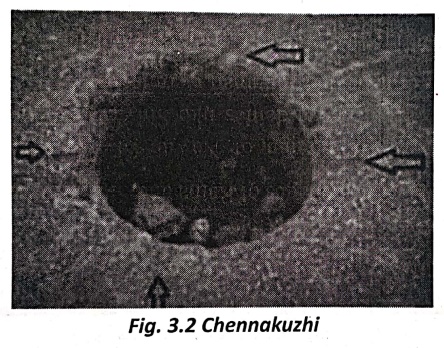
By
being so called, we can realize that it functioned as an iron mill during the
Sangam period. The information, data and names obtained confirm that an iron
ore plant was operating at this place since the Sangam period.
Large
circular pots of clay were probably used for smelting iron. Such pits are found
wherever iron scraps are available. These were also called 'Chennakuzhigal'
because they spewed fire.
Evidence
1.
It is special to see a Chennakuzhi in Raginipatti Kanmai.
2.
The pond in Porpanikottai is called 'Neeravi Kulam' and there is a Chennakuzhi
near it.
3. Secondary Casting Plants
About
200 metres away from the Porpanai Fort, the secondary iron casing furnaces had
been operating. The raw material redstones are not found here. So, this
secondary raw materials required for the plant should have been obtained from
the primary metal separation plant itself.
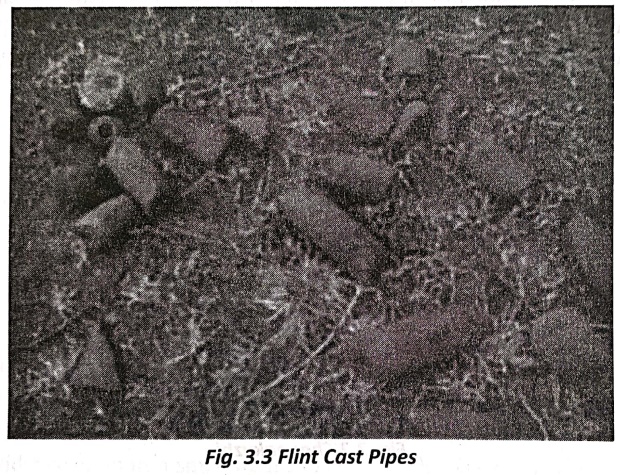
The
carbon iron alloy thus obtained is melted in flint iron pots. Then it is poured
into flint casting pipes to form the basic structure of long rod-like iron, as
can be seen from the flint castings lying around here. And we can see that the
lower part of these flint pipes is buried in the soil and molten metal is
poured into it.
Evidence
From
Thiruvarangam to Porpanaikottai, in some areas of the ridges with iron wastes,
of earthern furnaces of iron smelting plants partially destroyed, flint iron
pipes, iron containers used for waste disposal have been detected in many
places.
4. Comparison of Sangam Smelting with Modern Smelting
The
iron ore laterite rock is broken and pulverized and mixed with charcoal powder
to subject it to the primary ore separation, where the ore is roasted at high
temperatures and enriched with carbon particles. It can be seen in
archaeological studies and historical records of metal smelting that it is used
as a raw material for the next level of iron smelting. This can be compared
with the modern metallurgical practice.
Herbal Use
Iron
requires a lot of heat for melting it. They did not burn trees to that extent.
Instead, they used herbs to smelt iron, which stands as the evidence of
technology.
Location of Smelter
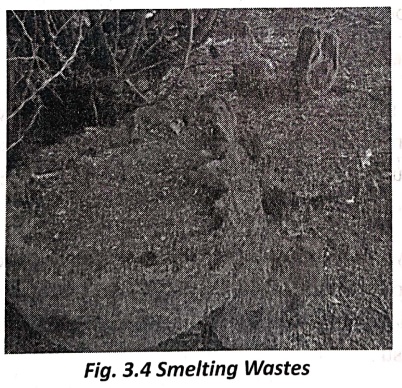
It
is natural for factories to be located where raw materials are available.
Accordingly, it has been found through the continuous field survey that ores
have been mined near the iron ore smelter and the iron ore wastes are found
scattered nearby.
Tamils and Technology: Unit III: Manufacturing Technology : Tag: Tamil : Tamils and Technology - Smelting Iron, Steel Manufacturing Technology
Tamils and Technology: Unit III: Manufacturing Technology
Under Subject
Tamils and Technology தமிழர்களும் தொழில்நுட்பமும்
UC25H02 2nd Semester | 2025 Regulation | 2nd Semester 2025 Regulation
Related Subjects
English Essentials II
EN25C02 2nd Semester | 2025 Regulation | 2nd Semester 2025 Regulation
Tamils and Technology தமிழர்களும் தொழில்நுட்பமும்
UC25H02 2nd Semester | 2025 Regulation | 2nd Semester 2025 Regulation
Linear Algebra
MA25C02 2nd Semester | 2025 Regulation
Transforms and its Applications
MA25C03 2nd Semester EEE Dept | 2025 Regulation | 2nd Semester 2025 Regulation

Applied Physics (CE) II
PH25C02 2nd Semester Civil, Agri Depts | 2025 Regulation | 2nd Semester 2025 Regulation
Applied Physics (CSIE) II
PH25C03 2nd Semester AIDS, CSE, IT, CSE(CY) Dept | 2025 Regulation | 2nd Semester 2025 Regulation
Applied Physics (EE) II
PH25C04 2nd Semester EEE Dept | 2025 Regulation | 2nd Semester 2025 Regulation

Applied Physics (ME) II
PH25C05 2nd Semester Mechanical Dept | 2025 Regulation | 2nd Semester 2025 Regulation
Applied Chemistry (CE) II
CY25C02 2nd Semester Civil Dept | 2025 Regulation | 2nd Semester 2025 Regulation

Applied Chemistry (ME) II
CY25C03 2nd Semester Mechanical Dept | 2025 Regulation | 2nd Semester 2025 Regulation

Electron Devices
EC25C01 2nd Semester ECE Dept | 2025 Regulation | 2nd Semester 2025 Regulation
Digital Principles and Computer Organization
CS25C06 2nd Semester AIDS, CSE, IT, CSE(CY) Dept | 2025 Regulation | 2nd Semester 2025 Regulation

Basic Electrical and Electronics Engineering
EE25C01 2nd Semester | 2025 Regulation | 2nd Semester 2025 Regulation

Basic Civil and Mechanical Engineering
GE25C01 2nd Semester EEE Dept | 2025 Regulation | 2nd Semester 2025 Regulation
Data Structures using CPlusPlus
CS25C05 2nd Semester ECE Dept | 2025 Regulation | 2nd Semester 2025 Regulation
Engineering Drawing
ME25C01 EEE, Mech, Agri, EEE Depts | 2025 Regulation | 2nd Semester 2025 Regulation
Data Structures and Algorithms
CS25C04 2nd Semester EEE Dept | 2025 Regulation

Circuits and Network Analysis
EC25C02 2nd Semester ECE Dept | 2025 Regulation | 2nd Semester 2025 Regulation

Engineering Mechanics
ME25C02 2nd Semester Mech, Civil, Agri Depts | 2025 Regulation | 2nd Semester 2025 Regulation
Object Oriented Programming (OOPs)
CS25C07 2nd Semester CSE, CSE(CY) Depts | 2025 Regulation | 2nd Semester 2025 Regulation