Applied Physics I: Chapter 10: Applied Optics - Lasers
Carbon-di-Oxide [CO2] Laser
Characteristics, Principle, Construction, Working, Applications
![Carbon-di-Oxide [CO2] Laser - Characteristics, Principle, Construction, Working, Applications](https://www.poriyaan.in/media/articlewww/img-Carbo-fw.png)
The transition between these vibrational and rotational energy levels leads to the construction of molecular gas laser. Here the Nitrogen atoms are initially raised to excited state.
CARBON‒DI‒OXIDE [CO2]
LASER
Characteristics of CO2 Laser
Type: Molecular
Gas Laser
Active medium:
Mixture of CO2, N2 and Helium (or) Water vapour
Active centre: CO2
Pumping method: Electric
discharge method
Optical Resonator:
Metallic mirror of gold (or) silicon mirrors coated with aluminium
Power output:
10 KW
Nature of output: Continuous
(or) pulsed
Wavelength of the
output: 9.6 μm & 10.6 μm (96000Å & 106000Å)
Introduction
An
Indian Engineer C.K.N.Patel designed the CO2 laser. We know in the
case of atoms, electrons can be excited to higher energy levels. The
distribution of electrons in the shells and sub‒shells define the electronic
state of the molecule (eg. He‒Ne laser).

Besides
these electronic energy levels, the molecule can have other energy levels also
due to rotation and vibration of the molecule (CO2) they give rise
to various rotational and vibrational energy levels, as shown in Fig.10.12.
E1E2
‒ Electronic energy levels
v',v"‒ Vibrational energy levels
j,
j' ‒ Rotational energy levels.
Principle
The
transition between these vibrational and rotational energy levels leads to the
construction of molecular gas laser. Here the Nitrogen atoms are initially
raised to excited state. The nitrogen atoms delivers the energy to CO2
atoms which has closest energy level to it. Then, transition takes place
between the vibrational energy levels of the CO2 atoms and hence
laser beam is emitted.
The
molecular gas laser can have two types of transitions
(i)
Transition between vibrational states of the same electronic state (Fig.10.13).

(ii)
Transition between vibration levels of different electronic state (Fig.10.14).
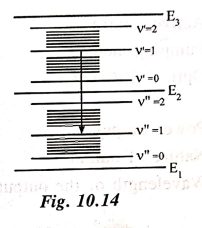
NOTE: No need to write
the introduction and to draw these figures, if CO2 LASER is asked
for 8 marks.
CO2
laser of satisfies the first condition (i.e.) here the laser transition occurs
between vibrational energy levels of the same electronic state.
Fundamental modes of vibration of the CO2 molecule
There
are three fundamental modes of vibration.
1.
Symmetric stretching mode (10°0)
2.
Bending mode (01°0, 02°0)
3.
Asymmetric stretching mode (00°1, 00°2)
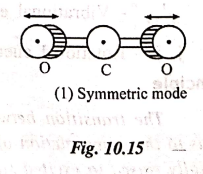
i) Symmetric stretching
mode (10°0)
Here
the carbon atom is stationary and the oxygen atoms oscillate (or) vibrate along
the axis of the molecule as shown in Fig.10.15 (simultaneously it approaches
(or) departs with respect to the carbon atom). The state of vibration is given
by 3 integers (mn'q) here (10°0), which corresponds to the degree of
excitation.
ii) Bending mode (01°0,
02°0)
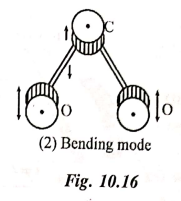
Here
the atoms will not be linear, rather the atoms will vibrate perpendicular to
the molecular axis as shown in Fig 10.16. This gives rise to two quanta of
frequency represented by (01°0, 02°0).
iii) Asymmetric
stretching mode (00°1, 00°2)
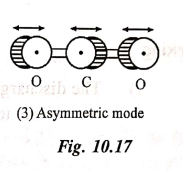
Here
all the three atoms will vibrate. Here the oxygen atoms vibrate in the opposite
direction to the vibration direction of carbon atom as shown in Fig.10.17,
which gives the quanta of frequency (00°1 and 00°2)
NOTE: In general the Quanta
of frequency is represented as mn'q
m → Quanta of frequency,
when CO2 is in symmetric stretching mode.
n → Quanta of frequency,
when CO2 is in bending mode.
q → Quanta of frequency,
when CO2 is in Asymmetric stretching mode.
l → Angular momentum about the axis of
the molecule.
Since rotational energy
is not considered I = 0.
Construction
It
consists of a discharge tube in which CO2 is taken along with
nitrogen and helium gases with their pressure level of 0.33:1.2:7 mm of Hg for
CO2, nitrogen and the He respectively. Nitrogen helps to increase
the population of atoms in the upper level of CO2, while helium
helps to depopulate the atoms in the lower level of CO2 and also to
cool the discharge tube.
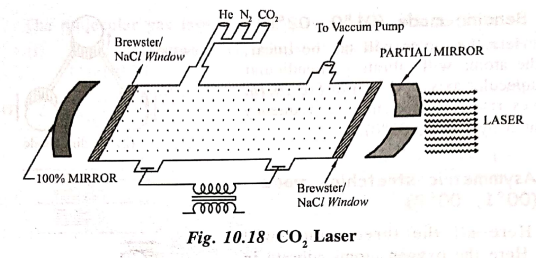
The
discharge is produced by D.C. excitation. At the ends of the tube Sodium
chloride/Brewster windows are placed as shown in Fig. 10.18. Confocal silicon
mirrors coated with Aluminium (or) metallic mirror of gold is employed for
proper reflection, which form the resonant cavity. The output power can be
increased by increasing the diameter of the tube.
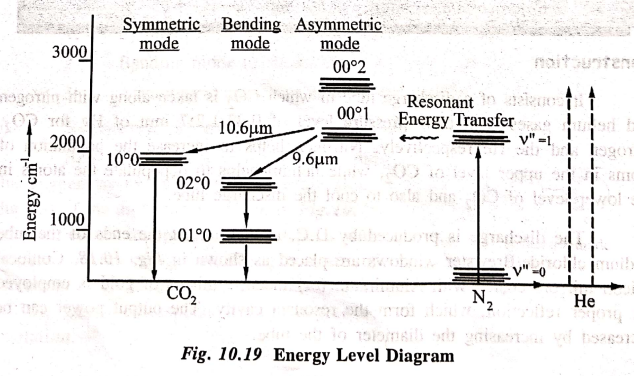
Working
1.
The discharge is passed through the tube first, the Nitrogen atoms are raised
to excited state
e‒
+ N2 → N2*
2)
The excited N2 atoms undergo resonant energy transfer with CO2
atom and raises CO2(00°1) to excited state due to closer energy
level of CO2 (00°1) and Nitrogen.
N2*+CO2 → CO2*+N2
3)
When transition takes place between 00°1 to 10°0, laser of wavelength 10.6 μm
is emitted as shown in Fig.10.19.
4)
Similarly, when transition takes place between 00°1 and 02°0 laser beam of
wavelength 9.6 μm is emitted as shown in Fig.10.19
5)
Since 00°1 → 10°0 has a higher gain than 00°1 → 02°0 transition, usually the
laser beam of wavelength 10.6 μm is produced more.
6)
When the gas flow is longitudinal power output is 50 to 60 watts but if the gas
flow is perpendicular to the discharge tube the output power may be raised to
10 kilowatt/m.
7)
This type of CO2 laser is known as TEA laser (Transversely Excited
Atmospheric Pressure Laser).
8)
The contamination of carbon monoxide and oxygen will also have some effect on
the laser action. To avoid this the unused gases can be pumped out and fresh CO2
must be pumped inside the bas discharge tube.
NOTE: The upper energy level
of Helium cannot be seen in the energy level diagram, because it occurs very
far from the ground state energy level.
Applications of CO2 Laser
1.
This laser has applications in medical field such as neurosurgery,
microsurgery, treatment of liver, lungs and also in bloodless operations.
2.
It is widely used in open air communication.
3.
This laser also have wide applications over military field.
Applied Physics I: Chapter 10: Applied Optics - Lasers : Tag: Applied Physics : Characteristics, Principle, Construction, Working, Applications - Carbon-di-Oxide [CO2] Laser
Applied Physics I: Chapter 10: Applied Optics - Lasers
Under Subject
Applied Physics I
PH25C01 1st Semester | 2025 Regulation | 1st Semester 2025 Regulation
Related Subjects

English Essentials I
EN25C01 1st Semester | 2025 Regulation | 1st Semester 2025 Regulation

தமிழர் மரபு - Heritage of Tamils
UC25H01 1st Semester | 2025 Regulation | 1st Semester 2025 Regulation
Applied Calculus
MA25C01 Maths 1 M1 - 1st Semester | 2025 Regulation | 1st Semester 2025 Regulation
Applied Physics I
PH25C01 1st Semester | 2025 Regulation | 1st Semester 2025 Regulation

Applied Chemistry I
CY25C01 1st Semester | 2025 Regulation | 1st Semester 2025 Regulation
Makerspace
ME25C04 1st Semester | 2025 Regulation | 1st Semester 2025 Regulation
Computer Programming C
CS25C01 1st Semester | 2025 Regulation | 1st Semester 2025 Regulation
Computer Programming Python
CS25C02 1st Semester | 2025 Regulation | 1st Semester 2025 Regulation
Fundamentals of Electrical and Electronics Engineering
EE25C03 1st Semester | 2025 Regulation | 1st Semester 2025 Regulation
Introduction to Mechanical Engineering
ME25C03 1st Semester | 2025 Regulation | 1st Semester 2025 Regulation

Introduction to Civil Engineering
CE25C01 1st Semester Civil Department | 2025 Regulation | 1st Semester 2025 Regulation
Essentials of Computing
CS25C03 1st Semester - AID CSE IT Department | 2025 Regulation | 1st Semester 2025 Regulation

Applied Physics I Laboratory
PH25C01 1st Semester practical Laboratory Manual | 2025 Regulation | 1st Semester Laboratory 2025 Regulation

Applied Chemistry I Laboratory
CY25C01 1st Semester practical Laboratory Manual | 2025 Regulation | 1st Semester Laboratory 2025 Regulation

Computer Programming C Laboratory
CS25C01 1st Semester practical Laboratory Manual | 2025 Regulation | 1st Semester Laboratory 2025 Regulation

Computer Programming Python Laboratory
CS25C02 1st Semester practical Laboratory Manual | 2025 Regulation | 1st Semester Laboratory 2025 Regulation
Engineering Drawing
ME25C01 EEE Mech Dept | 2025 Regulation | 2nd Semester 2025 Regulation

Basic Electronics and Electrical Engineering
EE25C04 1st Semester ECE Dept | 2025 Regulation | 2nd Semester 2025 Regulation