Applied Physics I: Chapter 10: Applied Optics - Lasers
Nd-YAG [Neodymium-Yttrium Aluminium Garnet] Laser
Characteristics, Principle, Construction, Working, Applications
![Nd-YAG [Neodymium-Yttrium Aluminium Garnet] Laser - Characteristics, Principle, Construction, Working, Applications](https://www.poriyaan.in/media/articlewww/img-Nd-YA-Bn.png)
Nd‒YAG laser is a doped insulator laser. It is a four level system in which the active medium is taken in the form of a crystal.
ND‒YAG [NEODYMIUM‒YTTRIUM
ALUMINIUM GARNET] LASER
Characteristics of Nd‒YAG laser
Type: Doped
insulator laser [Solid state laser]
Active medium: Yttrium
Aluminium Garnet [Y3Al5O12]
Active centre:
Neodymium [Nd3+ ions]
Pumping method:
Optical pumping
Pumping source:
Xenon flash lamp
Optical Resonator: Ends
of the rods polished with silver and two mirrors, one of them is totally
reflecting and the other is partially reflecting.
Power output:
2×10⁴ watts
Nature of output:
Pulsed
Wavelength emitted:
1.064 μm.
Introduction
Nd‒YAG
laser is a doped insulator laser. It is a four level system in which the
active medium is taken in the form of a crystal. Here the crystal is
intensionally doped during its growth. Those type of lasers has number of
energy levels with same energy. The laser is used to generate high power
intensity.
Principle
The
term "Doped Insulator Laser" refers to the active medium, yttrium
aluminium garnet doped with neodymium Nd3+. The neodymium ion has
many energy levels. Due to optical pumping these ions are raised to excited
levels. During the transition from metastable state to E1 state, the
laser beam of wavelength 1.064 μm is emitted.
Construction
The
active medium is made as a rod which has yttrium aluminium garnet [Y3
Al5 O12] doped with a rare earth metal ion neodymium Nd3+.
The Nd3+ ions normally occupies the yttrium ions and provides the
energy levels for both the lasing transitions and pumping. This rod is placed
inside a highly reflecting elliptical cavity as shown in Fig.10.10.
A
close optical coupling is made by placing the xenon flash lamp near by the
laser rod, in such a way that most of the radiation from the flash tube passes
through the laser rod due to the elliptical cavity. The flash tube may be
switched ON and controlled with the help of a capacitor. The discharge of
capacitor is initiated using a high voltage source.
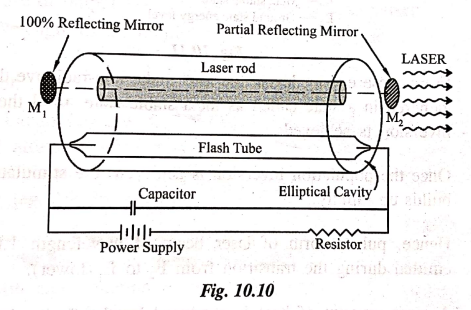
The
optical resonator is formed by grinding the ends of the rods and coated with
silver accompanied by two mirrors, one is 100% reflecting and the other is
partially reflecting which is included to increase the efficiency of the output
beam.
Working
1.
The xenon flash lamp is switched ON and the light is allowed to fall on the
laser rod.
2.
The intense white light excites the neodymium (Nd3+) ions from the
ground state to various energy levels above E2. Hence the atoms are
raised to group of higher levels in E3 as illustrated in the energy
level diagram Fig.10.11.

3.
From these energy levels the ions make non‒radiative decay and is gathered in a
state called as meta stable state, until the population inversion is achieved.
4.
Once the population inversion is achieved, the stimulated emission builds up
rapidly.⠀ 5. Hence, pulsed form of
laser beam of wavelength 1.064 μm is emitted during the transition from E4
to E1 (lower).
6.
A large amount of heat is produced by the flash tube during the working. Hence
cooling arrangement is made either by blowing air (or) circulating water over
the crystal.
Applications of Nd‒YAG Laser
1.
It is used in transmitting signals to a longer distances.
2.
It is used in long haul communication system.
3.
It is also used in the endoscopic applications.
4.
It plays a vital role in remote sensing applications.
NOTE:
For continuous laser beam the xenon flash lamp may be replaced with quartz ‒
halogen lamps.
Applied Physics I: Chapter 10: Applied Optics - Lasers : Tag: Applied Physics : Characteristics, Principle, Construction, Working, Applications - Nd-YAG [Neodymium-Yttrium Aluminium Garnet] Laser
Applied Physics I: Chapter 10: Applied Optics - Lasers
Under Subject
Applied Physics I
PH25C01 1st Semester | 2025 Regulation | 1st Semester 2025 Regulation
Related Subjects

English Essentials I
EN25C01 1st Semester | 2025 Regulation | 1st Semester 2025 Regulation

தமிழர் மரபு - Heritage of Tamils
UC25H01 1st Semester | 2025 Regulation | 1st Semester 2025 Regulation
Applied Calculus
MA25C01 Maths 1 M1 - 1st Semester | 2025 Regulation | 1st Semester 2025 Regulation
Applied Physics I
PH25C01 1st Semester | 2025 Regulation | 1st Semester 2025 Regulation

Applied Chemistry I
CY25C01 1st Semester | 2025 Regulation | 1st Semester 2025 Regulation
Makerspace
ME25C04 1st Semester | 2025 Regulation | 1st Semester 2025 Regulation
Computer Programming C
CS25C01 1st Semester | 2025 Regulation | 1st Semester 2025 Regulation
Computer Programming Python
CS25C02 1st Semester | 2025 Regulation | 1st Semester 2025 Regulation
Fundamentals of Electrical and Electronics Engineering
EE25C03 1st Semester | 2025 Regulation | 1st Semester 2025 Regulation
Introduction to Mechanical Engineering
ME25C03 1st Semester | 2025 Regulation | 1st Semester 2025 Regulation

Introduction to Civil Engineering
CE25C01 1st Semester Civil Department | 2025 Regulation | 1st Semester 2025 Regulation
Essentials of Computing
CS25C03 1st Semester - AID CSE IT Department | 2025 Regulation | 1st Semester 2025 Regulation

Applied Physics I Laboratory
PH25C01 1st Semester practical Laboratory Manual | 2025 Regulation | 1st Semester Laboratory 2025 Regulation

Applied Chemistry I Laboratory
CY25C01 1st Semester practical Laboratory Manual | 2025 Regulation | 1st Semester Laboratory 2025 Regulation

Computer Programming C Laboratory
CS25C01 1st Semester practical Laboratory Manual | 2025 Regulation | 1st Semester Laboratory 2025 Regulation

Computer Programming Python Laboratory
CS25C02 1st Semester practical Laboratory Manual | 2025 Regulation | 1st Semester Laboratory 2025 Regulation
Engineering Drawing
ME25C01 EEE Mech Dept | 2025 Regulation | 2nd Semester 2025 Regulation

Basic Electronics and Electrical Engineering
EE25C04 1st Semester ECE Dept | 2025 Regulation | 2nd Semester 2025 Regulation