Applied Physics I: Chapter 10: Applied Optics - Lasers
Rhodamine - 6g (or) Xanthene Dye Laser
Characteristics, Principle, Construction, Working, Advantages, Disadvantages, Limitations, Applications
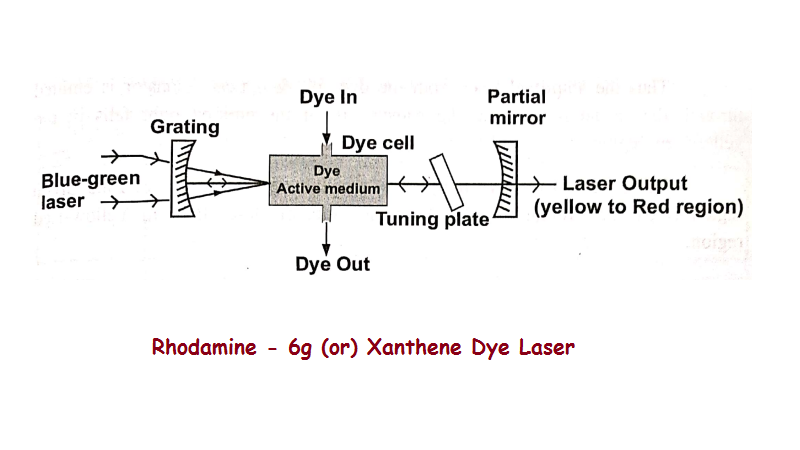
Organic dye such as Rhodamine‒6G (or) Xanthene dye dissolved in solvents like water or alcohol is placed in the Dye cell.
RHODAMINE ‒ 6G (OR)
XANTHENE DYE LASER
Characteristics of Rhodamine - 6G Dye laser
Type: Dye
Laser
Active medium:
Organic Dyes such as Rhodamine‒6G (or) Xanthene dissolved in solvents like
Water (or) Alcohol.
Active Centre:
Rhodamine‒6G (or) Xanthene dye.
Pumping method:
Optical Pumping
Pumping Source:
Flash lamp (or) another laser like N2 laser (or) argon‒ion laser
Optical Resonator:
Resonant cavity consisting of diffraction grating at one end and a partially reflective
mirror on the other end.
Power output:
5.6 to 6.5 watts. (Upto 320mW on tuning)
Output Wavelength:
Yellow to Red region (upto 500Å on tuning)
Nature of Output: Both
Pulsed and Continuous waves.
Principle
Organic
dye such as Rhodamine‒6G (or) Xanthene dye dissolved in solvents like water or
alcohol is placed in the Dye cell. The pumping source excites these Dye
molecules to excited state. After achieving population inversion, these
molecules emit photons of the same wavelength, leading to laser action.
Construction
Liquid
solution of Rhodamine‒6G (or) Xanthene organic dye dissolved in a solvent such
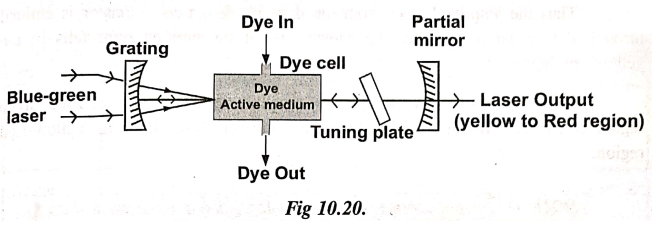
as water or alcohol is placed in the Dye cell as shown in Fig 10.20.
Strong
light source such as flash lamp (or) lasers like N2 laser (or) Argon‒
ion laser act as a pumping source to excite the Xanthene molecules.
A
tuning plate is used for better tuning of laser wavelength and hence these
lasers are also called as Tunable Lasers.
For
better tuning, one of the mirrors of the resonant cavity is replaced by
diffraction grating. Thus, in dye lasers the optical resonator consists of
diffraction grating at one end and the partially reflective mirror at the other
end.
Working
Strong
light source like Flash lamp (or) argon‒ion laser (Blue‒Green Laser) is
switched ON.
This
light passes through the Rhodamine‒6G (or) Xanthene organic dye molecules kept
inside the Dye cell and excite these molecules to the excited state.
The
excited dye molecules spontaneously emit photons, and some of these photons
stimulate other excited molecules to emit photons of the same wavelength, which
leads to laser action.
These
photons are reflected back and forth between the diffraction grating and the
partially reflecting mirror i.e., through the optical resonator and thus
amplified.
Now,
with the help of tuning plate and by rotating the diffraction grating at
different angles, we can produce laser of different wavelength even upto 500Å
and due to this reason, dye lasers are also called tunable lasers.
For
tunable Lasers, the angle of diffraction (θ) must satisfy the following
condition, viz.,
2d sineθ = nλ (n = 1, 2,
3, ...)
Where
d
is the grating spacing.
and
λ is the wavelength of radiation.
Thus
the amplified laser from the dye cell & optical resonator is emitted
through the partial mirror and the wavelength of the emitted light falls in the
yellow‒red region.
Here,
we can observe that, when the light of wavelength in Blue‒Green region is
passed through the Dye laser, it emits the laser light in Yellow‒Red region.
NOTE: Dye lasers operate
without the intervening of metastable state.
Advantages
(i)
Dye lasers possess wide range of tunable wavelengths and hence it is used for
various applications.
(ii)
These lasers will achieve very high power output in both pulsed and continuous
wave modes.
(iii)
The dye lasers will have high repetition rates and will allow efficient
cooling.
Disadvantages / Limitations
(i)
Dye molecules will degrade in due course of time and hence the lifespan of Dye
laser is less.
(ii)
The experimental setup for Dye laser is complex in nature and hence maintenance
cost will be high.
Applications
(i)
Dye lasers are widely used in spectroscopy for the study of properties of
materials.
(ii)
In Astronomy, dye lasers are used to create artificial guide stars.
(iii)
Since Dye lasers are Tunable lasers, they are used to selectively excite
molecules and study their reactions in research field.
(iv)
Dye lasers are used to separate different isotopes of an element.
(v)
Dye lasers are used to do cosmetic procedures like hair removal, skin
rejuvenation and tattoo removal.
(vi)
In medical field dye lasers plays a vital role in treating eye diseases and
studying the effects of laser light on eye structures.
Applied Physics I: Chapter 10: Applied Optics - Lasers : Tag: Applied Physics : Characteristics, Principle, Construction, Working, Advantages, Disadvantages, Limitations, Applications - Rhodamine - 6g (or) Xanthene Dye Laser
Applied Physics I: Chapter 10: Applied Optics - Lasers
Under Subject
Applied Physics I
PH25C01 1st Semester | 2025 Regulation | 1st Semester 2025 Regulation
Related Subjects

English Essentials I
EN25C01 1st Semester | 2025 Regulation | 1st Semester 2025 Regulation

தமிழர் மரபு - Heritage of Tamils
UC25H01 1st Semester | 2025 Regulation | 1st Semester 2025 Regulation
Applied Calculus
MA25C01 Maths 1 M1 - 1st Semester | 2025 Regulation | 1st Semester 2025 Regulation
Applied Physics I
PH25C01 1st Semester | 2025 Regulation | 1st Semester 2025 Regulation

Applied Chemistry I
CY25C01 1st Semester | 2025 Regulation | 1st Semester 2025 Regulation
Makerspace
ME25C04 1st Semester | 2025 Regulation | 1st Semester 2025 Regulation
Computer Programming C
CS25C01 1st Semester | 2025 Regulation | 1st Semester 2025 Regulation

Computer Programming Python
CS25C02 1st Semester | 2025 Regulation | 1st Semester 2025 Regulation
Fundamentals of Electrical and Electronics Engineering
EE25C03 1st Semester | 2025 Regulation | 1st Semester 2025 Regulation
Introduction to Mechanical Engineering
ME25C03 1st Semester | 2025 Regulation | 1st Semester 2025 Regulation

Introduction to Civil Engineering
CE25C01 1st Semester Civil Department | 2025 Regulation | 1st Semester 2025 Regulation
Essentials of Computing
CS25C03 1st Semester - AID CSE IT Department | 2025 Regulation | 1st Semester 2025 Regulation

Applied Physics I Laboratory
PH25C01 1st Semester practical Laboratory Manual | 2025 Regulation | 1st Semester Laboratory 2025 Regulation

Applied Chemistry I Laboratory
CY25C01 1st Semester practical Laboratory Manual | 2025 Regulation | 1st Semester Laboratory 2025 Regulation

Computer Programming C Laboratory
CS25C01 1st Semester practical Laboratory Manual | 2025 Regulation | 1st Semester Laboratory 2025 Regulation

Computer Programming Python Laboratory
CS25C02 1st Semester practical Laboratory Manual | 2025 Regulation | 1st Semester Laboratory 2025 Regulation
Engineering Drawing
ME25C01 EEE Mech Dept | 2025 Regulation | 2nd Semester 2025 Regulation

Basic Electronics and Electrical Engineering
EE25C04 1st Semester ECE Dept | 2025 Regulation | 2nd Semester 2025 Regulation