Applied Physics I: Chapter 10: Applied Optics - Lasers
Einstein's co-efficients
Lasers | Optics
(i) Absorption (ii) Spontaneous emission and (iii) Stimulated emission.
EINSTEIN'S
CO‒EFFICIENTS
We
know that, when light is absorbed by the atoms (or) molecules, then it goes
from the lower energy level (E1) to the higher energy level (E2)
and during the transition from higher energy level (E2) to lower
energy level (E1), the light is emitted from the atoms (or)
molecules.
Let
us consider an atom exposed to (light) photons of energy E2 ‒ E1=hv, then, three distinct processes takes
place.
(i)
Absorption.
(ii)
Spontaneous emission and
(iii)
Stimulated emission.
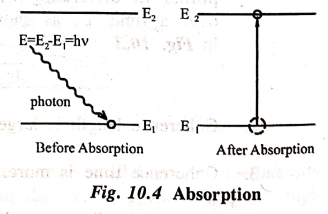
Process (i) Absorption
An
atom in the lower energy level (or) ground state energy level E1
absorbs the incident photon radiation of energy (hv) and goes to the higher energy level (or) excited energy state E2
as shown in Fig.10.4
This
process is called absorption.
If
there are many number of atoms in the ground state then each atom will absorb
the energy from the incident photon and goes to the excited state then,
The
rate of absorption (R12) is proportional to the
following factors.
(i.e)
R12 α Energy density of incident radiation (ρv)
α No.of atoms in the ground state (N1)
(i.e)
R12 α ρv N1
(or) R12 = B12 ρv N1 ………..(1)
Where
B12 is a constant which gives the probability of absorption
transition per unit time.
NOTE:
The subscript 12 represents the transition is from energy level E1
to E2. Similarly 21 represents the transition is from energy E2
to E1.
Normally, the atoms in
the excited state will not stay there for a long time, rather it comes to
ground state by emitting a photon of energy E=hv. Such an emission takes place
by one of the following two methods.
Process (ii) Spontaneous emission
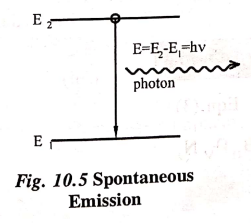
The
atom in the excited state returns to the ground state by emitting a photon of
energy E=(E2‒E1) = hv,
spontaneously without any external triggering as shown in Fig.10.5. This
process is known spontaneous emission.
Such
an emission is random and is independent of incident radiation. If N1
and N2 are the numbers of atoms in the ground state (E1)
and excited state (E2) respectively, then
The
rate of spontaneous emission is R21 (Sp) α N2
(or)
R21 (Sp) = A21N2
Where
A21 is a constant which gives the probability of spontaneous emission
transitions per unit time.
Process (iii) Stimulated emission
The
atom in the excited state can also return to the ground state by external
triggering (or) inducement of photon thereby emitting a photon of energy equal
to the energy of the incident photon, known as stimulated emission.

Thus
results in two photons of same energy, phase difference and of same
directionality as shown in Fig.10.6.
The
rate of stimulated emission is given by
R21
(St) α Pv N2
(or)
R21 (St) = B21 Pv N2 ………..(3)
where
B21 is a constant which gives the probability of stimulated emission
transitions per unit time.
Einstein's theory
Einstein's
theory of absorption and emission of light by an atom is based on Planck's
theory of radiation. Also under thermal equilibrium, the population of energy
levels obey the Boltzmann's distribution law.
(i.e)
under thermal equilibrium,
The rate of absorption = The rate of emission
(i.e) Eqn.(1) = Eqn.(2) Eqn. (3)
B12 ρv N1 = A21 N2 + B21
ρv N2
ρv
[B12N1 ‒ B21N2 ] = A21 N2
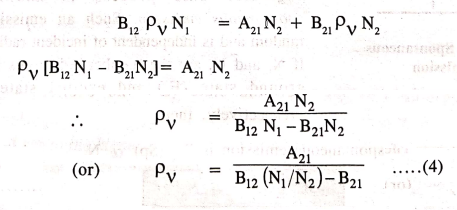
……………………….(4)
We
know that from Boltzmann distribution law
N1
= No e‒E1/KBT
Similarly
N2 = No e‒E2/KBT
Where
KB
is the Boltzmann constant,
T
is the absolute temperature and
No
is the number of atoms at absolute zero.
At
equilibrium, we can write the ratio of Population levels as follows,
(i.e)
N1 /N2 = e(E2‒E1)/KBT

Since
E2‒E1=hv, we
have
N1/N2 = ehv/KBT …………..(5)
Substituting
eqn.(5) in eqn.(4) we have
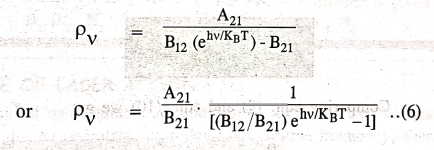
…………..(6)
This
equation has a very good agreement with Planck's energy distribution radiation
law.
(ie.)

…………..(7)
Therefore
comparing equations (6) and (7), we can write
B12 = B21 = B
A21 / B21 = 8πhv3 / c3
……………………(8)
Taking
A21 = A
The
constants A and B are called Einstein Coefficients, which accounts for
spontaneous and stimulated emission probabilities. It also explains the
importance of metastable states.
Ratio of magnitudes of stimulated and spontaneous emission rates
From
equations (2) and (3) we have
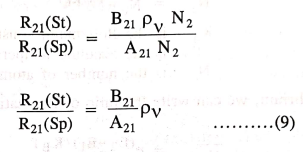
Substituting
eqn.(6) in eqn (9), we can write
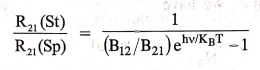
since B12 = B21, we can
write

Comparing
eqn. (9) and eqn. (10) we get

In
a simpler way the ratio can be written as
R = [B21/A21]
ρv
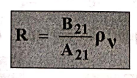
Generally
spontaneous emission is more predominant in the optical region (ordinary
light). To increase the number of coherent photons, stimulated emission should
dominate over spontaneous emission. To achieve this, an artificial condition
called population inversion is necessary.
Applied Physics I: Chapter 10: Applied Optics - Lasers : Tag: Applied Physics : Lasers | Optics - Einstein's co-efficients
Applied Physics I: Chapter 10: Applied Optics - Lasers
Under Subject
Applied Physics I
PH25C01 1st Semester | 2025 Regulation | 1st Semester 2025 Regulation
Related Subjects

English Essentials I
EN25C01 1st Semester | 2025 Regulation | 1st Semester 2025 Regulation

தமிழர் மரபு - Heritage of Tamils
UC25H01 1st Semester | 2025 Regulation | 1st Semester 2025 Regulation
Applied Calculus
MA25C01 Maths 1 M1 - 1st Semester | 2025 Regulation | 1st Semester 2025 Regulation
Applied Physics I
PH25C01 1st Semester | 2025 Regulation | 1st Semester 2025 Regulation

Applied Chemistry I
CY25C01 1st Semester | 2025 Regulation | 1st Semester 2025 Regulation
Makerspace
ME25C04 1st Semester | 2025 Regulation | 1st Semester 2025 Regulation
Computer Programming C
CS25C01 1st Semester | 2025 Regulation | 1st Semester 2025 Regulation
Computer Programming Python
CS25C02 1st Semester | 2025 Regulation | 1st Semester 2025 Regulation
Fundamentals of Electrical and Electronics Engineering
EE25C03 1st Semester | 2025 Regulation | 1st Semester 2025 Regulation
Introduction to Mechanical Engineering
ME25C03 1st Semester | 2025 Regulation | 1st Semester 2025 Regulation

Introduction to Civil Engineering
CE25C01 1st Semester Civil Department | 2025 Regulation | 1st Semester 2025 Regulation
Essentials of Computing
CS25C03 1st Semester - AID CSE IT Department | 2025 Regulation | 1st Semester 2025 Regulation

Applied Physics I Laboratory
PH25C01 1st Semester practical Laboratory Manual | 2025 Regulation | 1st Semester Laboratory 2025 Regulation

Applied Chemistry I Laboratory
CY25C01 1st Semester practical Laboratory Manual | 2025 Regulation | 1st Semester Laboratory 2025 Regulation

Computer Programming C Laboratory
CS25C01 1st Semester practical Laboratory Manual | 2025 Regulation | 1st Semester Laboratory 2025 Regulation

Computer Programming Python Laboratory
CS25C02 1st Semester practical Laboratory Manual | 2025 Regulation | 1st Semester Laboratory 2025 Regulation
Engineering Drawing
ME25C01 EEE Mech Dept | 2025 Regulation | 2nd Semester 2025 Regulation

Basic Electronics and Electrical Engineering
EE25C04 1st Semester ECE Dept | 2025 Regulation | 2nd Semester 2025 Regulation