Applied Chemistry I: UNIT 4: Corrosion and Control
Corrosion Control by Electrochemical Protection or Cathodic Protection
The principle involved in the electrochemical protection (or) cathodic protection is to force the metal to behave like a cathode. The important cathodic protections are (i) Sacrificial anodic protection (ii) Impressed current cathodic protection
CORROSION CONTROL BY
ELECTROCHEMICAL PROTECTION OR CATHODIC PROTECTION
The principle involved
in the electrochemical protection (or) cathodic protection is to force the
metal to behave like a cathode. The important cathodic protections are
(i) Sacrificial anodic
protection
(ii) Impressed current
cathodic protection
1. Sacrificial anodic protection method
In this method, the
metallic structure to be protected is made cathode by connecting it with more
active metal (anodic metal). So that all the corrosion will concentrate only on
the active metal. The artificially made anode thus gradually gets corroded
protecting the original metallic structure.

Hence this process is otherwise
known as sacrificial anodic protection.
Aluminium, Zinc, Magnesium
are used as sacrificial anodes.
Applications of sacrificial anodic protection
(a) This method is used
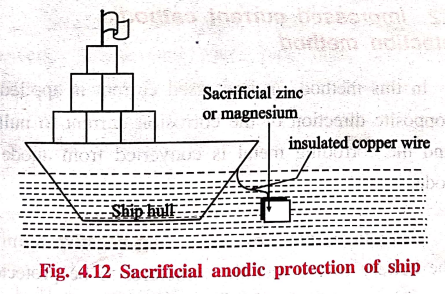
for the protection of ships and boats. Sheets of Mg or Zn are hung around the
hull of the ship (Fig. 4.12). Zn or Mg will act as anode compared to iron (ship
or boat is made of iron), so corrosion concentrates on Zn or Mg. Since they are
sacrificed in the process of saving iron, they are called sacrificial anodes.
(b) Protection of
underground pipelines, cables from soil corrosion (Fig. 4.13(a)).
(c) Insertion of Mg
sheets into the domestic water boilers to prevent the formation of rust (Fig.
4.13(b)).
(d) Calcium metal is
employed to minimize engine corrosion.

2. Impressed current cathodic protection method
In this method, an
impressed current is applied in the opposite direction of the corrosion current
to nullify it, and the corroding metal is converted from anode to cathode.
This can be done by
connecting negative terminal of the battery to the metallic structure, to be
protected, and positive terminal of the battery is connected to an inert anode.
Inert anodes used for this purpose are graphite, platinised titanium. The anode
is buried in a “back fill" (containing mixture of gypsum, coke, breeze,
sodium sulphate). The "back fill" provides good electrical contact to
anode (Fig. 4.14).

Applications of impressed current protection
Structures like tanks,
pipelines, transmission line towers, underground water pipe lines, oil pipe
lines, ships, etc., can be protected by this method.
Table
4.3 Comparison of Galvanic method (Sacrificial anode) and Impressed current
Cathodic method

Sacrificial anodic method
1. No external power
supply is necessary.
2. This method requires
periodical replacement of sacrificial anode.
3. Investment is low.
4. Soil and
microbiological corrosion effects are not taken into account.
5. This is most
economical method especially when short‒term protection is required.
6. This method is
suitable when the current requirement and the resistivity of the electrolytes are
relatively low.
Impressed current method
1. External power
supply must be present.
2. Here anodes are
stable and do not disintegrate.
3. Investment is more.
4. Soil and
microbiological corrosion effects are taken into account.
5. This method is well suited
for large structures and long term operations.
6. But this method can
be practiced even the current requirement and the resistivity of the
electrolytes are high.
Applied Chemistry I: UNIT 4: Corrosion and Control : Tag: Applied Chemistry : - Corrosion Control by Electrochemical Protection or Cathodic Protection
Applied Chemistry I: UNIT 4: Corrosion and Control
Under Subject

Applied Chemistry I
CY25C01 1st Semester | 2025 Regulation | 1st Semester 2025 Regulation
Related Subjects

English Essentials I
EN25C01 1st Semester | 2025 Regulation | 1st Semester 2025 Regulation

தமிழர் மரபு - Heritage of Tamils
UC25H01 1st Semester | 2025 Regulation | 1st Semester 2025 Regulation

Applied Calculus
MA25C01 Maths 1 M1 - 1st Semester | 2025 Regulation | 1st Semester 2025 Regulation

Applied Physics I
PH25C01 1st Semester | 2025 Regulation | 1st Semester 2025 Regulation
Applied Chemistry I
CY25C01 1st Semester | 2025 Regulation | 1st Semester 2025 Regulation

Makerspace
ME25C04 1st Semester | 2025 Regulation | 1st Semester 2025 Regulation

Computer Programming C
CS25C01 1st Semester | 2025 Regulation | 1st Semester 2025 Regulation

Computer Programming Python
CS25C02 1st Semester | 2025 Regulation | 1st Semester 2025 Regulation
Fundamentals of Electrical and Electronics Engineering
EE25C03 1st Semester | 2025 Regulation | 1st Semester 2025 Regulation
Introduction to Mechanical Engineering
ME25C03 1st Semester | 2025 Regulation | 1st Semester 2025 Regulation

Introduction to Civil Engineering
CE25C01 1st Semester Civil Department | 2025 Regulation | 1st Semester 2025 Regulation

Essentials of Computing
CS25C03 1st Semester - AID CSE IT Department | 2025 Regulation | 1st Semester 2025 Regulation

Applied Physics I Laboratory
PH25C01 1st Semester practical Laboratory Manual | 2025 Regulation | 1st Semester Laboratory 2025 Regulation

Applied Chemistry I Laboratory
CY25C01 1st Semester practical Laboratory Manual | 2025 Regulation | 1st Semester Laboratory 2025 Regulation

Computer Programming C Laboratory
CS25C01 1st Semester practical Laboratory Manual | 2025 Regulation | 1st Semester Laboratory 2025 Regulation

Computer Programming Python Laboratory
CS25C02 1st Semester practical Laboratory Manual | 2025 Regulation | 1st Semester Laboratory 2025 Regulation
Engineering Drawing
ME25C01 EEE Mech Dept | 2025 Regulation | 2nd Semester 2025 Regulation

Basic Electronics and Electrical Engineering
EE25C04 1st Semester ECE Dept | 2025 Regulation | 2nd Semester 2025 Regulation