Applied Chemistry I: UNIT 4: Corrosion and Control
Organic Coatings
Paints, Varnishes, Enamels, Lacquers
An organic coating is a thin protective (or) decorative layer made from carbon based materials like polymers and resins. Examples: 1. Paints 2. Varnishes 3. Enamels 4. Lacquers.
ORGANIC COATINGS
An organic coating is a
thin protective (or) decorative layer made from carbon based materials like
polymers and resins. They are applied to surfaces for protection against
corrosion, wear and other environmental factors.
Examples:
1. Paints
2. Varnishes
3. Enamels
4. Lacquers.
1. Paints
Paint is a mechanical
dispersion of one or more finely divided pigments in a medium (thinner +
vehicle). When a paint is applied to a metal surface, the thinner evaporates,
while the vehicle undergoes slow oxidation forming a pigmented film.
Requisites or characteristics of a good paint
(i) It should spread
easily on the metal surface.
(ii) It should have
high hiding (covering) power.
(iii) It should not
crack on drying.
(iv) It should adhere
well to the surface.
(v) The colour of the
paint should be stable.
(vi) It should be a
corrosion and water resistant.
(vii) It should give a glossy film.
Constituents and their functions of a paint
1. Pigments
Pigments are solid and
colour producing substances in the paint.
Functions
(i) It gives colour and
opacity to the film.
(ii) It also provides
strength to the film.
(iii) It protects the
film by reflecting the destructive UV rays.
Examples
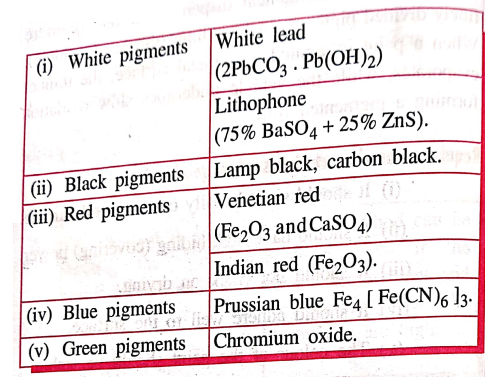
(i) White pigments
(ii) Black pigments
(iii) Red pigments
(iv) Blue pigments
(v) Green pigments
2. Vehicle or drying oil
This is a non‒volatile
portion of a medium. This is the film forming constituent of the paint. These
are high molecular weight fatty acids present in vegetable and animal oils.
Functions
(i) They form a
protective film by the oxidation and polymerisation of the oil.
(ii) They hold the
pigment particles together on in the metal surface.
(iii) They impart water
repellency, toughness and durability to the film.
Examples:
Linseed
oil, dehydrated castor oil.
3. Thinners (or) solvents
This is a volatile
portion of a medium. It easily evaporates after application of the paint.
Functions
(i) It reduces the
viscosity of the paint, so that it can be easily applied on the surface.
(ii) Its dissolves the
oil, pigments, etc. and produces a homogeneous mixture.
(iii) It increases the
elasticity of the film.
(iv) It increases the
penetrating power of the vehicle.
4. Extenders or fillers
These are white (or)
colourless pigments.
Functions
(i) It reduces the cost
of the paint.
(ii) It retards the
settling of the pigment in all paints.
(iii) It modifies the
shades of the pigments.
(iv) It prevents
shrinkage and cracking.
Examples:
Talc,
gypsum, china clay, etc.
5. Driers
These are the substances,
used to accelerate the process of drying.
Functions
(i) They act as oxygen‒carriers
(or) catalysts.
(ii) They provide
oxygen, which is essential for oxidation, polymerisation of drying oil.
Examples:
Metallic
soaps, linoleates and resinates of Co, Mn and Pb.
6. Plasticisers
These are chemicals
added to the paint to provide elasticity to the film and to prevent cracking of
the film.
Examples:
Triphenyl phosphate, tricresyl phosphate, etc.
7. Anti‒skinning agents
These are chemicals
added to the paint to prevent gelling and skinning of the paint.
Example:
Polyhydroxy
phenol.
Pigment Volume Concentration (P.V.C)
It is an important
property of a paint. The following equation is used to calculate the P.V.C.
P.V.C = Volume of
pigment in the paint / [ Volume of pigment in the paint + Volume of non‒volatile
vehicle in the paint ]
Higher the volume of
P.V.C, lower will be the durability, adhesion, consistency of the paint.
Mechanism of drying of drying oils
Drying oils are the
film forming constituents of the paint. These are glyceryl esters of high molecular
weight fatty acids.
Structure of an oil
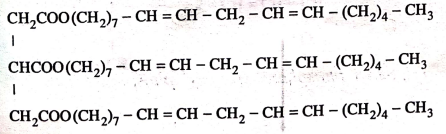
The mechanism involves
oxidation, polymerisation condensation reactions. The oil containing conjugated
double bonds dry very faster than the non‒conjugated oils.
Mechanism for conjugated oil
The various steps
involved in the mechanism of drying of conjugated oil are given below.
Step
‒ 1
The oil absorbs oxygen
and gives di‒radical

Step
2
The di‒radical again
reacts with oxygen and fatty group to give peroxy and poly peroxy radicals

Step
‒ 3
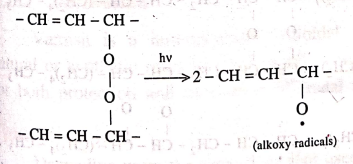
Polyperoxides are
decomposed by heat and light to give alkoxy radicals 
Step
‒ 4
These alkoxy radicals
react with another fatty groups, form ether linkages.

Thus, the various oil
molecules are linked through ether linkages and forms highly cross‒linked macromolecular
film. The structure of macromolecular film is shown below.

Failure of a paint
A paint may fail due to
the following reasons.
1.
Chalking
It is the progressive
powdering of the paint film on the painted surface. This occurs due to improper
dispersion of pigment in vehicle.
2.
Cracking
Cracking of paint film
is due to the unequal expansion or contraction of paint coats.
3.
Erosion
It is very quick
chalking.
4.
Blistering
This is due to improper
surface exposure of paint to strong sunshine
2. Varnishes
Varnish is a
homogeneous colloidal solution of natural or synthetic resin in spirit or oil.
Varnish is used for both protection and decoration of metal surfaces.
Types of varnishes
Depending upon the type
of solvent used, varnishes are classified into two types.
1. Spirit varnish
2. Oil varnish.
1.
Spirit varnish
Spirit varnish is
prepared by dissolving natural or synthetic resins in a volatile solvent
(spirit). This type of varnish dries just by the evaporation of the solvent.
The film formed is
brittle and not strong. It is used for polishing wooden surfaces.
2.
Oil varnish
Oil varnish is prepared
by dissolving natural or synthetic resins in a drying oil and volatile solvent.
This type of varnish dries by the evaporation of the solvent followed by
oxidation and polymerisation of the drying oil.
Oil varnishes dry slowly,
but the film is hard. It is used for interior and exterior works.
Characteristics of a good varnish
(i) It should be soft.
(ii) It should produce
a shining and glossy film on drying
(iii) It should dry
quickly.
(iv) It should not
shrink or crack after drying.
Uses of Varnish
1. It is used to
protect the materials against corrosion.
2. It is a coating
prior to paint coating.
3. It is also used for
improving the appearance of wooden surfaces.
3. Enamels
Enamels are pigmented
varnish, ie., a colloidal dispersion of pigments and varnish. Enamels dry
slowly but form hard, lustrous and glossy film.
Drying occurs in two
ways
(i) Brushing enamels
The drying of enamel
painted surface may occur at normal temperature (sun light) in presence of air.
This type of enamels are known as "brushing enamels."
(ii) Baking enamels
The drying of enamel
painted surface may also occur at elevated temperature either in the presence
or absence of air. This type of enamels are known as "baking
enamels."
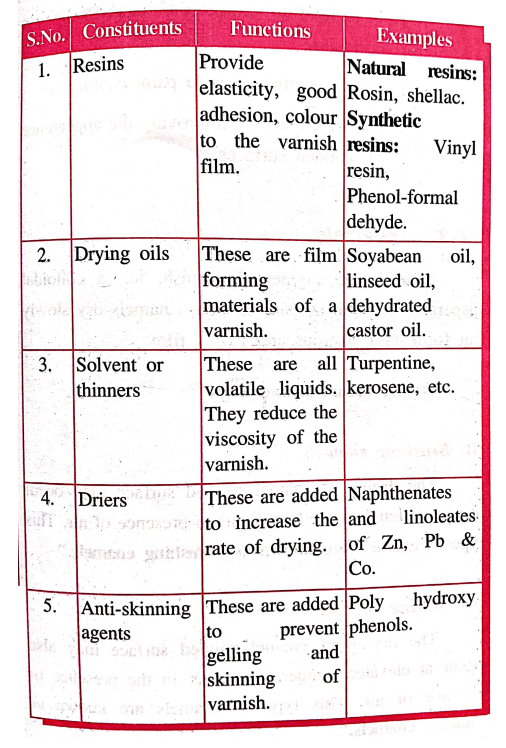
Table
4.5 Constituents of enamels
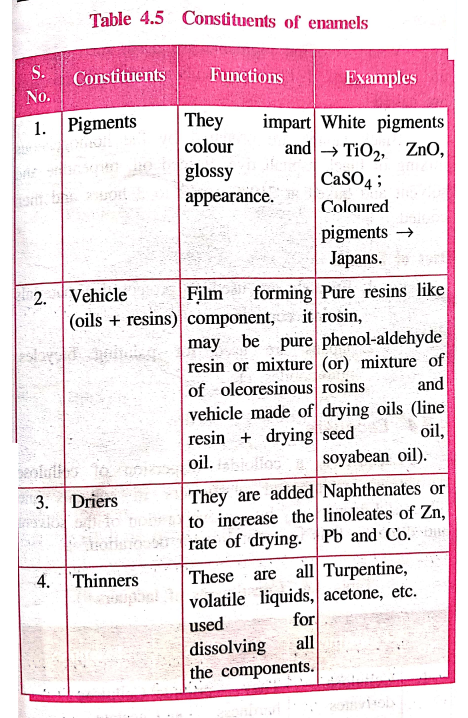
Japans
When coloured pigments
are used, such enamels are called japans. If black pigments are used, the
enamels are called black japans.
Black japans are
prepared by the homogeneous mixing of black asphalt dye, linseed oil,
turpentine and solvent and baked at 210°C for 2 to 3 hours and then cooled.
Uses of Enamels
1. Enamels are used to
protect the materials against corrosion.
2. Japans are used for
painting bicycles, automobiles, etc.,
4. Lacquersb
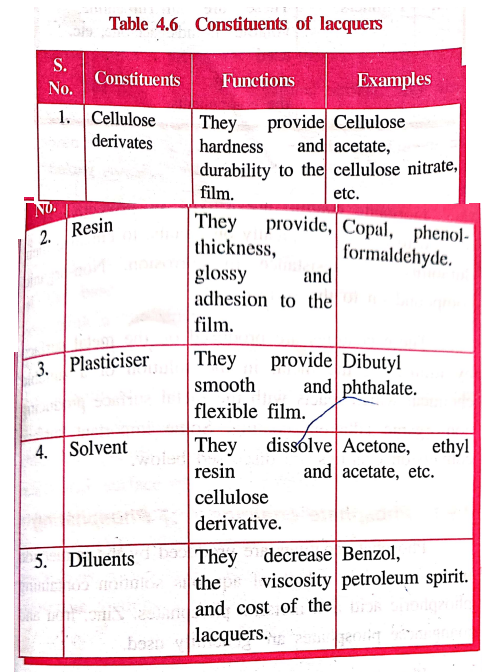
Lacquer is a colloidal
dispersion of cellulose derivatives, resins and plasticisers in solvents and
diluents. Lacquers dry by the evaporation of the solvent and diluents. It is
used for interior decoration.
Table
4.6 Constituents of lacquers
Uses of lacquers
(i) It is used for
interior decoration of wood work and furniture.
(ii) In the preparation
of artificial leather goods.
(iii) It is also used
for giving a finishing coat to automobile bodies.
Applied Chemistry I: UNIT 4: Corrosion and Control : Tag: Applied Chemistry : Paints, Varnishes, Enamels, Lacquers - Organic Coatings
Applied Chemistry I: UNIT 4: Corrosion and Control
Under Subject

Applied Chemistry I
CY25C01 1st Semester | 2025 Regulation | 1st Semester 2025 Regulation
Related Subjects

English Essentials I
EN25C01 1st Semester | 2025 Regulation | 1st Semester 2025 Regulation

தமிழர் மரபு - Heritage of Tamils
UC25H01 1st Semester | 2025 Regulation | 1st Semester 2025 Regulation
Applied Calculus
MA25C01 Maths 1 M1 - 1st Semester | 2025 Regulation | 1st Semester 2025 Regulation
Applied Physics I
PH25C01 1st Semester | 2025 Regulation | 1st Semester 2025 Regulation
Applied Chemistry I
CY25C01 1st Semester | 2025 Regulation | 1st Semester 2025 Regulation

Makerspace
ME25C04 1st Semester | 2025 Regulation | 1st Semester 2025 Regulation
Computer Programming C
CS25C01 1st Semester | 2025 Regulation | 1st Semester 2025 Regulation

Computer Programming Python
CS25C02 1st Semester | 2025 Regulation | 1st Semester 2025 Regulation
Fundamentals of Electrical and Electronics Engineering
EE25C03 1st Semester | 2025 Regulation | 1st Semester 2025 Regulation
Introduction to Mechanical Engineering
ME25C03 1st Semester | 2025 Regulation | 1st Semester 2025 Regulation

Introduction to Civil Engineering
CE25C01 1st Semester Civil Department | 2025 Regulation | 1st Semester 2025 Regulation
Essentials of Computing
CS25C03 1st Semester - AID CSE IT Department | 2025 Regulation | 1st Semester 2025 Regulation

Applied Physics I Laboratory
PH25C01 1st Semester practical Laboratory Manual | 2025 Regulation | 1st Semester Laboratory 2025 Regulation

Applied Chemistry I Laboratory
CY25C01 1st Semester practical Laboratory Manual | 2025 Regulation | 1st Semester Laboratory 2025 Regulation

Computer Programming C Laboratory
CS25C01 1st Semester practical Laboratory Manual | 2025 Regulation | 1st Semester Laboratory 2025 Regulation

Computer Programming Python Laboratory
CS25C02 1st Semester practical Laboratory Manual | 2025 Regulation | 1st Semester Laboratory 2025 Regulation
Engineering Drawing
ME25C01 EEE Mech Dept | 2025 Regulation | 2nd Semester 2025 Regulation

Basic Electronics and Electrical Engineering
EE25C04 1st Semester ECE Dept | 2025 Regulation | 2nd Semester 2025 Regulation