Applied Chemistry I: UNIT 4: Corrosion and Control
Inorganic Coating
Phosphate (or) Phosphating, Chromate, Anodization, Vitreous (or) porcelain enamel coatings
These coatings are produced on the metal surface by immersing the metal in the solution of a suitable chemical which reacts with the metal surface producing non‒organic adherent coating. Some important surface conversion coatings are discussed below. 1. Phosphate coatings (or) Phosphating 2. Chromate coatings 3. Anodization (or) Anodised Coating 4. Vitreous (or) porcelain enamel coatings
INORGANIC COATING
Inorganic coating are a
type of protective layer applied to material, typically on metals, to enhance
their durability and resistance to corrosion. Non‒organic compound on to the
surface.
These coatings are
produced on the metal surface by immersing the metal in the solution of a
suitable chemical which reacts with the metal surface producing non‒organic
adherent coating. Some important surface conversion coatings are discussed
below.
1. Phosphate coatings (or) Phosphating
Phosphate coatings are
produced by the immersion of base metal in a bath of aqueous solution
containing phosphoric acid and metallic phosphates. Zinc, iron and manganese
phosphates are generally used.
Phosphate coatings are
usually applied to iron, zinc, steel, cadmium and aluminium. During the
phosphate coatings, phosphating solution dissolves and reacts with the surface
of the base metal forms an insoluble metal‒phosphate compound. metal‒phosphate
compound forms an adherent deposit over the base metal. It is grey in colour.
Uses
1. It is used as a base
for the paints lacquers, which increase the resistance of the films to
humidity.
2. It also impair
welding strength.
2. Chromate coatings
Chromate coatings are
produced by the immersion of the base metal in a bath of aqueous solution
containing acidic potassium chromate followed by the immersion in a bath of
neutral chromate solution.
Chromate coatings are
usually applied to zinc, cadmium, aluminium and magnesium. During the chromate
coating, chromating solution dissolves and reacts with surface of the base
metal forms an insoluble metal‒chromate compound containing mixture of Cr (III)
and Cr (VI). This metal‒chromate compound is amorphous, non‒porous and more
corrosion resistant than phosphate coatings. It is golden brown or black in
colour.
Uses
It is also used as a
base for paints, lacquers and enamels.
3. Anodization (or) Anodised Coating
Anodization or anodic
oxidation is an electrolytic process in which a thick oxide coating is produced
on the base metal.
Anodized coatings are
generally produced on non‒ferrous metals like Al, Zn, Mg and their alloys by
anodic oxidation process, in which the base metal is made as an anode. It is
carried out by passing a moderate direct electric current through a bath in
which the metal or alloy is suspended from anode. The bath usually contains
sulphuric, chromic, phosphoric, oxalic or boric acid.
Example:
Anodizing
on aluminium.
Anode (base metal):
Aluminium.
Cathode: Innert metal.
Electrolyte: Dil
sulphuric acid, oxalic acid, 3% chromic acid.
Temperature: 40‒50°C.
Current density: 0.2‒2mA/cm2.
Anodized coating on
aluminium is done by making aluminium as an anode in an electrolytic bath
containing sulphuric, chromic or phosphoric acid at moderate temperatures
(about 35‒40°C) and the cathode is a plate of lead or stainless steel. On
passing the current oxidation starts at anode and oxygen combines with the
anodic metal to form the oxide. The oxide film, initially will be very thin and
grows from the metal surface very thin and grows from the metal outwards and increases
in thickness as oxidation continues at aluminium anode. The oxide film is very
porous and soft and this can be sealed by immersing it in boiling water. This
treatment converts porous alumina (Al2O3) into hydrated
alumina (Al2O3 • H2O), which occupies more
volume thereby the pores are sealed.
Advantages of anodization
Anodization provides
(i) an insulating coat
for the electrically conducting base metal (aluminium),
(ii) very good
resistance to corrosion,
(iii) thicker oxide
coating and hence it is more protective,
(iv) the film may be
coloured with organic (or) inorganic dyes,
(v) anodized metal
(like anodised aluminium) is used in automobile engine piston.
Table 4.7 Differences between Electroplating and Anodising
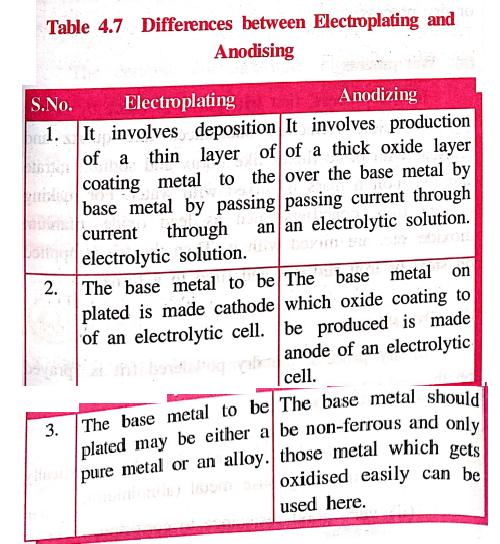
Electroplating
1. It involves
deposition of a thin layer of coating metal to the base metal by passing current
through an electrolytic solution.
2. The base metal to be
plated is made cathode of an electrolytic cell.
3. The base metal to be
plated may be either a pure metal or an alloy.
Anodizing
1. It involves
production of a thick oxide layer over the base metal by passing current
through an electrolytic solution.
2. The base metal on which
oxide coating to be produced is made anode of an electrolytic cell.
3. The base metal
should be non‒ferrous and only those metal which gets oxidized easily can be
used here.
4. Vitreous (or) porcelain enamel coatings
Vitreous or porcelain
enamels are glass like decorative and protective films applied to steel and
iron articles.
1. Vitreous enamel coatings
Vitreous coating can be
done either by wet process or dry process.
(a) Wet process
In wet process, first
frit (glass) is made by fusing together acidic refractory substances like
quartz and feldspar with basic fluxes like borax and and sodium nitrate and the
molten mass is mixed with water. For making opaque film, opacifiers such as
lead oxide, titanium dioxide, etc. are mixed with it. Then the frit is applied
on steel or iron surfaces and fired in a furnace.
(b) Dry processing
In dry process, the dry
powdered frit is sprayed on the surface and fired.
Vitreous enamels
provide glossy and permanent colour to the base metals. These coatings are
corrosion resistant and withstand temperatures upto 1000°C.
Uses
Enamelled articles are
not widely used because of brittleness. They are used as sanitary wares.
Vitreous enamelled steel is used in kitchen utensils, containers and basins.
2. Ceramic coatings
Ceramic coatings are
made of mixing high refractory oxides such as chromium trioxide with silica
materials. The paste of silica material and refractory oxide is sprayed and
then fired.
The ceramic coatings
have high chemical and corrosion resistance.
Uses
Ceramic coatings are
used in nozzles, thermo couple tubes, blades in gas turbines and electrical
insulations.
Applied Chemistry I: UNIT 4: Corrosion and Control : Tag: Applied Chemistry : Phosphate (or) Phosphating, Chromate, Anodization, Vitreous (or) porcelain enamel coatings - Inorganic Coating
Applied Chemistry I: UNIT 4: Corrosion and Control
Under Subject

Applied Chemistry I
CY25C01 1st Semester | 2025 Regulation | 1st Semester 2025 Regulation
Related Subjects

English Essentials I
EN25C01 1st Semester | 2025 Regulation | 1st Semester 2025 Regulation

தமிழர் மரபு - Heritage of Tamils
UC25H01 1st Semester | 2025 Regulation | 1st Semester 2025 Regulation

Applied Calculus
MA25C01 Maths 1 M1 - 1st Semester | 2025 Regulation | 1st Semester 2025 Regulation
Applied Physics I
PH25C01 1st Semester | 2025 Regulation | 1st Semester 2025 Regulation
Applied Chemistry I
CY25C01 1st Semester | 2025 Regulation | 1st Semester 2025 Regulation

Makerspace
ME25C04 1st Semester | 2025 Regulation | 1st Semester 2025 Regulation

Computer Programming C
CS25C01 1st Semester | 2025 Regulation | 1st Semester 2025 Regulation

Computer Programming Python
CS25C02 1st Semester | 2025 Regulation | 1st Semester 2025 Regulation
Fundamentals of Electrical and Electronics Engineering
EE25C03 1st Semester | 2025 Regulation | 1st Semester 2025 Regulation
Introduction to Mechanical Engineering
ME25C03 1st Semester | 2025 Regulation | 1st Semester 2025 Regulation

Introduction to Civil Engineering
CE25C01 1st Semester Civil Department | 2025 Regulation | 1st Semester 2025 Regulation

Essentials of Computing
CS25C03 1st Semester - AID CSE IT Department | 2025 Regulation | 1st Semester 2025 Regulation

Applied Physics I Laboratory
PH25C01 1st Semester practical Laboratory Manual | 2025 Regulation | 1st Semester Laboratory 2025 Regulation

Applied Chemistry I Laboratory
CY25C01 1st Semester practical Laboratory Manual | 2025 Regulation | 1st Semester Laboratory 2025 Regulation

Computer Programming C Laboratory
CS25C01 1st Semester practical Laboratory Manual | 2025 Regulation | 1st Semester Laboratory 2025 Regulation

Computer Programming Python Laboratory
CS25C02 1st Semester practical Laboratory Manual | 2025 Regulation | 1st Semester Laboratory 2025 Regulation
Engineering Drawing
ME25C01 EEE Mech Dept | 2025 Regulation | 2nd Semester 2025 Regulation

Basic Electronics and Electrical Engineering
EE25C04 1st Semester ECE Dept | 2025 Regulation | 2nd Semester 2025 Regulation