Applied Chemistry I: UNIT 4: Corrosion and Control
Dry (or) Chemical Corrosion
Dry corrosion is due to the attack of metal surfaces by the atmospheric gases such as oxygen, hydrogen sulphide, sulphur dioxide, nitrogen, etc.
DRY OR CHEMICAL CORROSION
Dry corrosion is due to
the attack of metal surfaces by the atmospheric gases such as oxygen, hydrogen
sulphide, sulphur dioxide, nitrogen, etc.
There are 3 main types
of dry corrosion.
1. Oxidation corrosion
(or) corrosion by oxygen.
2. Corrosion by
hydrogen.
3. Liquid‒metal
corrosion.
1. Oxidation corrosion (or) corrosion by oxygen
Oxidation corrosion is
brought about by the direct attack of oxygen at low or high temperatures on
metal surface in the absence of moisture. Alkali metals (Li, Na, K, etc.) and
alkaline‒earth metals (Mg, Ca, Sn, etc.) are rapidly oxidised at low
temperature. At high temperature, almost all metals (except, Ag, Au and Pt) are
oxidised.
Mechanism of dry corrosion
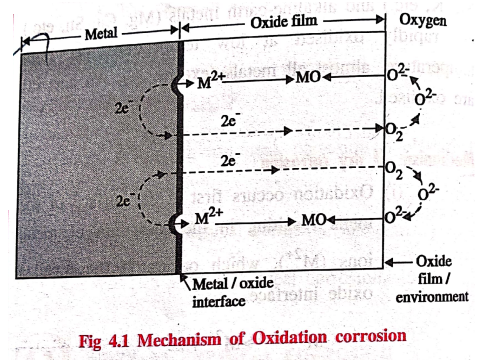
(i) Oxidation occurs
first at the surface of the metal resulting in the formation of metal ions (M2+),
which occurs at the metal / oxide interface.
M → M2+ + 2e‒
(ii) Oxygen changes to
ionic form (O2‒) due to the transfer of electron from metal, which occurs
at the oxides film / environment interface
½O2 + 2e‒ → O2‒
(iii) Oxide ions reacts
with the metal ion to form the metal‒oxide film.
M + ½O2 → M2+
+ O2‒ = MO (Metal‒oxide film)
Once the metal surface
is converted to a monolayer of metal‒oxide, for further corrosion (oxidation)
to occur, the metal ion diffuses outward through the metal‒oxide barrier. Thus
the growth of oxide film commences perpendicular to the metal surface (Fig.
4.1).
Nature of oxide film
The nature of oxide
film formed on the metal surface plays an important role in oxidation
corrosion.
1.
Stable oxide layer
A stable oxide layer is
a fine‒grained in structure, and gets adsorbed tightly to the metal surface.
Such a layer is impervious in nature and stops further oxygen attack through
diffusion. Such a film behaves as a protective coating and no further corrosion
can develop.
Example: Oxides of Al,
Sn, Pb, Cu, etc., are stable oxide layers.
2.
Unstable oxide layer
Unstable oxide layer is
mainly produced on the surface of noble metals, which decomposes back into the
metal and oxygen.
Metal oxide ↔ Metal +
Oxygen
Example: Oxides of Pt,
Ag, etc., are unstable oxide layers.
3.
Volatile oxide layer
The oxide layer
volatilizes as soon as it is formed, leaving the metal surface for further
corrosion.
Example: Molybdenum
oxide (MoO3) is volatile.
4.
Protective (or) Non‒Protective oxide film (Pilling‒ Bedworth rule)
(i) According to
Pilling‒Bedworth rule, if the volume of oxide layer formed is less than the
volume of metal, the oxide layer is porous and non‒protective.
Example: The volume of
oxides of alkali and alkaline earth metals such as Na, Mg, Ca, etc., is less
than the volume of metal consumed, the oxide layer formed is porous and non‒protective.
(ii) On the other hand,
if the volume of oxide layer formed is greater than the volume of metal, the
oxide layer is non‒porous and protective.
Example: The volume of
oxides of heavy metals such as Pb, Sn, etc., is greater than the volume of
metal, the oxide layer formed is non‒porous and protective.
Pilling‒Bedworth ratios
The ratio of the volume
of metal oxide formed to the volume of metal consumed is called. “Pilling‒Bedworth
ratio”.
PB ratio = Volume of
metal oxide / Volume of metal consumed
If the PB ratio is slightly
greater than 1, the metal oxide layer will be protective and non porous.
2. Corrosion by hydrogen
1. Hydrogen embrittlement (at ordinary temperature)
When metals contact
metals contact to H2S at ordinary temperature causes evolution of
atomic hydrogen.
Fe + H2S → FeS + 2H
This atomic hydrogen
diffuses readily into the metal and collects in the voids, where it recombines
to form molecular hydrogen.
H+H → H2↑
Collection of these
hydrogen gases in the voids develop very high pressure, which causes cracks and
blisters on metal.
Thus, the process of
formation of cracks and blisters on the metal surface, due to high pressure of
hydrogen gas, is called hydrogen embrittlement
2. Decarburisation (at higher temperature)
At higher temperature
atomic hydrogen is formed by the thermal dissociation of molecular hydrogen.
H2 --- Heat→ 2H
when steel is exposed
to this environment, the atomic hydrogen readily combines with carbon of steel
and produces methane gas.
C + 4H →
CH4↑
Collection of these
gases in the voids develop very high pressure, which causes cracking. Thus, the
process of decrease in carbon content in steel is termed as
"decarburisation"
of steel.
3. Liquid‒metal corrosion
This is due to the
chemical action of flowing liquid metal at high temperature. The corrosion
reaction involves
(i) either dissolution
of a solid metal by a liquid metal. (or)
(ii) liquid metal may
penetrate into the solid metal.
Applied Chemistry I: UNIT 4: Corrosion and Control : Tag: Applied Chemistry : - Dry (or) Chemical Corrosion
Applied Chemistry I: UNIT 4: Corrosion and Control
Under Subject

Applied Chemistry I
CY25C01 1st Semester | 2025 Regulation | 1st Semester 2025 Regulation
Related Subjects

English Essentials I
EN25C01 1st Semester | 2025 Regulation | 1st Semester 2025 Regulation

தமிழர் மரபு - Heritage of Tamils
UC25H01 1st Semester | 2025 Regulation | 1st Semester 2025 Regulation

Applied Calculus
MA25C01 Maths 1 M1 - 1st Semester | 2025 Regulation | 1st Semester 2025 Regulation

Applied Physics I
PH25C01 1st Semester | 2025 Regulation | 1st Semester 2025 Regulation
Applied Chemistry I
CY25C01 1st Semester | 2025 Regulation | 1st Semester 2025 Regulation

Makerspace
ME25C04 1st Semester | 2025 Regulation | 1st Semester 2025 Regulation

Computer Programming C
CS25C01 1st Semester | 2025 Regulation | 1st Semester 2025 Regulation

Computer Programming Python
CS25C02 1st Semester | 2025 Regulation | 1st Semester 2025 Regulation

Fundamentals of Electrical and Electronics Engineering
EE25C03 1st Semester | 2025 Regulation | 1st Semester 2025 Regulation
Introduction to Mechanical Engineering
ME25C03 1st Semester | 2025 Regulation | 1st Semester 2025 Regulation

Introduction to Civil Engineering
CE25C01 1st Semester Civil Department | 2025 Regulation | 1st Semester 2025 Regulation

Essentials of Computing
CS25C03 1st Semester - AID CSE IT Department | 2025 Regulation | 1st Semester 2025 Regulation

Applied Physics I Laboratory
PH25C01 1st Semester practical Laboratory Manual | 2025 Regulation | 1st Semester Laboratory 2025 Regulation

Applied Chemistry I Laboratory
CY25C01 1st Semester practical Laboratory Manual | 2025 Regulation | 1st Semester Laboratory 2025 Regulation

Computer Programming C Laboratory
CS25C01 1st Semester practical Laboratory Manual | 2025 Regulation | 1st Semester Laboratory 2025 Regulation

Computer Programming Python Laboratory
CS25C02 1st Semester practical Laboratory Manual | 2025 Regulation | 1st Semester Laboratory 2025 Regulation
Engineering Drawing
ME25C01 EEE Mech Dept | 2025 Regulation | 2nd Semester 2025 Regulation

Basic Electronics and Electrical Engineering
EE25C04 1st Semester ECE Dept | 2025 Regulation | 2nd Semester 2025 Regulation