Applied Physics I: Chapter 4: Oscillations and Waves
Differential equation for a simple harmonic Motion
The differential equation for a simple harmonic motion shall be obtained from the expressions of displacement and velocity, as follows.
DIFFERENTIAL
EQUATION FOR A SIMPLE HARMONIC MOTION
The
differential equation for a simple harmonic motion shall be obtained from the
expressions of displacement and velocity, as follows.
(i) Displacement:
The displacement of vibrating particle at any instant is defined as the
distance moved by the particle from its mean position of rest.
Let
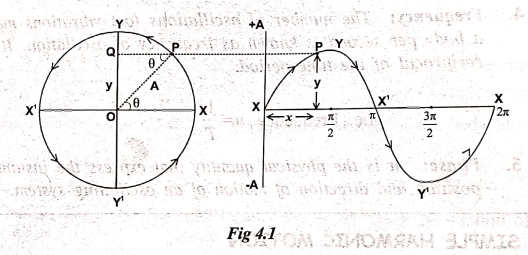
us consider a particle 'P' moving in a circular path of radius ‘A' with uniform
velocity 'v' and angular velocity ω, with respect to the centre of the circle
of reference 'O' as shown in Fig. 4.1.
When
the particle 'P' moves around the circle, then the foot of the perpendicular
“Q' vibrates along the diameter YY'. Further, if the motion of the particle 'P'
is uniform, then the motion of 'Q' is also periodic. i.e., the particle will
take the same time to vibrate between the points Y and Y'.
Therefore,
if the particle 'P' completes one revolution, then the foot of the
perpendicular 'Q' will complete one vertical oscillation.
Thus,
the distance OQ is termed as displacement of the particle and is denoted by the
letter 'y'.
If
the particle moves from 'X' to 'P' in 't' seconds, then the angle between POX
is given by
∟POX
= ∟QPO = θ = ωt
From
ΔQPO, we can write
sin
θ (or) sin ωt = OQ / OP ……….(1)
Since
OQ = y and OP = A, we can write equation (1) as
sin
ωt = y / A
(or)
y
= A sin ωt ………….(2)
Equation
(2) represents the equation for the displacement of the vibrating particle at
any instant 't'.
(ii) Velocity:
Velocity of the vibrating particle is defined as the rate of change of
displacement.
Velocity
(v) = dy/dt ………….(3)
Substituting
eqn (2) in eqn (3) we get
v = d(A sin ωt) / dt
v = A ω cosωt
Equation
(4) represent the velocity of the vibrating particle at any instant 't'.
(iii) Acceleration
:
Acceleration of the vibrating particle is defined as the rate of change of
velocity.
Acceleration
= dv/dt ………….(5)
Substituting
eqn (4) is eqn (5) we get
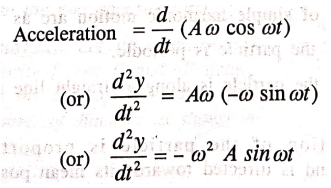
Since
Asin ωt = y, we can write the above equation as
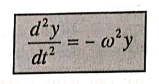
d2y / dt2 = ‒ω2y ………..(6)
Equation
(6) represents the acceleration of the vibrating particle at any instant 't'
(or) the so called differential equation
for a simple harmonic motion.
This
type of motion, where the acceleration is directed towards a fixed point (the
mean position of rest) and is proportional to the displacement of the vibrating
particle is called Simple Harmonic
Motion (SHM).
Graphical
Representation of SHM
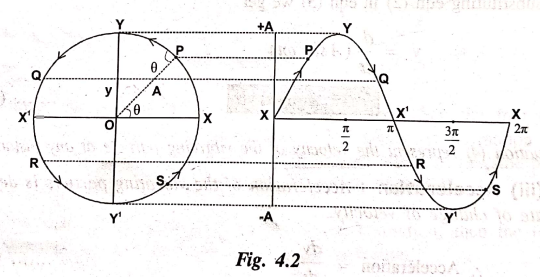
Fig.
4.2 shows the change in displacement of the vibrating particle at various positions
(say,P,Q,R,S) and angles in one complete vibration, which is also called as the
displacement curve. From this curve
we can see that the motion of the particle is a simple harmonic motion (SHM) and the curve is termed as the
graphical representation of SHM.
Characteristics of SHM
The
characteristics of simple harmonic motion are as follows.
(i)
The motion of the particle is periodic.
(ii)
The motion of the particle is along a straight line about its mean position.
(iii)
The acceleration of the particle is proportional to the displacement and is
directed towards its mean position.
Applied Physics I: Chapter 4: Oscillations and Waves : Tag: Applied Physics : - Differential equation for a simple harmonic Motion
Applied Physics I: Chapter 4: Oscillations and Waves
Under Subject
Applied Physics I
PH25C01 1st Semester | 2025 Regulation | 1st Semester 2025 Regulation
Related Subjects

English Essentials I
EN25C01 1st Semester | 2025 Regulation | 1st Semester 2025 Regulation

தமிழர் மரபு - Heritage of Tamils
UC25H01 1st Semester | 2025 Regulation | 1st Semester 2025 Regulation
Applied Calculus
MA25C01 Maths 1 M1 - 1st Semester | 2025 Regulation | 1st Semester 2025 Regulation
Applied Physics I
PH25C01 1st Semester | 2025 Regulation | 1st Semester 2025 Regulation

Applied Chemistry I
CY25C01 1st Semester | 2025 Regulation | 1st Semester 2025 Regulation

Makerspace
ME25C04 1st Semester | 2025 Regulation | 1st Semester 2025 Regulation
Computer Programming C
CS25C01 1st Semester | 2025 Regulation | 1st Semester 2025 Regulation
Computer Programming Python
CS25C02 1st Semester | 2025 Regulation | 1st Semester 2025 Regulation

Fundamentals of Electrical and Electronics Engineering
EE25C03 1st Semester | 2025 Regulation | 1st Semester 2025 Regulation
Introduction to Mechanical Engineering
ME25C03 1st Semester | 2025 Regulation | 1st Semester 2025 Regulation

Introduction to Civil Engineering
CE25C01 1st Semester Civil Department | 2025 Regulation | 1st Semester 2025 Regulation
Essentials of Computing
CS25C03 1st Semester - AID CSE IT Department | 2025 Regulation | 1st Semester 2025 Regulation

Applied Physics I Laboratory
PH25C01 1st Semester practical Laboratory Manual | 2025 Regulation | 1st Semester Laboratory 2025 Regulation

Applied Chemistry I Laboratory
CY25C01 1st Semester practical Laboratory Manual | 2025 Regulation | 1st Semester Laboratory 2025 Regulation

Computer Programming C Laboratory
CS25C01 1st Semester practical Laboratory Manual | 2025 Regulation | 1st Semester Laboratory 2025 Regulation

Computer Programming Python Laboratory
CS25C02 1st Semester practical Laboratory Manual | 2025 Regulation | 1st Semester Laboratory 2025 Regulation
Engineering Drawing
ME25C01 EEE Mech Dept | 2025 Regulation | 2nd Semester 2025 Regulation

Basic Electronics and Electrical Engineering
EE25C04 1st Semester ECE Dept | 2025 Regulation | 2nd Semester 2025 Regulation