Applied Physics I: Chapter 4: Oscillations and Waves
Torsional pendulum
Principle, Description, Working
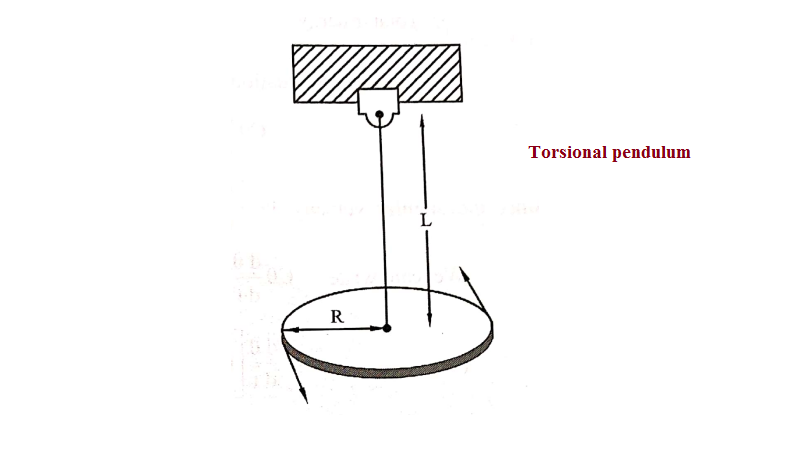
When a disc (torsion pendulum) is rotated in a horizontal plane, the disc executes simple harmonic oscillation due to the restoring couple produced in the wire.
TORSIONAL
PENDULUM
When
a body is fixed at one end and twisted about its axis by means of a torque at
the other end, then the body is said to be under torsion. The torsion involves
shearing strain and hence the modulus involved is the RIGIDITY MODULUS.
Torsion
Pendulum
Principle:
When a disc (torsion pendulum) is rotated in a horizontal plane, the disc
executes simple harmonic oscillation due to the restoring couple produced in
the wire.
Description:
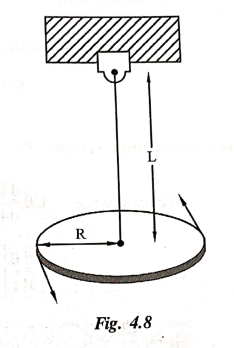
A torsion pendulum consists of a wire with one end fixed to a split chuck and
the other end fixed to the centre of the circular disc of radius R as shown in
Fig. 4.8.
Let
‘L’ be the distance between the chuck end to the disc and 'r' be the radius of
the suspended wire.
Working:
The circular disc is rotated in horizontal plane so that the wire is twisted
through an angle 'θ'. The various elements of the wire will undergo shearing strain
and a restoring couple is produced. Now if the disc is released, the disc will
produce torsion oscillations.
The
couple acting on the disc produces an angular acceleration in it, which is
proportional to the angular displacement and is always directed towards its
mean position.
Therefore
from the law of conservation of energy the total energy of the system is
conserved.
Total
energy of the torsion pendulum = Potential Energy (P.E) + Kinetic Energy (K.E)
…………….(1)
The
potential energy confined to the wire is equal to the work done in twisting the
disc, thereby creating a restoring couple (C).
Total
energy. = constant.
r
= wire redbus
R
= circular disc grediaus
∴ Restoring couple (P.E)
through an angle θ = 0∫θMoment of couple × dθ
P.E.
= 0∫θ Cθ.dθ
P.E.
= Cθ2 / 2 ………..(2)
Let
'ω' the angular velocity with which the disc oscillates, due to the resorting
couple, then
The
kinetic energy confined to the rotating disc (Deflecting couple) = ½ Iω2
(i.e)
K.E. = ½ Iω2 ……………………..(3)
Here
I is the moment of inertia of the circular disc
Total
Energy T = Cθ2/2 + Iω2/2
= Constant ...........(4)
Differentiating
equation (4) with respect to time 't'
we get,
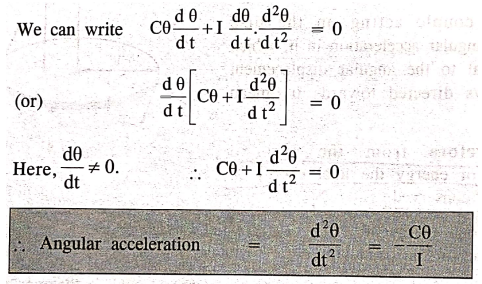
Cθ.dθ/dt + Iω.dω/dt = 0

Since
the angular velocity ω=dθ/dt and the Angular Acceleration dω/dt = d2θ/dt2
Angular
acceleration = d2θ/dt2 = Cθ/I ………..(5)
The
negative sign indicates that the couple tends to decrease the twist on the
wire.
Period of Oscillation
We
know, the time period of oscillation T = 2π√[ Displacement / Acceleration ]
Substituting
from Eqn.(5), we have T = 2π√[ θ / Cθ/I ]
(or)
Time period of torsion oscillation T = 2π√[I/C] ……….(6)
(f=1/T)
∴ Frequency of
oscillation f = 1/2π . √[C/I]
Rigidity modulus of the
wire
If
'r' is the radius of the wire and ‘L’
is the length of the wire suspended, then we know
The
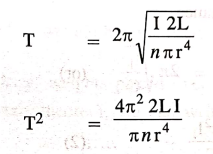
torque per unit twist C = nπr4 / 2L …………..(7)
Substituting
eqn.(7) in eqn.(6) we get,
(or)
Rigidity
modulus of the wire (n) = 8πIL / T2r4 Nm‒2

Thus
torsion pendulum is used to find the rigidity modulus for various materials.
Applied Physics I: Chapter 4: Oscillations and Waves : Tag: Applied Physics : Principle, Description, Working - Torsional pendulum
Applied Physics I: Chapter 4: Oscillations and Waves
Under Subject
Applied Physics I
PH25C01 1st Semester | 2025 Regulation | 1st Semester 2025 Regulation
Related Subjects

English Essentials I
EN25C01 1st Semester | 2025 Regulation | 1st Semester 2025 Regulation

தமிழர் மரபு - Heritage of Tamils
UC25H01 1st Semester | 2025 Regulation | 1st Semester 2025 Regulation
Applied Calculus
MA25C01 Maths 1 M1 - 1st Semester | 2025 Regulation | 1st Semester 2025 Regulation
Applied Physics I
PH25C01 1st Semester | 2025 Regulation | 1st Semester 2025 Regulation

Applied Chemistry I
CY25C01 1st Semester | 2025 Regulation | 1st Semester 2025 Regulation

Makerspace
ME25C04 1st Semester | 2025 Regulation | 1st Semester 2025 Regulation
Computer Programming C
CS25C01 1st Semester | 2025 Regulation | 1st Semester 2025 Regulation

Computer Programming Python
CS25C02 1st Semester | 2025 Regulation | 1st Semester 2025 Regulation
Fundamentals of Electrical and Electronics Engineering
EE25C03 1st Semester | 2025 Regulation | 1st Semester 2025 Regulation

Introduction to Mechanical Engineering
ME25C03 1st Semester | 2025 Regulation | 1st Semester 2025 Regulation

Introduction to Civil Engineering
CE25C01 1st Semester Civil Department | 2025 Regulation | 1st Semester 2025 Regulation
Essentials of Computing
CS25C03 1st Semester - AID CSE IT Department | 2025 Regulation | 1st Semester 2025 Regulation

Applied Physics I Laboratory
PH25C01 1st Semester practical Laboratory Manual | 2025 Regulation | 1st Semester Laboratory 2025 Regulation

Applied Chemistry I Laboratory
CY25C01 1st Semester practical Laboratory Manual | 2025 Regulation | 1st Semester Laboratory 2025 Regulation

Computer Programming C Laboratory
CS25C01 1st Semester practical Laboratory Manual | 2025 Regulation | 1st Semester Laboratory 2025 Regulation

Computer Programming Python Laboratory
CS25C02 1st Semester practical Laboratory Manual | 2025 Regulation | 1st Semester Laboratory 2025 Regulation
Engineering Drawing
ME25C01 EEE Mech Dept | 2025 Regulation | 2nd Semester 2025 Regulation

Basic Electronics and Electrical Engineering
EE25C04 1st Semester ECE Dept | 2025 Regulation | 2nd Semester 2025 Regulation