Applied Calculus: UNIT I: Differential Calculus
How derivative affects the shape of a curve
Differential Calculus
Explanation, Formula, Equation, Example and Solved Problems - How derivative affects the shape of a curve - Differential Calculus
HOW DERIVATIVES AFFECT THE SHAPE OF
A CURVE
We know that f '(x) represents the slope of the curve y = f(x)
at the point (x, f(x)). It tells us
the direction in which the curve proceeds at each point. It is reasonable to
expect that information about f '(x) will provide us with information
about f(x). The derivative of ƒ can
tell us where a function is increasing or decreasing.

Notice that:
• Between A and B and
between C and D, the tangent lines have positive slope and so f '(x)
> 0.
• Between B and C the
tangent lines have negative slope and so f
'(x) < 0
• Thus it appears that f increases when f '(x) is positive and
decreases when f '(x) is negative.
Increasing/Decreasing test.
• If f '(x) > 0 on an interval I, then f is increasing function on that
interval I.
• If f '(x) < 0 on an interval I, then f is decreasing function on that
interval I.
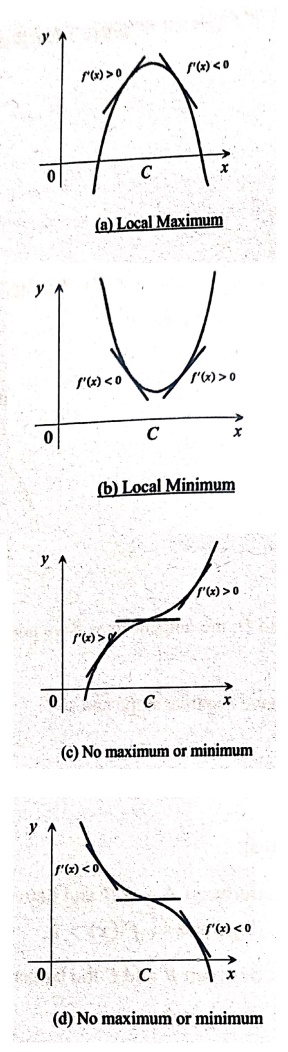
First derivative test
Suppose that c is a
critical point of a function.
• If f ' changes from +ive to ‒ive at c, then
ƒ has the local maximum at c.
• If f ' changes from ‒ive to +ive at c, then
ƒ has the local minimum at c.
• If f ' does not change sign at c, then f has no local maximum or minimum at c.
The first derivate test
is a consequence of the increasing/decreasing test
Definition
If the graph of f, lies above all of its tangents on an
interval I, then the curve is called concave
upward on I
If the graph of f, lies below all of its tangents on an
interval I, then the curve is called concave
downward on I
If a function ƒ has a
local extremum at a point c, then c must be a critical point of f. However, a function is not guaranteed
to have a local extremum at a critical point. For example, f(x) = x3 has a critical point at x=0 since f '(x)
= 3x2 is zero at x = 0, but ƒ does not have a local
extremum at x=0. Using the results
from the previous section, we are now able to determine whether a critical
point of a function actually corresponds to a local extreme value. In this
section, we also see how the second derivative provides information about the
shape of a graph by describing whether the graph of a function curves upward or
curves downward.
Concavity test
• If ƒ"(x) > 0
for all in I, then the graph of ƒ is concave upward on I [f '(x) is increaing]
• If f"(x) < 0 for all in I, then the graph of ƒ is concave downward on
I [f '(x) is decreaing]
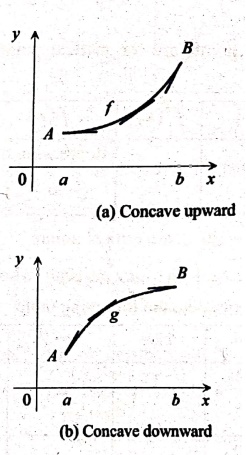
The below figure shows
the graphs of two increasing functions on (a,
b). Both graphs join point A to point
B but they look different because they bend in different directions. How can we
distinguish between these two types of behavior?. In the first figure the curve
lies above the tangents and is called concave
upward on (a, b). In the second figure the curve lies below the tangents
and is called concave downward on (a,
b).
Definition
A point P on a curve y = f(x)
is called an inflection point if f is continuous and the curve changes
from concave upward to concave downward or from concave downward to concave
upward at P.
If f "(c) = 0, then f(x)
has a point of inflection at x = c. The point of inflection is (c, f(c)).
Note:
• If a curve has a
tangent at a point of inflection, then the curve crosses its tangent there.
• There is a point of
inflection at any point where the second derivative changes sign
Second derivative test
Suppose f " be a continuous near c.
• If f '(c) = 0 and f"(c) < 0, then f(x)
has local maximum at x = c
• If f '(c) = 0 and f"(c) > 0, then f(x)
has local minimum at x = c
Example
138. Find the function f(x)=3x4‒4x3‒12x2
+5 is increasing and where it is decreasing.
Solution:
ƒ'(x) = 12x3 – 12x2 – 24x = 12x(x2
− x − 2) = 12x (x − 2)(x + 1)
To find the critical
point:
f '(x) = 0
12x (x‒2)(x + 1) = 0
x = ‒1,0,2 are critical
points
We divide the real line
into intervals whose end points are the critical points x = ‒1,0,2 and complete the following table.

The graph of ƒ shown in
figure confirms the information in the chart

Example
139. Find the local maximum and minimum values of the function g(x) = x+2sinx, 0 ≤ x ≤ 2π
Solution:
To find the critical numbers of g, we
differentiate
g'(x) = 1 + 2cosx
So g'(x) = 0 where cosx = ‒ 1/2
The solutions of this
equation are 2π/3 and 4π/3.
We divide the real line
into intervals whose end points are the critical points x = 2π/3,4π/3 and complete the following table.
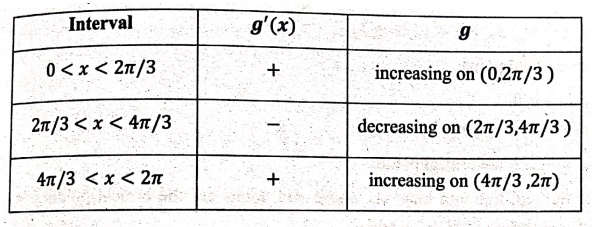
Because g'(x)
changes from positive to negative at 2π/3, the First Derivative Test tells us
that there is a local maximum at 2π/3 and the local maximum value is

Likewise, g'(x) changes from negative to positive at
4π/3 and so

is a local minimum
value. The graph of g in figure
supports our conclusion.

Example
140. Find where the function f(x) =
2x3 +3x2‒36x
a)
the intervals on which increasing/decreasing
b)
local maximum and minimum values of f
c)
intervals of concavity and inflection point.
Solution:
(a) The given function
f(x)=
2x3 + 3x2‒36x and
f '(x) = 6x2+6x‒36
=6(x2+x‒6) = 6(x+3)(x − 2)
f "(x)
= 12x+6 =6(2x+1)
To find the critical
point:
f '(x)
= 0
6(x+3)(x‒2)= 0
x = ‒3,2 are critical
points
We divide the real line
into intervals whose end points are the critical points x = ‒3,2 and complete the following table.
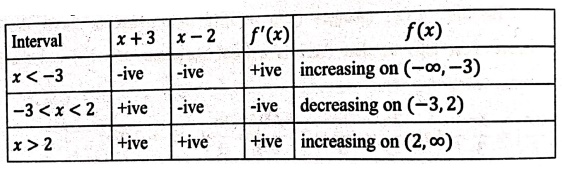
(b) Now we apply the
first derivative test to find the local extreme values f(x) changes from increasing to decreasing at x = ‒3. Thus the
function has a local maximum at x = ‒3
and the local maximum value is
ƒ(−3) = 2(‒3)3 + 3(−3)2 ‒
36(−3) = 81
f(x)
changes from decreasing to increasing at
x = 2. Thus the function has a local minimum at x = 2 and the local minimum value is
ƒ(2) = 2(2)3 + 3(2)2 ‒
36(2) = ‒44
(c) To find point of
inflection:
f '(x)
= 0
6(2x + 1) = 0
2x+1=0
⇒
2x = ‒1
x =
‒ 1/2
We divide the real line
into intervals whose end points are the critical point x = ‒ ½ and complete the following table.

Since the curve changes
from concave downward to concave upward at
x = ‒ ½ the points of inflection is ( ‒1/2 , f(‒1) )
ƒ(−1/2) = 2 ( − 1/2 )2
+ 3 (− 1/2 )2 ‒ 36 (− 1/2) = 37/2
Hence the point of
inflection is (‒1/2 , 37/2).
Example
141. f(x) = e2x + e‒x
a)
Find the intervals on which increasing/decreasing
b)
Local maximum and minimum values of ƒ
c)
intervals of concavity and inflection point
Solution:
(a) The given function
is
f(x)
= e2x+e‒x and
ƒ'(x) = 2e2x
‒ e‒x
ƒ"(x) = 4e2x
+ e‒x
To find the critical
point:
f '(x) = 0
2e2x ‒ e‒x
= 0
2e2x = e‒x
2 = e‒x / e2x
⇒
2
= e‒3x
log2 = loge‒3x = ‒3x
‒3x= log 2
x =
‒1/3 log2
We divide the real line
into intervals whose end points are the critical point x = ‒1/3 log 2 and complete the following table.
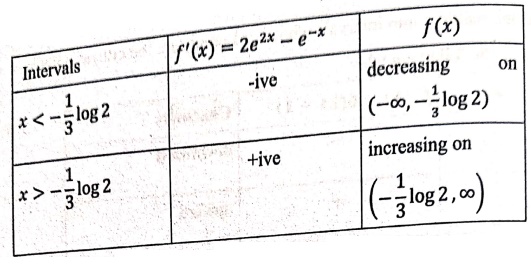
(b) Now we apply the first derivative test to find the local extreme values f(x) changes from decreasing to increasing at x = ‒ 1/3 log 2. Thus the function has a local minimum at x= ‒ 1/3 log 2 and the local minimum value is
f(‒1/3 log 2) = e‒2/3log
2 + e1/3log 2

= elog 2 pw(‒2/3)
+ elog 2 pw(1/3)
= 2‒2/3+ 21/3
= 1.889
(c) To find point of
inflection:
f "(x) = 0
f "(x) = 4e2x + e‒x
Since 4e2x
> 0 and e‒x > 0 for all values of x in R, f ''(x) > 0.Hence f is concave upward on (‒∞, ∞). There is no point of an
inflection.
Example
142. f(x) = cos2x ‒ 2sinx
a)
Find the intervals on which increasing/decreasing
b)
Local maximum and minimum values of f
c)
intervals of concavity and inflection point
Solution:
a) The given function is
f(x)
= cos2x ‒ 2 sin x
and
f '(x) = 2 cos x(‒ sin x) ‒ 2 cos x
= ‒2 cosx sinx
‒ 2 cosx
=‒2 cosx (1 + sinx)
To find the critical
point:
f '(x) = 0
‒2 cosx(1
+ sin x) = 0
cos x = 0 and 1 + sin x = 0
cos x = 0
⇒
x
= π/2, 3π/2
1 + sin x = 0
sin x = ‒1
⇒
x=
3π / 2
Therefore the critical
points are π/2, 3π/2
Each of this critical
points lies in the interval [0, 2π].
We divide the real line
into intervals whose end points are the critical points x = π/2, 3π/2 and complete the following table.

(b) Now we apply the
first derivative test to find the local extreme values f(x) changes from decreasing to increasing at x = π/2. Thus the function has a local minimum at x= π/2 and the
local minimum value is
f(π/2)
= cos2(π/2) ‒ 2sin(π/2)
= 0‒2(1) = ‒2
f(x)
changes from increasing to decreasing at
x = 3π/2. Thus the function has a local maximum at x = 3π/2 and the local maximum value is
f(3π/2)
= cos2(3π/2) ‒ 2 sin(3π/2)
= 0‒2(‒1) = ‒2
c) To find point of
inflection
f
''(x) = −2 cosx (cos x) + (sin x + 1) 2sinx
= ‒2 cos2x + 2 sin2x + 2 sinx
= 2(‒cos2x +
sin2x + sinx)
= 2(‒(1 − sin2x) + sin2x + sinx)
= 2(‒1 + sin2x + sin2x + sinx)
= 2(2 sin2x + sinx ‒ 1)
= 2(2sinx – 1)(sinx +1)
ƒ"(x) = 0
2(2sinx – 1)(sinx+1)=0
2sinx ‒ 1 = 0 and sinx + 1=0
2sinx – 1 = 0
2sinx – 1 = 0
2sinx = 1
sin x = ½
x = π/6,
π ‒ π/6
x
=
π/6, [6π ‒ π]/6
x
=
π/6, 5π/6
Also sinx + 1 = 0
sin x = ‒1
x = 3π/2
x = π/6, 5π/6, 3π/2
We divide the real line
into intervals whose end points are the critical points x = π/6, 5π/6, 3π/2 and complete the following table.
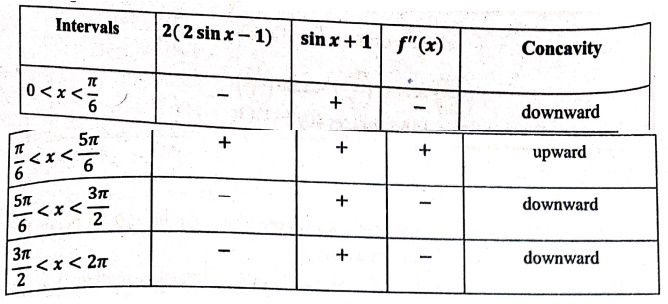
Since the curve changes
from concave downward to concave upward at
x = π/6 and the curve changes from concave upward to concave downward at x = 5π/6
Thus, the points of
inflection are (π/6, ,f(π/6)) and (5π/6,
,f(5π/6)).
Since,
f(π/6)
= cos2(π/6) ‒ 2sin(π/6)
= (√3/2)2 ‒
2(1/2)
= 3/4 ‒ 1
= ‒ 1/4
f(5π/6)
= cos2(5π/6) ‒ 2sin(5π/6)
= (√3/2)2 ‒
2(1/2)
= 3/4 ‒ 1
= ‒ 1/4
Hence, the points of
inflection are (π/6,‒1/4) and (5π/6, ‒1/4)
Example
143. A particle is moving along a horizontal coordinate line (positive to the
right) with position function s(t) = 2t3 ‒ 14t2 + 22t ‒ 5,
t≥0, Find the velocity and acceleration, and describe the motion of the
particle.
Solution:
The displacement is
s(t) = 2t3‒14t2
+ 22t ‒ 5
When the function s(t)
is increasing, the particle is moving to the right; when s(t) is decreasing,
the particle is moving to the left.
To find the critical
points of s, we differentiate
The velocity is
v(t)
= s'(t) = 6t2 ‒ 28t + 22
= 2(3t2 ‒
14t + 11) = 2(t − 1)(3t ‒ 11)
So s'(t) = 0
2(t ‒ 1)(3t ‒ 11) = 0
t = 1 or t = 11/3.
We divide the real line
into intervals whose end points are the critical points x =
1,11/3 and complete the
following table.

The particle is moving
to the right in the time intervals [0, 1) and (11/3,∞) and moving to the left
in (1, 11/3).
The acceleration is
a(t) = v'(t) = s"(t) =
12t ‒ 28 = 4(3t ‒ 7)
momentarily stationary
(at rest) at t = 1 and t = 11/3. The acceleration a(t) = s"(t)
= 4(3t ‒ 7) is zero when t = 7/3.
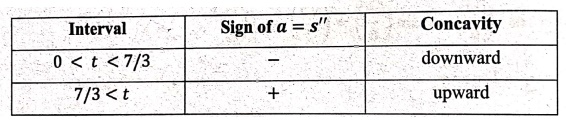
The particle starts out
moving to the right while slowing down, and then reverses and begins moving to
the left at t = 1 under the influence of the leftward acceleration over the
time interval [0,7/3). The acceleration then changes direction at t = 7/3 but
the particle continues moving leftward, while slowing down under the rightward
acceleration. At t = 11/3 the
particle reverses direction again: moving to the right in the same direction as
the acceleration, so it is speeding up.
Example
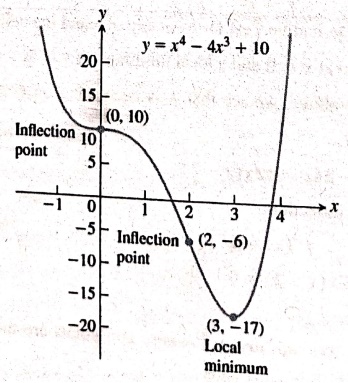
144. Sketch a graph of the function
f(x)
= x4 − 4x3 + 10
using
the following steps.
(a)
Identify where the extrema of ƒ occur.
(b)
Find the intervals on which ƒ is increasing and the intervals on which f is decreasing.
(c)
Find where the graph of ƒ is concave up and where it is concave down.
(d)
Sketch the general shape of the graph for f.
(e)
Plot some specific points, such as local maximum and minimum points, points of
inflection, and intercepts. Then sketch the curve.
Solution:
The function f is
continuous since f '(x) = 4x3‒ 12x2
exists. The domain of ƒ is (‒∞, ∞), and the domain of f ' is also (‒∞, ∞), Thus, the critical points of f occur only at the zeros of f '. Since
f '(x) = 4x3 ‒ 12x2 = 4x2(x − 3).
To find the critical
point:
f '(x) = 0
4x2(x‒3)=0
x = 0,3 are critical
points
We divide the real line
into intervals whose end points are the critical points x = 0,3 and complete the following table

a) Using the First
Derivative Test for local extrema and the table above, we see that there is no
extremum at x = 0 and a local minimum
at x = 3.
(b) Using the table
above, we see that f is decreasing on
(‒∞, 0] and [0,3], and increasing on [3,∞).
(c) f ''(x)
= 12x2 ‒ 24x = 12x(x‒2)
To find the point of
inflection:
ƒ"(x) = 0
12x(x‒2)=0
x
= 0 or x = 2.
We divide the real line
into intervals whose end points are the critical points x = 0,2 and complete the following table

We see that ƒ is
concave up on the intervals (‒∞, 0) and (2,∞), and concave down on (0,2).
(d) Summarizing the
information in the last two tables, we obtain the following.
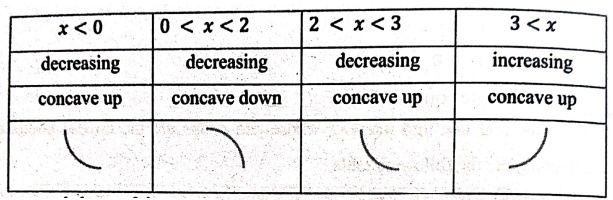
The general shape of
the graph
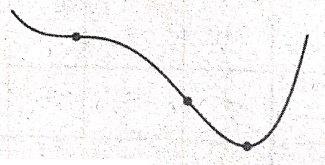
e) The graph of f(x) is shown below:
Example
145. Discuss the curve y=x4‒4x3 with respect to concavity,
points of inflection, and local maxima and minima. Use this information to sketch
the curve.
Solution:
Let f(x) = x4 ‒ 4x3.
Then
f '(x) = 4x3‒12x2
= 4x2(x − 3)
ƒ"(x) = 12x2
‒ 24x = 12x(x − 2).
The critical numbers
are given by
f '(x) = 0
4x2(x‒3)=0
x = 0 and x = 3.
We divide the real line
into intervals whose end point are the critical points x=0,3 and complete the
following table.
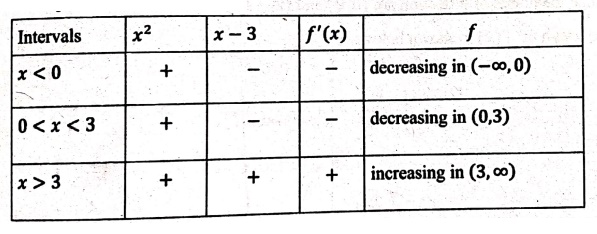
Now we apply the first
derivative test to find the local extreme values.
f '(x)
changes from decreasing to increasing at
x = 3. Thus the function has a local minimum at x = 3 and the local minimum value is
ƒ(3) = (3)4 ‒
4(3)3
= 81‒108 = ‒27
Since f(x) has no change at x=0. Thus, f(x) has neither local maximum nor local
minimum.
For concavity,
ƒ"(x) = 0
12x(x‒2)=0
x = 0,2
We divide the real line
into intervals with 0,2 as endpoints and complete the following table.

Since the curve changes
from concave upward to concave downward at
x = 0 and the curve changes from concave downward to concave upward x=2.
Thus, the points of
inflection are (0, f(0)) and (2, f(2)).
Since,
f(0)
= (0)4‒4(0)3 = 0
ƒ(2) = (2)4
− 4(2)3 = 16 – 32 = −16.
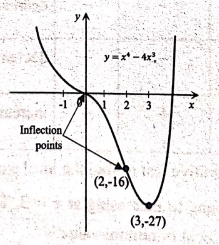
Hence the points of
inflection are (0,0) and (2,‒16).
The graph of f(x) is shown below:
Example
146. Sketch the graph of the function f(x)
= x2/3 (6‒x)1/3
Solution:
The function is
ƒ(x) = x2/3(6 − x)1/3
Taking log on both
sides and differentiate with respect to x
log f(x) = log(x2/3(6‒x)1/3]
= log x2/3 +
log(6‒x)1/3
= 2/3 logx + 1/3 log(6‒x)

Since f '(x)
= 0 when x = 4 and does not exist when x = 0
or x = 6, the critical numbers are 0,4 and 6.
We divide the real line
into intervals with 0,2 as endpoints and complete the following table.
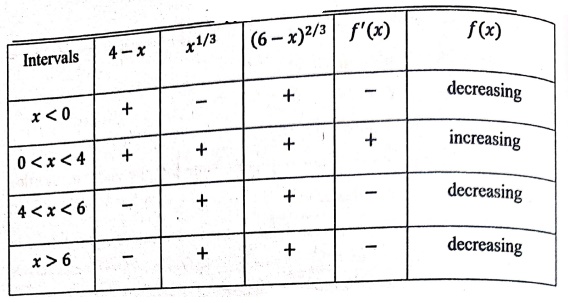
We apply the first
derivative test to find the local extreme values.
f(x)
change from decreasing to increasing at x
= 0,Thus, the function has a local minimum x = 0 and local minimum value is
ƒ(0) = (0)2/3(6‒0)1/3
= 0
f(x)
change from increasing to decreasing at x
= 4,Thus, the function has a local maximum x = 4 and local maximum value is
f(4)
= (4)2/3(6‒4)1/3 = 25/3
Since f '(x)
has no change at x = 6. Thus, f(x) has neither local minimum nor local
maximum.
For concavity, since f "(x) does not exist at x = 0 and x =6 .So the critical points are x = 0,6.
We divide the real line
into intervals with 0,6 as endpoints and complete the following table.
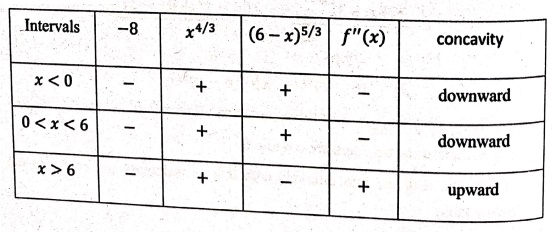
Since the curve changes
from concave downward to concave upward at
x = 6. Thus, the points of inflection are (6,ƒ(6)).
Since, f(6) = (6)2/3(6 – 6)1/3
= 0
Hence, the points of
inflection is (6,0).
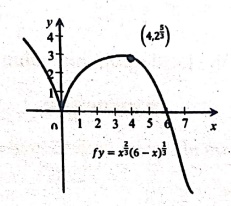
The graph is sketched
in following figure. Note that the curve has vertical tangents at (0,0) and (6,
0) because |ƒ'(x)| → ∞ as x → 0 and
as x → 6.
Example
147. Find the local maximum and minimum values of f(x) = √x‒4√x using both the first and second derivative
tests.
Solution:
f(x)
= √x ‒ 4√x
f '(x) = 1/2x‒1/2 ‒ 1/4x‒3/4
= [ 2 4√x ‒ 1 ] / [ 4 4√x3
]
f
'(x) = 0
⇒
24√x −1 = 0
⇒x
= 1 / 16
First derivative test:
f '(x) > 0 when x > 1/16
f
'(x) < 0 ⇒.0 < x > 1/16
Since f '(x)
changes from negative to positive at x =
1/16 f(x) has local minimum value at x = 1/16.
The local minimum value
is
f(1/16) = ¼ ‒ ½ = ‒ ¼
Second derivative test:
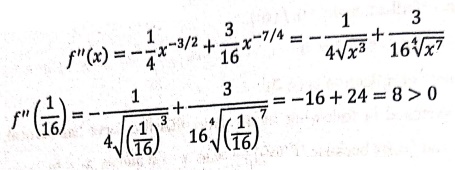
= ‒16+24=8 > 0
f(x)
has local minimum value at x= 1 / 16
f(1/16)
= ¼ ‒ ½ = ‒ ¼ = is the local minimum
value of f (x).
EXERCISE
38. Find the local
maximum and minimum values of the function
f(x)
= x + 2sinx, 0≤ x ≤ 2π.
Ans:
local maximum = 3.83, local minimum = 2.46
39. Suppose the
derivative of the function f is
f '(x) = (x+1)2(x‒3)5(x‒6)4
on what interval is f increasing?
Ans:
(3,∞)
40. Show that the
inflection points of the curve y=x sin x lie
on the curve y2(x2+4)=4x2.
41. If the function f(x) = x3 + ax2 +
bx has the local minimum value ‒ 2√3/9 at x=1/√3 what are the values of a and b ?
Ans:
a = 0, b = ‒1
42. Which of the
tangent lines to the curve f(x) = x3
+ ax2 + bx has the smallest slope?
43. Use the first and
second derivatives of f(x) = e1/x, together with asymptotes to sketch its graph.
Applied Calculus: UNIT I: Differential Calculus : Tag: Applied Calculus : Differential Calculus - How derivative affects the shape of a curve
Applied Calculus: UNIT I: Differential Calculus
Under Subject

Applied Calculus
MA25C01 Maths 1 M1 - 1st Semester | 2025 Regulation | 1st Semester 2025 Regulation
Related Subjects

English Essentials I
EN25C01 1st Semester | 2025 Regulation | 1st Semester 2025 Regulation

தமிழர் மரபு - Heritage of Tamils
UC25H01 1st Semester | 2025 Regulation | 1st Semester 2025 Regulation
Applied Calculus
MA25C01 Maths 1 M1 - 1st Semester | 2025 Regulation | 1st Semester 2025 Regulation

Applied Physics I
PH25C01 1st Semester | 2025 Regulation | 1st Semester 2025 Regulation

Applied Chemistry I
CY25C01 1st Semester | 2025 Regulation | 1st Semester 2025 Regulation

Makerspace
ME25C04 1st Semester | 2025 Regulation | 1st Semester 2025 Regulation

Computer Programming C
CS25C01 1st Semester | 2025 Regulation | 1st Semester 2025 Regulation

Computer Programming Python
CS25C02 1st Semester | 2025 Regulation | 1st Semester 2025 Regulation

Fundamentals of Electrical and Electronics Engineering
EE25C03 1st Semester | 2025 Regulation | 1st Semester 2025 Regulation

Introduction to Mechanical Engineering
ME25C03 1st Semester | 2025 Regulation | 1st Semester 2025 Regulation

Introduction to Civil Engineering
CE25C01 1st Semester Civil Department | 2025 Regulation | 1st Semester 2025 Regulation

Essentials of Computing
CS25C03 1st Semester - AID CSE IT Department | 2025 Regulation | 1st Semester 2025 Regulation

Applied Physics I Laboratory
PH25C01 1st Semester practical Laboratory Manual | 2025 Regulation | 1st Semester Laboratory 2025 Regulation

Applied Chemistry I Laboratory
CY25C01 1st Semester practical Laboratory Manual | 2025 Regulation | 1st Semester Laboratory 2025 Regulation

Computer Programming C Laboratory
CS25C01 1st Semester practical Laboratory Manual | 2025 Regulation | 1st Semester Laboratory 2025 Regulation

Computer Programming Python Laboratory
CS25C02 1st Semester practical Laboratory Manual | 2025 Regulation | 1st Semester Laboratory 2025 Regulation

Engineering Drawing
ME25C01 EEE Mech Dept | 2025 Regulation | 2nd Semester 2025 Regulation

Basic Electronics and Electrical Engineering
EE25C04 1st Semester ECE Dept | 2025 Regulation | 2nd Semester 2025 Regulation