Applied Calculus: UNIT I: Differential Calculus
Mean Value Theorem
Differential Calculus
Explanation, Formula, Equation, Example and Solved Problems - Mean Value Theorem
MEAN‒VALUE THEOREM
(1) First form.
If (i) f(x) is continuous in the closed
interval [a, b], and
(ii) f '(x) exists in the open interval (a,
b), then there is at least one value c of
x in (a, b), such that
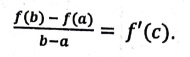
f(b)−f(a) / b‒a = f '(c).
Consider the function ϕ(x) = f(x)
‒ [ f(b)‒f(a) / b‒a ] x
Since f(x) is continuous in [a, b]; ∴
ϕ is also continuous in [a, b].
Since f '(x) exists in (a, b);
∴
ϕ'(x) also exists in (a, b) and = f '(x)
‒ [f(b)‒f(a) / b‒a ] ……(1)
Clearly ϕ(a) = bf(a)‒af(b) / b‒a = ϕ(b).
Thus ϕ(x) satisfies all the conditions of
Rolle's theorem.
∴
There at least one value c of x between
a and b such that ϕ'(c) = 0. Substituting
x = c in (1), we get
ƒ'(c) – [ f(b)−f(a) / b‒a] ………(2)
which proves the
theorem.
(2) Second form.
If we write b = a + h
then since a < c < b,
c = a+ θh
where 0 < θ < 1.
Thus the mean value
theorem may be stated as follows:
If (i) f(x) is continuous in the closed
interval [a, a + h]
and (ii) f '(x)
exists in the open interval (a, a + h)
then there is at least
one number θ (0 < θ < 1) such that
f(a + h) = f(a) + hf '(a + θh)
(3) Geometrical Interpretation.
Let A, B be the points
on the curve y = f(x) corresponding to x=a and
x = b so that A = [a, f(a)] and B = [b, f(b)]
∴
Slope of chord AB = f(b)‒f(a) / b‒a
By (2), the slope of
the chord AB = f '(c) the slope of
the tangent to the curve at c (x = c).
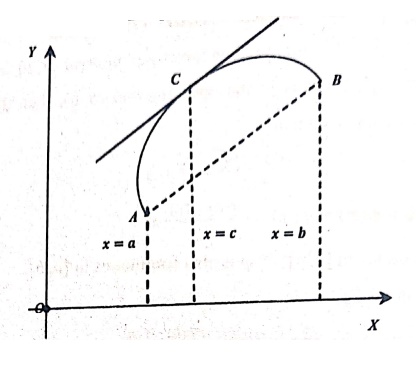
Hence the Lagrange's
mean value theorem asserts that if a curve AB has a tangent et each of its
points, then there exists at least one point C on this curve, the tangent at
which is parallel to the chord AB.
Cor. If f '(x)
= 0 in the interval (a, b) then f(x)
is constant in [a, b].
For, if x1,
x2 be any two values of x in
(a, b), then by (2),
f(x2)‒
f(x1) = (x2‒x1)
f '(c) = 0(x1 < c <
x2)
Thus f(x1) = f(x2)
i.e. f(x) has the same value every value of x in (a, b).
Example
148. Verify the mean value theorem on the given interval, and find all values
of c in that interval that satisfy the theorem.
(a)
f(x) = x2−x, [‒3,5]
(b)
f(x) = √[25 − x2], [‒5,3]
Solution:
(a) The given function
f(x) = x2‒ x is a
polynomial. It is continuous on [‒3,5] and differentiable on (‒3,5). Here a =
−3,b = 5.
f(a)
= f (‒3) = (‒3)2+3 = 12
f(b)
= ƒ(5) = 52 ‒ 5 = 20
f
'(x)=2x‒1
f
'(c) = 2c ‒ 1
The Lagrange's MVT is
f(b)‒f(a) = (b − a)ƒ'(c)
8 = 8[2c ‒ 1]
2c‒1=1
c=1
Therefore, c is in [‒3,5].
Hence, Mean Value
Theorem is verified.
The given function f(x) = √[25‒x2] is continuous on [‒5.3] and differentiable on (−5,3).
Here a = −5, b = 3.
f(a)
= ƒ (‒5) = √[25−25] = 0
f(b)
= f(3) = √[25−9] = 4

f
'(x) = [ 1 / 2√(25‒x2)] (‒2x)
= ‒x
/ √(25‒x2)
Then
f
'(c) = ‒c / √(25‒c2) ……(2)
The Lagrange's MVT is
f(b)‒f(a) = (b‒a) f '(c)
4 = 8 [ ‒c / √(25‒c2) ]
‒c / √(25‒c2) =
½
√(25‒c2) = ‒2c
Squaring, we get
25‒c2 = 4c2
5c2 = 25
c2 = 5
c = ±√5
c = ±2.24
Therefore, c is in [‒5,3].
Hence, Mean Value
Theorem is verified.
Example
149. Verify Lagrange's mean value theorem for the following functions:
a)
f(x) = x2 + 3x + 2 in
1 ≤ x ≤2
b)
f(x) = x3 + x − 1 in
[0,2]
c)
f(x) = 1/x in −1 ≤ x ≤ 1
d)
f(x) = 1 + x2/3 in [‒8,1]
e)
f(x) = x + 1/x in [1/2,2]
f)
f(x) = e−2x in [0,3]
Solution:
a) Given f(x) = x2 + 3x + 2 in 1 ≤ x ≤ 2.
Which is a polynomial.
It is continuous on [1,2] and differentiable on (1,2).
Here a = 1, b = 2
f '(x)= 2x + 3 i.e., f
' (c) = 2c + 3
Also f(b) = f(2) = 22 +3(2)+2 = 4+6+2 = 12
f(a)
= f(1) = 12 + 3(1) + 2 = 6
The Lagrange's MVT is
f(b)‒f(a) = (b − a) f '(c)
= 12‒6 = (2‒1) (2c+3)
⇒
6=2c+3
⇒2c
= 3
⇒
c = 3/2
i.e., 1 < 3/2 < 2
Hence, Lagrange's MVT
is verified for this function.
b) Given ƒ(x) = x3
+ x ‒ 1 in [0,2]. Which is a
polynomial. It is continuous on [0,2] and differentiable on (0,2).
Here, a = 0, b = 2
f '(x) = 3x2 + 1 i.e, f
'(c) = 3c2 + 1
Also f(b) = f(2) = 23 + 2 −1 = 8+2−1 = 9
f(a) = f(0)
= 0 + 0 ‒1 = ‒1
The Lagrange's MVT is
f(b)
‒ f(a) = (b − a) f '(c)
⇒
9
− (−1) = (2‒0)(3c2 + 1)
⇒
10 = 2(3c2 + 1)
⇒
3c2+1
= 5
⇒
3c2
= 4
⇒
c2
= 4/3
⇒
c = ± 2/√3 = ±1.1547
ie., 0 < 1.1547 <
2
Hence, the mean value
theorem is verified
c) Given f(x) = 1/x in ‒ 1 ≤ x ≤ 1
Here, a = ‒1, b = 1
f '(x) = ‒1/x2
It is easy to observe
that both the functions f(x) and f '(x)
do not exist at
x = 0.
Thus, f(x) is neither continuous nor differentiable
on ‒ 1 ≤ x ≤ 1. Therefore, the
Lagrange's MVT is not applicable for this function.
d) Given f(x) = 1 + x2/3 in [‒8,1]
The function f(x) is continuous on [‒8, 1] as the
function is finite for all values of x
on [‒8,1].
But, f '(x)
= 2/3 x−1/3 does not exist
at x = 0
i.e., f(x) is not differentiable in (‒8, 1)
Hence, Lagrange's MVT
is not applicable for this function.
e) Given f(x) = x + 1/x, [1/2,2]
Here, a = 1/2, b = 2
f '(x) = 1 ‒ 1/x2
f '(c) = 1 ‒ 1/c2
Also f(b) = f(2) = 2 + 1/2 = 5/2
f(a)
= f(1/2) = 1/2 + 2 = 5/2
The Lagrange's MVT is
f(b)
− f(a) = (b − a)ƒ'(c)
⇒
5/2
‒ 5/2 = (2 ‒ 1/2)[ 1‒ 1/c2 ]
⇒
0 = (3/2) [1 ‒ 1/c2]
⇒1
‒ 1/c2 = 0
⇒
c2
= 1
⇒
c
= ±1
le, 1/2 < c < 1
le, 1/2 < 1 < 2
Hence, Lagrange's MVT
is verified for this function.
f) Given f(x) = e‒2x, [0,3]. It is
continuous on [0,3] and differentiable on (0,3).
Here, a = 0, b = 3
f
'(x)
= (‒2)e‒2x
f
'(c) = (‒2)e‒2c
Also f(b) = ƒ(3) = e−6
ƒ(a) = f(0) = e−0
= 1
The Lagrange's MVT is
f(b)‒f(a) = (b − a)ƒ'(c)
⇒
e‒6‒1
= (3‒0)(‒2)e‒2c
⇒e‒6‒1
= ‒6e‒2c
⇒e‒2c
= ‒1/6 [ e‒6 ‒ 1 ]
⇒e‒2c
= ‒1/6 e‒6 + 1/6
= 1/6[1 + e‒6]
⇒
loge‒2c = log [1/6 (1‒e‒6)]
⇒
‒2c = log[1/6 (1‒e‒6) ]
⇒
c = ‒1/2 × log[1/6 (1‒e‒6)
]
i.e, 0 < c < 3,
Since c = 0.3896
Hence, Lagrange's MVT
is verified.
Example
150. Suppose that ƒ(0) = − 3 and f '(x)
≤ 5 for all values of x. How large can
ƒ(2) possibly be?
Solution:
Given f is differentiable (and therefore
continuous) everywhere.
In particular, we can
apply the Mean Value Theorem on the interval [0,2].
Lagrange's MVT is
f(b)
‒ f(a) = (b ‒ a) f '(c)
f(2)
‒ f(0) = f '(c)(2 – 0)
ƒ(2) = ƒ(0) + 2ƒ'(c)
... (1)
Given ƒ(0) = ‒3.
(1) ⇒ ƒ(2) = −3+ 2f '(c) ... (2)
Also given
f '(x) ≤ 5 for all x, so f '(c) ≤ 5.
We have 2f '(c) ≤ 10,
(2) ⇒ ƒ(2) = − 3 + 2f '(c) ≤ − 3 + 10 = 7
The largest possible
value for f(2) is 7.
Example
151. In the Mean value theorem, f(b) −
f(a) = (b − a)f '(c), determine e lying between a and b, if ƒ(x) = x(x
− 1)(x − 2), a = 0 and b = 1/2.
Solution:
f(a) = 0 ƒ(b) = 1/2 (‒ 1/2)
( − 3/2) = 3/8
ƒ'(x) = 3x2 − 6x + 2, f '(c) = 3c2 − 6c + 2
Substituting in (i),
3/8 – 0 = (1/2 – 0)(3c2
– 6c + 2)
⇒
12c2
‒ 24c + 5 = 0
c = { 24±√[(24)2‒12 × 5 × 4] } / 24
= 1±0.764 = 1.764; 0.236.
Since c lies between 0
and 1/2,
c = 0.236
Example
152. If f(x) = x3‒ x, a = 0,
b = 2, by mean value theorem find the value of c.
Solution:
Since f is a polynomial, it is continuous and
differentiable for all x, so it is
certainly continuous on [0,2] and differentiable on (0,2). Therefore, by the
Mean Value Theorem, there is a number c in (0, 2) such that
f(2)
‒ f(0) = f '(c)(2 – 0)
Now f(2) = 6, f(0) = 0 and f '(x) = 3x2‒1 so this equation becomes
6 = (3c2 ‒
1) 2 = 6c2‒2
which gives c2
= 4/3 that c = +2/√3. But c must lie in (0,2), so c = 2√3.
EXERCISE
44. Verify Lagrange's
mean value theorem for the following functions:
a) f(x) = x2/3 in
0≤x≤1
b) f(x) = x3 ‒ x2 in [‒1,2]
c) f(x) = x2 + 2x ‒ 1 in 0≤ x ≤1
d) f(x) = 2x2 ‒ 3x + 1 in [0,2]
e) f(x)=√[x‒1], in [1,3]
f) f (x) = x / x+2 in [1,4]
45. Suppose that 3 ≤ f '(x)
≤ 5, for all values of x. Show that
18 ≤ f(8) ‒ f(2) ≤ 30.
46. Using Lagrange's
Mean Value Theorem prove that
x/(1+x) < log(1+x) < x for all x < 0
Applied Calculus: UNIT I: Differential Calculus : Tag: Applied Calculus : Differential Calculus - Mean Value Theorem
Applied Calculus: UNIT I: Differential Calculus
Under Subject

Applied Calculus
MA25C01 Maths 1 M1 - 1st Semester | 2025 Regulation | 1st Semester 2025 Regulation
Related Subjects

English Essentials I
EN25C01 1st Semester | 2025 Regulation | 1st Semester 2025 Regulation

தமிழர் மரபு - Heritage of Tamils
UC25H01 1st Semester | 2025 Regulation | 1st Semester 2025 Regulation
Applied Calculus
MA25C01 Maths 1 M1 - 1st Semester | 2025 Regulation | 1st Semester 2025 Regulation

Applied Physics I
PH25C01 1st Semester | 2025 Regulation | 1st Semester 2025 Regulation

Applied Chemistry I
CY25C01 1st Semester | 2025 Regulation | 1st Semester 2025 Regulation

Makerspace
ME25C04 1st Semester | 2025 Regulation | 1st Semester 2025 Regulation

Computer Programming C
CS25C01 1st Semester | 2025 Regulation | 1st Semester 2025 Regulation

Computer Programming Python
CS25C02 1st Semester | 2025 Regulation | 1st Semester 2025 Regulation

Fundamentals of Electrical and Electronics Engineering
EE25C03 1st Semester | 2025 Regulation | 1st Semester 2025 Regulation

Introduction to Mechanical Engineering
ME25C03 1st Semester | 2025 Regulation | 1st Semester 2025 Regulation

Introduction to Civil Engineering
CE25C01 1st Semester Civil Department | 2025 Regulation | 1st Semester 2025 Regulation

Essentials of Computing
CS25C03 1st Semester - AID CSE IT Department | 2025 Regulation | 1st Semester 2025 Regulation

Applied Physics I Laboratory
PH25C01 1st Semester practical Laboratory Manual | 2025 Regulation | 1st Semester Laboratory 2025 Regulation

Applied Chemistry I Laboratory
CY25C01 1st Semester practical Laboratory Manual | 2025 Regulation | 1st Semester Laboratory 2025 Regulation

Computer Programming C Laboratory
CS25C01 1st Semester practical Laboratory Manual | 2025 Regulation | 1st Semester Laboratory 2025 Regulation

Computer Programming Python Laboratory
CS25C02 1st Semester practical Laboratory Manual | 2025 Regulation | 1st Semester Laboratory 2025 Regulation

Engineering Drawing
ME25C01 EEE Mech Dept | 2025 Regulation | 2nd Semester 2025 Regulation

Basic Electronics and Electrical Engineering
EE25C04 1st Semester ECE Dept | 2025 Regulation | 2nd Semester 2025 Regulation