Tamils and Technology: Unit IV: Agriculture and Irrigation Technology
Kumizhithoombu of Chola Period
Design, Importance, Structure, Mechanism
1. The Importance of Kumizhithoombi 2. Structure of Kumizhithoombi 3. The Mechanism of the Kumizhithoombu
KUMIZHITHOOMBU OF CHOLA
PERIOD
A
Kumizhithoombu is a scientifically designed system to remove water and silt
from a lake.
1. The Importance of Kumizhithoombi
The
Tamils have been managing irrigation water effectively by establishing a water
management system called Kumizhithoombi in the big lakes of Tamil Nadu 2000
years ago. This Kumizhithoombi system not only provided water for irrigation
but also prevented the lakes from the formation of silt and losing the depth.
Proof
1.
'Tamil Irrigation System Two Thousand Years Ago' - Kudavayil Balasubramanian.
2.
'Pity of a Dust Storm on a Waved Lake' - Kula. Shanmuga Sundaram.
The Causes for Lake / Pond Draining Away
The
main reason for the water bodies losing the depth is that when rainwater comes
to water bodies like lakes, ponds through drains and streams, they come
together with water, silt and sediments.
The Difference between Sluice and Bubble (Kumizhi)
The
sluices do the job of draining the water. The bubbles, in addition to draining
water, also remove sediments from lakes, ponds and sluices.
2. Structure of Kumizhithoombi
Bubbles
that release water to irrigation canals are not cosntructed like sluices on
lake shores. The bubble (Kumuzhi) is set in the lake 200-300 feet away from the
lake shore.
A
strong embankment is built on the ground level of the lake. Then, a black stone
tank is made under it. On the top of the tank, there is a large drain hole for the water to flow. They
drill a hole of the same size under the tank and connect it to the irrigation
canal outside the lake through a tunnel.
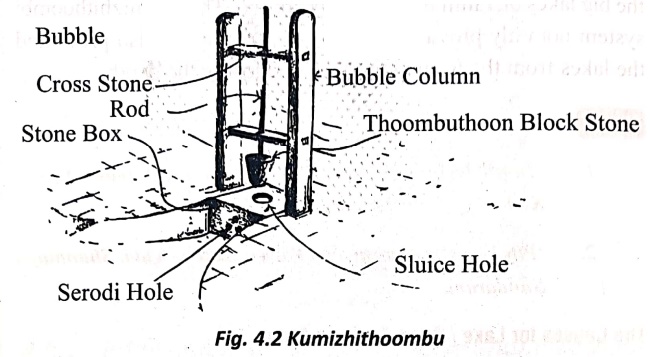
‘Thoombukkal'
is used to close and open the hole for water to flow into the tank. There is a
stone frame to move the Thoombukkal up and down.
There
are three small holes on the side (or) ground level of the tank. They are
called 'Serodi hole'.
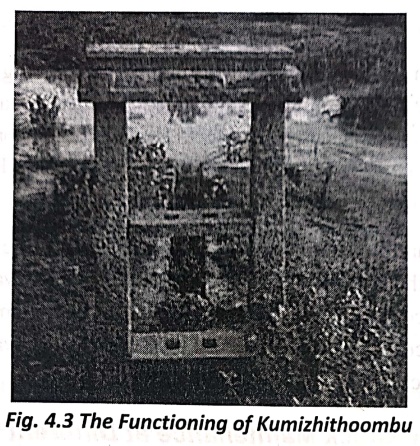
3. The Mechanism of the Kumizhithoombu
When
water is needed for irrigation, they swim in the lakes and dive to lift the
thoombu stone that blocks the water hole above the tank. Hence, water required
for irrigation is released. In this system under the lake, the water flows
through the water hole at a pressure equal to the water level of the lake. The
water pressure at the bottom of the lake is high. The pressure inside the stone
plate is less. Due to this, slit and slimy water will seep in quickly through
Serodi hole.
80%
good water comes out of the lake through the Neerodi hole while 20% of the pulp
water comes out of Serodi. In the same speed, good water is washed away. The
soil water is also washed away. This will reduce silting in the lake.
Evidences
1.
Rajarajan Thoombu: 'Sembian Mathevi Pereri' is the lake cut by Paranthak
Chola's youngest son Kandarathitha in accordance with the wishes of his second
wife, Sembian Mathevi. One of the sluices is named Rajarajan Thoombu in the
name of Rajarajan.
2.
The Kumizhithoombi erected during the reign of king Rajarajan contains
inscriptions of the king. So it is the property of the government. It means
that the Vandals will be punished by declared through an inscription that he
will carry the sand of the feet of those who maintain such Kumizhithoombus.
Tamils and Technology: Unit IV: Agriculture and Irrigation Technology : Tag: Tamil : Design, Importance, Structure, Mechanism - Kumizhithoombu of Chola Period
Tamils and Technology: Unit IV: Agriculture and Irrigation Technology
Under Subject
Tamils and Technology தமிழர்களும் தொழில்நுட்பமும்
UC25H02 2nd Semester | 2025 Regulation | 2nd Semester 2025 Regulation
Related Subjects
English Essentials II
EN25C02 2nd Semester | 2025 Regulation | 2nd Semester 2025 Regulation
Tamils and Technology தமிழர்களும் தொழில்நுட்பமும்
UC25H02 2nd Semester | 2025 Regulation | 2nd Semester 2025 Regulation
Linear Algebra
MA25C02 2nd Semester | 2025 Regulation

Transforms and its Applications
MA25C03 2nd Semester EEE Dept | 2025 Regulation | 2nd Semester 2025 Regulation

Applied Physics (CE) II
PH25C02 2nd Semester Civil, Agri Depts | 2025 Regulation | 2nd Semester 2025 Regulation
Applied Physics (CSIE) II
PH25C03 2nd Semester AIDS, CSE, IT, CSE(CY) Dept | 2025 Regulation | 2nd Semester 2025 Regulation
Applied Physics (EE) II
PH25C04 2nd Semester EEE Dept | 2025 Regulation | 2nd Semester 2025 Regulation

Applied Physics (ME) II
PH25C05 2nd Semester Mechanical Dept | 2025 Regulation | 2nd Semester 2025 Regulation
Applied Chemistry (CE) II
CY25C02 2nd Semester Civil Dept | 2025 Regulation | 2nd Semester 2025 Regulation

Applied Chemistry (ME) II
CY25C03 2nd Semester Mechanical Dept | 2025 Regulation | 2nd Semester 2025 Regulation

Electron Devices
EC25C01 2nd Semester ECE Dept | 2025 Regulation | 2nd Semester 2025 Regulation
Digital Principles and Computer Organization
CS25C06 2nd Semester AIDS, CSE, IT, CSE(CY) Dept | 2025 Regulation | 2nd Semester 2025 Regulation

Basic Electrical and Electronics Engineering
EE25C01 2nd Semester | 2025 Regulation | 2nd Semester 2025 Regulation

Basic Civil and Mechanical Engineering
GE25C01 2nd Semester EEE Dept | 2025 Regulation | 2nd Semester 2025 Regulation
Data Structures using CPlusPlus
CS25C05 2nd Semester ECE Dept | 2025 Regulation | 2nd Semester 2025 Regulation
Engineering Drawing
ME25C01 EEE, Mech, Agri, EEE Depts | 2025 Regulation | 2nd Semester 2025 Regulation
Data Structures and Algorithms
CS25C04 2nd Semester EEE Dept | 2025 Regulation

Circuits and Network Analysis
EC25C02 2nd Semester ECE Dept | 2025 Regulation | 2nd Semester 2025 Regulation

Engineering Mechanics
ME25C02 2nd Semester Mech, Civil, Agri Depts | 2025 Regulation | 2nd Semester 2025 Regulation
Object Oriented Programming (OOPs)
CS25C07 2nd Semester CSE, CSE(CY) Depts | 2025 Regulation | 2nd Semester 2025 Regulation