Tamils and Technology: Unit IV: Agriculture and Irrigation Technology
Pearl
Tamils Agriculture, Irrigation Technology
Tamils Agriculture, Irrigation Technology: 1. Mode of Pearl Formation 2. Properties of Pearl 3. Sanctity of Pearl 4. Medical Properties of Pearls 5. Pearls during the Sangam Period 6. Pearls in Sangam Literature
PEARL
Pearls
are closely associated with human history. These are considered to be the
oldest germ stones in the world since pre- historic times. It is believed that
pearls were discovered when the primitive man wandered along the beaches in
search of food.
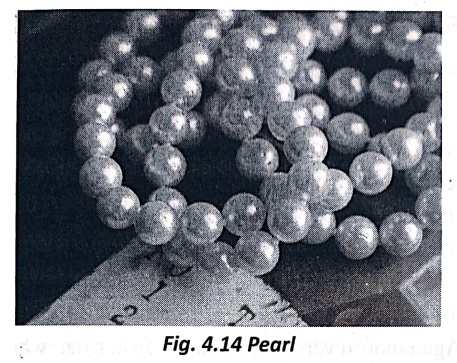
Pearl
is considered as one of the nine types of gem stones known as precious
Navarathnas.
1. Mode of Pearl Formation
1. Natural Pearl
Pearls
are obtained from a creature called a pearl sculptor. Nature gives us the pearl
as a finished product. Nacre is formed on the inner shells of pearl oysters and
dark blue oysters.
Naturally
produced pearls, when any parasites, small creatures, shells go inside the
shell, there is an eruption. At that time, a special kind of liquid called
nacre is secreted to protect itself by covering the object that enters.
The
longer the object is in the shell, more layers of nacre liquid will settle on
it, turning it into a precious pearl. Similarly, even if a small grain of sand
enters, it becomes a pearl. Naturally forming pearls like this are valuable.
There is no need to polish (or) brighten the natural pearls.
2. Artificial Pearl
A
pearl is not a mineral. It is formed by two calcium carbonate minerals namely
aragonite and calcite. These two minerals differ in their crystallinity.
*
Aragonite is formed by red square crystals.
*
Calcite is formed by triangular cyrstals.
Pearls
are formed by the ingestion of minerals such as aragonite and calcite, which
are mixed with a binding fluid called ganghelin (a protein) in the stomach.
Proofs
1.
The Chinese inserted a small lead Buddha statue into the shell's mouth while it
was open. After some time, when the oyster is opened, the Buddha statue is
encased in pearly liquid.
2.
The Japanese would push small grains through the shell's mouth. Nacre liquid
settles on it and a well-grown pearl is taken out.
Duration for the
formation of Pearls
Pearls
take 5-6 years to form in good water.
Perls
take 5-20 years to form in salt water.
A
shell produces a total of 60 pearls in its life time.
2. Properties of Pearl
Pearls
are solid, translucent, white in colour and spherical or oval in shape.
Animuthu
The
highest type of spherical pearls is called Animuthu. It is slightly larger in
size, highly compressed and shiny with high light penetration.
3. Sanctity of Pearl
Pearls
are generally symbols of purity, holiness, perfection, etc., and represent
human qualities such as virtue, love, wisdom, justice, spirituality and
fairness.
Proofs
1.
In ancient China, pearl jewelry was believed to bring purity to those who wore
them.
2.
In the Dark Ages, warriors considered that wearing pearl jewelry would give
them protection.
4. Medical Properties of Pearls
1.
If the Pearl is put in skimmed milk, it will float. If pearls are soaked in
water and the water is drunk, the acidity in the stomach will be neutralized
and intestinal diseases will be prevented.
2.
Pearl preserves smooth liver function.
3.
It has diabetes control properties.
4.
If pearls rich in calcium are worn and when they rub the body, the protein will
be dissolved. As a result, the body heat will subside.
Proofs
1.
Medical texts say that pearls give longer life.
2.
The method of making the pearl into powder with the herbal juice is mentioned
in Siddha medical texts.
3.
Cleopatra, the world's most beautiful woman crushed a pearl and mixed it with
wine and gave it to Mark Antony as dinner. This is considered to be the most
expensive dinner in the history of the world.
5. Pearls during the Sangam Period
The
earliest reference to pearls comes from China during the Sangam period. Pearls
were gifted to Chinese royalty as early as 2300 BC.
One
of the oldest books in China, the 'Sho King', published in 2350 BC, mentions
pearls found in the Hewai River and in the series of pearl rewards given after
death.
Proofs
1.
Lead Buddha
China
is credited with producing the first cultured pearls by inserting tiny lead
Buddha statues into the pearl oysters around 1000 AD.
2.
Pearls in Quran
Pearls
are referred to in holy books such as Quran.
3.
The New Testament
References
to pearls are found in both the New and Old Testaments.
Proofs
Mathew
2 notes; Resurrection 4 notes; Timothy 2 notes.
4.
Pearls as Jewelry
Even
before the 420 Century BC, it is evident that pearls were used as jewelry.
Prior to the period before 4th Century BC, pearls had been used as decorative
items in Egypt.
Evidence
1.
A piece of broken pearl jewelry has been found on the body of a Persian
Princess in an ancient stone coffin dating back to 420 BC at the Louvre Museum
in Paris.
There
is evidence of the pearl trade during the reign of Alexander the Great in the
4th Century BC.
6. Pearls in Sangam Literature
There
are many accounts of pearls in Sangam literature. It is understood from the
following proof that Avaiyar sang that pearls were found in abundance in the
Pandyan country and the Pandyan South as World famous for pearls.
Proof: Avaiyar
- Individual versa
1. Korkai Pearls
Korkai
was the primary capital of the Pandyas till 130 AD. Later, it became the port
and the second capital of the Pandyas. Here, the pearls were highly valued and
the pearls found were the best and the following Nartinai and Ingurunooru tell
us. It is said in the literature that the pearl trade went on extensively.
Proof: Nartinai
23: 5-6 Kanakayanar
In
the Korkai beach, the sea waves pile up pearls on the shore. Scattered on the
beach, these pearls get struck in the hooves of the rich man's horse and hinder
it. The following Agananooru verse, says that the pearls are found scattered to
this extent.
Proof: Agananooru
130: 9-11 Venkannanar
2. Musiri Pearls
Pearls
were also found in the port of Musiri, the country of Chera. These pearls were
sold in a town called Bandar. The Arabic word Bandar means the port.
Proof:
Pathirtupathu 7-Ampaththu 7th verse
Tamils and Technology: Unit IV: Agriculture and Irrigation Technology : Tag: Tamil : Tamils Agriculture, Irrigation Technology - Pearl
Tamils and Technology: Unit IV: Agriculture and Irrigation Technology
Under Subject
Tamils and Technology தமிழர்களும் தொழில்நுட்பமும்
UC25H02 2nd Semester | 2025 Regulation | 2nd Semester 2025 Regulation
Related Subjects

English Essentials II
EN25C02 2nd Semester | 2025 Regulation | 2nd Semester 2025 Regulation
Tamils and Technology தமிழர்களும் தொழில்நுட்பமும்
UC25H02 2nd Semester | 2025 Regulation | 2nd Semester 2025 Regulation
Linear Algebra
MA25C02 2nd Semester | 2025 Regulation

Transforms and its Applications
MA25C03 2nd Semester EEE Dept | 2025 Regulation | 2nd Semester 2025 Regulation

Applied Physics (CE) II
PH25C02 2nd Semester Civil, Agri Depts | 2025 Regulation | 2nd Semester 2025 Regulation
Applied Physics (CSIE) II
PH25C03 2nd Semester AIDS, CSE, IT, CSE(CY) Dept | 2025 Regulation | 2nd Semester 2025 Regulation
Applied Physics (EE) II
PH25C04 2nd Semester EEE Dept | 2025 Regulation | 2nd Semester 2025 Regulation

Applied Physics (ME) II
PH25C05 2nd Semester Mechanical Dept | 2025 Regulation | 2nd Semester 2025 Regulation
Applied Chemistry (CE) II
CY25C02 2nd Semester Civil Dept | 2025 Regulation | 2nd Semester 2025 Regulation

Applied Chemistry (ME) II
CY25C03 2nd Semester Mechanical Dept | 2025 Regulation | 2nd Semester 2025 Regulation

Electron Devices
EC25C01 2nd Semester ECE Dept | 2025 Regulation | 2nd Semester 2025 Regulation

Digital Principles and Computer Organization
CS25C06 2nd Semester AIDS, CSE, IT, CSE(CY) Dept | 2025 Regulation | 2nd Semester 2025 Regulation

Basic Electrical and Electronics Engineering
EE25C01 2nd Semester | 2025 Regulation | 2nd Semester 2025 Regulation

Basic Civil and Mechanical Engineering
GE25C01 2nd Semester EEE Dept | 2025 Regulation | 2nd Semester 2025 Regulation
Data Structures using CPlusPlus
CS25C05 2nd Semester ECE Dept | 2025 Regulation | 2nd Semester 2025 Regulation
Engineering Drawing
ME25C01 EEE, Mech, Agri, EEE Depts | 2025 Regulation | 2nd Semester 2025 Regulation
Data Structures and Algorithms
CS25C04 2nd Semester EEE Dept | 2025 Regulation

Circuits and Network Analysis
EC25C02 2nd Semester ECE Dept | 2025 Regulation | 2nd Semester 2025 Regulation

Engineering Mechanics
ME25C02 2nd Semester Mech, Civil, Agri Depts | 2025 Regulation | 2nd Semester 2025 Regulation
Object Oriented Programming (OOPs)
CS25C07 2nd Semester CSE, CSE(CY) Depts | 2025 Regulation | 2nd Semester 2025 Regulation