Applied Chemistry I: UNIT 5: Batteries
Lead Acid Storage Cell
Description, Construction, Working, Cell Reactions, Advantages, Disadvantages, Uses | secondary Battery

A lead acid storage cell is a secondary battery, which can operate both as a voltaic cell and as an electrolytic cell.
Lead Acid Storage
Cell
- SECONDARY BATTERY
Storage cell
A lead acid storage
cell is a secondary battery, which can operate both as a voltaic cell and as an
electrolytic cell. When it acts as a voltaic cell, it supplies electrical
energy and becomes "run down". When it is recharged, the cell
operates as an electrolytic cell.
Description
Anode:
Lead
Cathode:
Lead dioxide
Electrolyte:
H2SO4
Emf:
12 V
Cell
diagram: Pb/PbSO4 // H2SO4
(aq) / PbO2 / Pb
Construction
A lead‒acid storage
battery consists of a number of (3 to 6) voltaic cells connected in series to
get get 6 to 12 V battery. In each cell, the anode is made of lead. The cathode
is made of lead dioxide PbO2 (or) a grid made of lead, packed with PbO2.
A number of lead plates (anodes) are connected in parallel and a number of PbO2
plates (cathodes) are also connected in parallel.
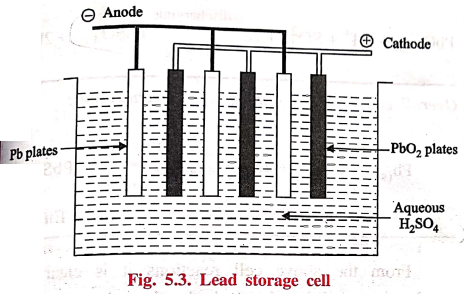
Various plates are
separated from the adjacent one by insulators like rubber (or) glass fibre. The
entire combinations is then immersed in dil. H2SO4 (38%
by mass) having a density of 1.30 gm/ml.
Working (Discharging)
When the lead‒acid
storage battery operates, the following reaction occurs.
At
anode: Lead is oxidized to Pb2+ ions, which
further combines with SO42‒ forms insoluble PbSO4.

At
cathode: PbO2 is reduced to Pb2+ ions,
which further combines with SO42‒ forms insoluble PbSO4.
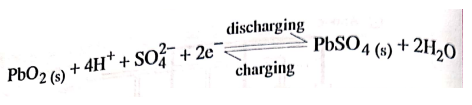
Overall
cell reaction during use (discharging):
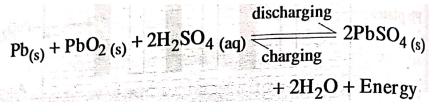
From the above cell
reactions it is clear that, PbSO4 is precipitated at both the
electrodes and H2SO4 is used up. As a result, the
concentration of H2SO4 decreases and hence the density of
H2SO4 falls below 1.2 gm/ml. So the battery needs
recharging.
Recharging the Battery
The cell can be charged
by passing electric current in the opposite direction. The electrode reaction
gets reversed. As a result, Pb is deposited on anode and PbO2 on the
cathode. The density of H2SO4 also increases.
The net reaction during
charging is

Advantages of lead‒acid batteries
(i) It is made easily.
(ii) It produces very
high current.
(iii) The self‒discharging
rate is low when compared to other rechargeable batteries.
(iv) It also acts
effectively at low temperature.
Disadvantages of lead‒acid batteries
(i) Recycling of this
battery causes environmental hazards.
(ii) Mechanical strain
and normal bumping reduces battery capacity.
Uses
1. Lead storage cell is
used to supply current mainly in automobiles such as cars, buses, trucks, etc.,
2. It is also used in
gas engine ignition, telephone exchanges, hospitals, power stations, etc.,
Applied Chemistry I: UNIT 5: Batteries : Tag: Applied Chemistry : Description, Construction, Working, Cell Reactions, Advantages, Disadvantages, Uses | secondary Battery - Lead Acid Storage Cell
Applied Chemistry I: UNIT 5: Batteries
Under Subject

Applied Chemistry I
CY25C01 1st Semester | 2025 Regulation | 1st Semester 2025 Regulation
Related Subjects

English Essentials I
EN25C01 1st Semester | 2025 Regulation | 1st Semester 2025 Regulation

தமிழர் மரபு - Heritage of Tamils
UC25H01 1st Semester | 2025 Regulation | 1st Semester 2025 Regulation
Applied Calculus
MA25C01 Maths 1 M1 - 1st Semester | 2025 Regulation | 1st Semester 2025 Regulation
Applied Physics I
PH25C01 1st Semester | 2025 Regulation | 1st Semester 2025 Regulation
Applied Chemistry I
CY25C01 1st Semester | 2025 Regulation | 1st Semester 2025 Regulation
Makerspace
ME25C04 1st Semester | 2025 Regulation | 1st Semester 2025 Regulation
Computer Programming C
CS25C01 1st Semester | 2025 Regulation | 1st Semester 2025 Regulation

Computer Programming Python
CS25C02 1st Semester | 2025 Regulation | 1st Semester 2025 Regulation
Fundamentals of Electrical and Electronics Engineering
EE25C03 1st Semester | 2025 Regulation | 1st Semester 2025 Regulation
Introduction to Mechanical Engineering
ME25C03 1st Semester | 2025 Regulation | 1st Semester 2025 Regulation

Introduction to Civil Engineering
CE25C01 1st Semester Civil Department | 2025 Regulation | 1st Semester 2025 Regulation
Essentials of Computing
CS25C03 1st Semester - AID CSE IT Department | 2025 Regulation | 1st Semester 2025 Regulation

Applied Physics I Laboratory
PH25C01 1st Semester practical Laboratory Manual | 2025 Regulation | 1st Semester Laboratory 2025 Regulation

Applied Chemistry I Laboratory
CY25C01 1st Semester practical Laboratory Manual | 2025 Regulation | 1st Semester Laboratory 2025 Regulation

Computer Programming C Laboratory
CS25C01 1st Semester practical Laboratory Manual | 2025 Regulation | 1st Semester Laboratory 2025 Regulation

Computer Programming Python Laboratory
CS25C02 1st Semester practical Laboratory Manual | 2025 Regulation | 1st Semester Laboratory 2025 Regulation
Engineering Drawing
ME25C01 EEE Mech Dept | 2025 Regulation | 2nd Semester 2025 Regulation

Basic Electronics and Electrical Engineering
EE25C04 1st Semester ECE Dept | 2025 Regulation | 2nd Semester 2025 Regulation