Applied Chemistry I: UNIT 5: Batteries
Dry Cell (or) Leclanche's Cell
Description, Construction, Working, Cell Reactions, Advantages and Disadvantages, Uses | Primary Battery
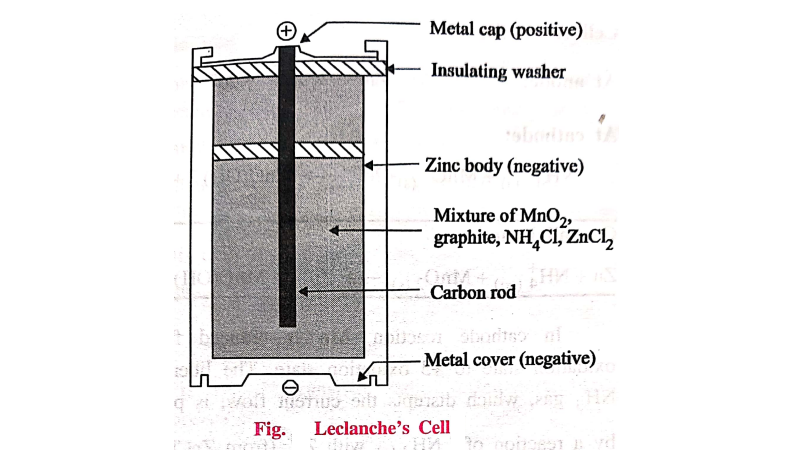
It is a primary cell, which works without fluid component.
Dry Cell (or)
Leclanche's Cell - PRIMARY BATTERIES
It is a primary cell,
which works without fluid component.
Description
Anode
:
Zinc
Cathode
:
Carbon rod (graphite)
Electrolyte
:
( NH4Cl + ZnCl2 + MnO2 + Starch + H2O
)
Emf
: 1.5
V
Construction
A dry cell consists of
a zinc cylinder, which acts as anode. This zinc cylinder is filled with an
electrolyte consisting of NH4Cl, ZnCl2 and MnO2
in the form of paste using starch and water.

A carbon rod
(graphite), acts as cathode, is immersed in the electrolyte in the centre of
the cell. The zinc cylinder has an outer insulation of cardboard case. During
use, the zinc cylinder gets consumed and at the end, it will develop holes
which are responsible for leakages.
Working
When the cell is working,
zinc loses electrons and Zn2+ ions gets dissolved in the
electrolyte. The electrons pass through the circuit and are consumed at
cathode. This causes discharge of NH4+ ions from the
electrolyte.
Cell reactions:
At
anode: Zn → Zn2+
+ 2e‒
At
cathode: NH4+(aq) + MnO2(s)
+ 2e‒ → MnO(OH) ̄ + NH3
Overall
Reaction:
Zn + NH4+(aq)
+ MnO2(s) → Zn2+ + MnO(OH) ̄ + NH3
In cathode reaction, Mn
is reduced from +4 oxidation +3 oxidation state. The liberation of NH3
gas, which disrupts the current flow, is prevented by a reaction of NH3(g)
with Zn2+ (from ZnCl2).
ZnCl2 + 2NH3 → [ Zn(NH3)2 ] Cl2(s)
The voltage of
Leclanche's cell is about 1.5 V.
Advantages and Disadvantages of Leclanche's cell
Advantages
1. The cost of dry cell
is cheap and easily available.
2. The compact size of
it makes it suitable for powering small electronic devices.
3. The electrolyte used
in dry cell is not harmful and no leakage.
4. It is easy and safe
for transportation.
Disadvantages
1. This dry cell does not
have an indefinite life, because NH4Cl being acidic corrodes the
zinc container, even if it is not used.
2. When current is
drawn rapidly from it, products build up on the electrodes, so voltage drop
occurs.
3. This cell can not be
recharged.
4. Voltage decreases
with continuous usage.
Uses:
It is used in
transistor radios, calculators, Flash lights, torches etc.,
Applied Chemistry I: UNIT 5: Batteries : Tag: Applied Chemistry : Description, Construction, Working, Cell Reactions, Advantages and Disadvantages, Uses | Primary Battery - Dry Cell (or) Leclanche's Cell
Applied Chemistry I: UNIT 5: Batteries
Under Subject

Applied Chemistry I
CY25C01 1st Semester | 2025 Regulation | 1st Semester 2025 Regulation
Related Subjects

English Essentials I
EN25C01 1st Semester | 2025 Regulation | 1st Semester 2025 Regulation

தமிழர் மரபு - Heritage of Tamils
UC25H01 1st Semester | 2025 Regulation | 1st Semester 2025 Regulation
Applied Calculus
MA25C01 Maths 1 M1 - 1st Semester | 2025 Regulation | 1st Semester 2025 Regulation
Applied Physics I
PH25C01 1st Semester | 2025 Regulation | 1st Semester 2025 Regulation
Applied Chemistry I
CY25C01 1st Semester | 2025 Regulation | 1st Semester 2025 Regulation
Makerspace
ME25C04 1st Semester | 2025 Regulation | 1st Semester 2025 Regulation
Computer Programming C
CS25C01 1st Semester | 2025 Regulation | 1st Semester 2025 Regulation
Computer Programming Python
CS25C02 1st Semester | 2025 Regulation | 1st Semester 2025 Regulation
Fundamentals of Electrical and Electronics Engineering
EE25C03 1st Semester | 2025 Regulation | 1st Semester 2025 Regulation
Introduction to Mechanical Engineering
ME25C03 1st Semester | 2025 Regulation | 1st Semester 2025 Regulation

Introduction to Civil Engineering
CE25C01 1st Semester Civil Department | 2025 Regulation | 1st Semester 2025 Regulation
Essentials of Computing
CS25C03 1st Semester - AID CSE IT Department | 2025 Regulation | 1st Semester 2025 Regulation

Applied Physics I Laboratory
PH25C01 1st Semester practical Laboratory Manual | 2025 Regulation | 1st Semester Laboratory 2025 Regulation

Applied Chemistry I Laboratory
CY25C01 1st Semester practical Laboratory Manual | 2025 Regulation | 1st Semester Laboratory 2025 Regulation

Computer Programming C Laboratory
CS25C01 1st Semester practical Laboratory Manual | 2025 Regulation | 1st Semester Laboratory 2025 Regulation

Computer Programming Python Laboratory
CS25C02 1st Semester practical Laboratory Manual | 2025 Regulation | 1st Semester Laboratory 2025 Regulation
Engineering Drawing
ME25C01 EEE Mech Dept | 2025 Regulation | 2nd Semester 2025 Regulation

Basic Electronics and Electrical Engineering
EE25C04 1st Semester ECE Dept | 2025 Regulation | 2nd Semester 2025 Regulation