Applied Chemistry I: UNIT 5: Batteries
Nickel‒Cadmium Cell (or) Nicad Battery
Description, Construction, Working, Cell Reactions, Advantages, Disadvantages, Uses | secondary Battery
This is also a rechargeable battery.
Nickel‒Cadmium Cell
(or) Nicad Battery
- SECONDARY BATTERY
This is also a
rechargeable battery.
Description
Anode:
Cadmium
Cathode:
Metal grid + NiO2 paste
Electrolyte:
KOH
Emf:
1.4 V
Cell
diagram: Cd | Cd(OH)2 || KOH (aq) | NiO2
| Ni
Construction
Nickel‒cadmium cell
consists of a cadmium anode and a metal grid containing a paste of NiO2
acting as a cathode. The electrolyte in this cell is KOH.
Working (Discharging)
When the Nicad battery
operates, at the anode cadmium is oxidised to Cd2+ ions and
insoluble Ca(OH)2 is formed. It produces about 1.4V.
At
anode: Cadmium is oxidised to Cd2+ and further
it combines with OH‒ ions to form Cd(OH)2.

At
cathode: NiO2 is reduced to Ni2+ ions which further combine with OH‒ ions
to form Ni(OH)2.

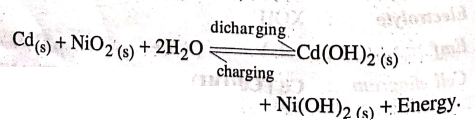
Overall
reaction during use (discharging)
From the above cell
reactions it is clear that, there is no formation of gaseous products, the
products Ca(OH)2 and Ni(OH)2 adhere well to the surfaces.
This can be reconverted by recharging the cell.
Recharging the Battery
The recharging process
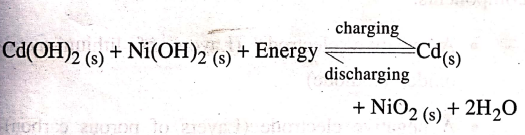
is similar to lead storage battery. When the current is passed in the opposite
direction, the electrode reaction gets reversed. As a result, Cd gets deposited
on anode and NiO2 on the cathode.
The net reaction during
charging is
Advantage
1. It is smaller and
lighter.
2. It has longer life
than lead storage cell.
3. Like a dry cell, it
can be packed in a sealed container.
Disadvantage
It is more expensive
than lead storage battery.
Uses
It is used in calculators,
electronic flash units, transistors and cordless appliances.
Applied Chemistry I: UNIT 5: Batteries : Tag: Applied Chemistry : Description, Construction, Working, Cell Reactions, Advantages, Disadvantages, Uses | secondary Battery - Nickel‒Cadmium Cell (or) Nicad Battery
Applied Chemistry I: UNIT 5: Batteries
Under Subject

Applied Chemistry I
CY25C01 1st Semester | 2025 Regulation | 1st Semester 2025 Regulation
Related Subjects

English Essentials I
EN25C01 1st Semester | 2025 Regulation | 1st Semester 2025 Regulation

தமிழர் மரபு - Heritage of Tamils
UC25H01 1st Semester | 2025 Regulation | 1st Semester 2025 Regulation
Applied Calculus
MA25C01 Maths 1 M1 - 1st Semester | 2025 Regulation | 1st Semester 2025 Regulation
Applied Physics I
PH25C01 1st Semester | 2025 Regulation | 1st Semester 2025 Regulation
Applied Chemistry I
CY25C01 1st Semester | 2025 Regulation | 1st Semester 2025 Regulation
Makerspace
ME25C04 1st Semester | 2025 Regulation | 1st Semester 2025 Regulation
Computer Programming C
CS25C01 1st Semester | 2025 Regulation | 1st Semester 2025 Regulation
Computer Programming Python
CS25C02 1st Semester | 2025 Regulation | 1st Semester 2025 Regulation
Fundamentals of Electrical and Electronics Engineering
EE25C03 1st Semester | 2025 Regulation | 1st Semester 2025 Regulation
Introduction to Mechanical Engineering
ME25C03 1st Semester | 2025 Regulation | 1st Semester 2025 Regulation

Introduction to Civil Engineering
CE25C01 1st Semester Civil Department | 2025 Regulation | 1st Semester 2025 Regulation
Essentials of Computing
CS25C03 1st Semester - AID CSE IT Department | 2025 Regulation | 1st Semester 2025 Regulation

Applied Physics I Laboratory
PH25C01 1st Semester practical Laboratory Manual | 2025 Regulation | 1st Semester Laboratory 2025 Regulation

Applied Chemistry I Laboratory
CY25C01 1st Semester practical Laboratory Manual | 2025 Regulation | 1st Semester Laboratory 2025 Regulation

Computer Programming C Laboratory
CS25C01 1st Semester practical Laboratory Manual | 2025 Regulation | 1st Semester Laboratory 2025 Regulation

Computer Programming Python Laboratory
CS25C02 1st Semester practical Laboratory Manual | 2025 Regulation | 1st Semester Laboratory 2025 Regulation
Engineering Drawing
ME25C01 EEE Mech Dept | 2025 Regulation | 2nd Semester 2025 Regulation

Basic Electronics and Electrical Engineering
EE25C04 1st Semester ECE Dept | 2025 Regulation | 2nd Semester 2025 Regulation