Applied Chemistry I: UNIT 5: Batteries
Lithium‒ion battery (LIB) (or) Lithium‒ion cell
Description, Components, Construction, Working, Cell Reactions, Advantages, Disadvantages, Applications | secondary Battery
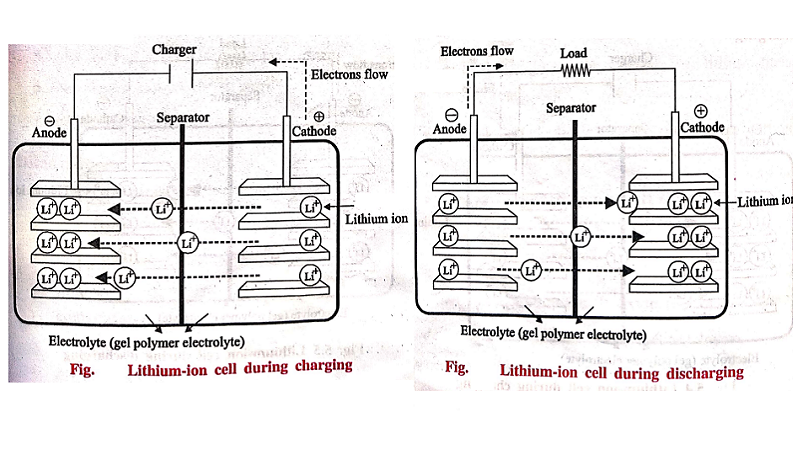
Lithium‒ion battery is a secondary battery. As in lithium cell, it does not contain metallic lithium as anode. As the name suggests, the movement of lithium ions are responsible for charging and discharging.
Lithium‒ion battery
(LIB) (or) Lithium‒ion cell
- SECONDARY BATTERY
Lithium‒ion battery is
a secondary battery. As in lithium cell, it does not contain metallic lithium
as anode. As the name suggests, the movement of lithium ions are responsible
for charging and discharging.
Components
Lithium‒ion cell has
the following three components.
• A positive electrode
(Layers of lithium‒metal oxide) (cathode)
• A negative electrode
(Layers of porous carbon) (anode)
• An electrolyte
(Polymer gel) (separator)
Description
Cathode:
Lithium‒cobalt oxide (LiCoO2) Layers
Anode:
Graphite (Porous carbon) layers
Electrolyte:
Polymer gel (organic solvent)
Construction
The positive electrode
is typically made from a layers of chemical compound called lithium‒cobalt
oxide (LiCoO2).
The negative electrode
is made from layers of porous carbon (C) (graphite).
Both the electrodes are
dipped in a polymer gel electrolyte (organic solvent) and separated by a
separator, which is a perforated plastic and allows the Li+ ions to
pass through.
Working
Charging
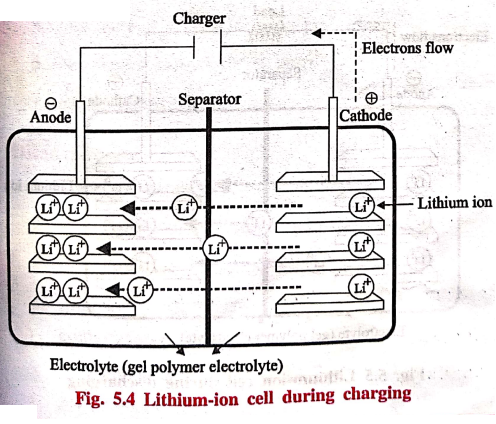
During charging, Li+
ions flow from the positive electrode (LiCoO2) to the negative
electrode (graphite) through the electrolyte. Electrons also flow from the
positive electrode to the negative electrode through the wire. The electrons
and Li+ ions combine at the negative electrode and deposit there as
Li.
LiCoO2 + C →
Li1‒xCoO2 + CLix
Discharging
During discharging, the
Li+ ions flow back through the electrolyte from negative electrode
to the positive electrode. Electrons flow from the negative electrode to the
positive electrode through the wire.
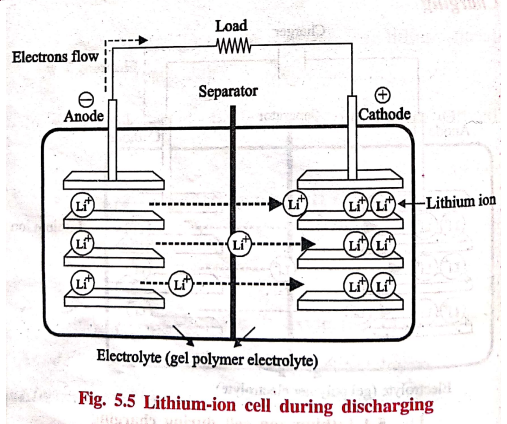
The Li+ ions
and electrons combine at the positive electrode and deposit there as Li.
Li1‒xCoO2
+ CLix → LiCoO2 + C
Advantages and Disadvantages of lithium‒ion batteries
Advantages
1. It is light in
weight.
2. Rate of self‒discharge
is low.
3. Have higher energy
density than other rechargeable batteries.
4. Have a greater
number of charge and discharge of cycles.
5. Operates at higher
voltage (3.7 V)
6. No liquid
electrolyte is used.
7. Easy maintenance.
Disadvantages
1. They are expensive.
2. Availability of
lithium is difficult.
3. Difficulties in
transportation.
4. Improper disposal
leads to environment contamination.
5. It is temperature‒sensitive
battery and explode at high temperature.
Applications
1. It is used in
portable electronic devices like cellular phones, digital cameras, tablets and
laptop computers.
2. It is used in
biomedical implantable devices such as pace makers.
3. It is currently used
in most electric vehicles because of their high energy per unit mass.
Applied Chemistry I: UNIT 5: Batteries : Tag: Applied Chemistry : Description, Components, Construction, Working, Cell Reactions, Advantages, Disadvantages, Applications | secondary Battery - Lithium‒ion battery (LIB) (or) Lithium‒ion cell
Applied Chemistry I: UNIT 5: Batteries
Under Subject

Applied Chemistry I
CY25C01 1st Semester | 2025 Regulation | 1st Semester 2025 Regulation
Related Subjects

English Essentials I
EN25C01 1st Semester | 2025 Regulation | 1st Semester 2025 Regulation

தமிழர் மரபு - Heritage of Tamils
UC25H01 1st Semester | 2025 Regulation | 1st Semester 2025 Regulation
Applied Calculus
MA25C01 Maths 1 M1 - 1st Semester | 2025 Regulation | 1st Semester 2025 Regulation
Applied Physics I
PH25C01 1st Semester | 2025 Regulation | 1st Semester 2025 Regulation
Applied Chemistry I
CY25C01 1st Semester | 2025 Regulation | 1st Semester 2025 Regulation
Makerspace
ME25C04 1st Semester | 2025 Regulation | 1st Semester 2025 Regulation
Computer Programming C
CS25C01 1st Semester | 2025 Regulation | 1st Semester 2025 Regulation
Computer Programming Python
CS25C02 1st Semester | 2025 Regulation | 1st Semester 2025 Regulation
Fundamentals of Electrical and Electronics Engineering
EE25C03 1st Semester | 2025 Regulation | 1st Semester 2025 Regulation
Introduction to Mechanical Engineering
ME25C03 1st Semester | 2025 Regulation | 1st Semester 2025 Regulation

Introduction to Civil Engineering
CE25C01 1st Semester Civil Department | 2025 Regulation | 1st Semester 2025 Regulation
Essentials of Computing
CS25C03 1st Semester - AID CSE IT Department | 2025 Regulation | 1st Semester 2025 Regulation

Applied Physics I Laboratory
PH25C01 1st Semester practical Laboratory Manual | 2025 Regulation | 1st Semester Laboratory 2025 Regulation

Applied Chemistry I Laboratory
CY25C01 1st Semester practical Laboratory Manual | 2025 Regulation | 1st Semester Laboratory 2025 Regulation

Computer Programming C Laboratory
CS25C01 1st Semester practical Laboratory Manual | 2025 Regulation | 1st Semester Laboratory 2025 Regulation

Computer Programming Python Laboratory
CS25C02 1st Semester practical Laboratory Manual | 2025 Regulation | 1st Semester Laboratory 2025 Regulation
Engineering Drawing
ME25C01 EEE Mech Dept | 2025 Regulation | 2nd Semester 2025 Regulation

Basic Electronics and Electrical Engineering
EE25C04 1st Semester ECE Dept | 2025 Regulation | 2nd Semester 2025 Regulation