Linear Algebra: UNIT III: Inner Product Spaces
Adjoint of Linear Operator
Definition and Theorems - Adjoint of Linear Operator.
ADJOINT OF LINEAR
OPERATOR
Definition
Adjoint of linear
operator:
Let
V be a finite dimensional inner product space and let T be a linear operator on
V. Then there exist a unique function T* : V→ V such that < T(x), y > = <
x, T*(y) > for all x, y ∈
V. The linear operator T* is called adjoint of operator T.
Theorem 1
Let V be an inner
product space and let T and U be a linear operator on V then
(a) (T+U)* = T* + U*
(b) (cT)* =  T*
for any c ∈
F
T*
for any c ∈
F
(c) (TU)* = U*T*
(d) T**=T
(e) I*=I
Proof:
(a) (T+U)* = T* +U*
<
x, (T + U)* (y) > = < (T + U) (x), y >
= < T(x)+U (x), y >
=
< T(x), y> + <U (x), y>
=
<x, T*(y) > + < x, U*(y) >
=
< x, T*(y) + U*(y) >
=
< x, (T* + U*) y >
(T + U)* (y) = (T* + U*) (y)
(T + U)* = T* + U*
(b) (cT)* =T*
< x, (cT)* y > = < cT (x), y >
= < x, T*(v) >
= < x, T*(v) >
(CT)* = T*
(c) (TU)*=U*T*
< x, (TU)* (y) > = < (TU) (x), y >
= <T(x) U (x), y>
=
<T(x), y> < U(x), y >
=
<x, T*(y) ) ( x, U*(y) >.
=
< x, U*(y) T*(y) >
(TU)* = U*T*
(d) T**=T
<
x,T(y) > = < T*(x), y >
=
< x, T**(y) >
T
(y) = T**(y)
T = T**
Theorem 2
Let V be a finite
dimensional inner product space over F, and let g: V →F be a linear
transformation. Then there exists a unique vector y ∈ V such that g(x)=<x,y> for
all x ∈
V.
Proof:
Let
β = {v1, v2, v3... vn} be an
orthonormal basis for V1 and let
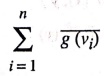
Let
us define h: V→F by h(x) = <x, y> which is linear.
Further
1 ≤ j ≤ n we have
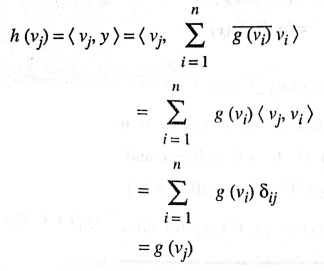
Since
g and h both on B, we have g=h.
Theorem 3
Let V be a finite
dimensional inner product space, and let T be a linear operator on V. Then
there exists a unique function. T* : V → V such that
< T (x), y > = < x, T*(y) > for
all x, y ∈
V and T* is linear.
Proof:
Let
y ∈ V. Define g: V→F by
g(x)= <T(x), y> for all x ∈
V. To show g is linear, let x1,
x2 ∈
V and c ∈ F.
g(cx1+x2)
= < T(cx1 + x2),
y > = < cT (x1) + T
(x2), y >
= c<T(x1),
y> + <T(x2), y> = cg(x1) + g(x2)
Hence
g is linear.
To
obtain a unique vector y' ∈
V such that
g(x) = <x, y'>.
(i.e)
< T(x), y> = <x, y'> for all x ∈
V.
Define
T* : V→ V by T*(y) = y', we have
< T(x), y > = <x, T* (y)>
To
show T* is linear
Let
y1, y2 ∈ V and c ∈ F. For any x ∈ V we have
<x,
T* (cy1+ y2) >
= < T (x), cy1 + y2
>
= <T(x), y1 > + <
T (x), y2 >
= <x, T* (y1) >
+ < x, T*(y2) >
=
< x, cT* (y1) + T*(y2) >
Since
x is arbitrary T* (cy1 + y2)
= cT*(y1) + T*(y2).
Finally
we have to show that T* is unique.
Suppose
that U: V→V is linear and it satisfies
< T(x), y > = < x, U (y) > for all
x, y ∈ V.
Then
< x, T*(y) > = <x, U (y)> for all x, y ∈ V, so T*= U.
Note:
The linear operator T* is called the adjoint of the operator T. The symbol T*
is read as “T star”.
T*
is the unique operator on V satisfying
< T(x), y > = <x, T*(y) > for all
x, y ∈ V.
<x, T(y)> = 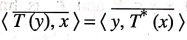 = < T*(x), y>
So < x, T(y) > = <T*(x), y> for
all x, y ∈
V.
Theorem 4
Let V be a finite
dimensional inner product space, and let β be an orthonormal basis for V. If T
is a linear operator on V, then [T*]β = [T]*β
Proof:
Let
A = [T]β, B = [T]*β and let β = {v1,
v2, v3... vn }
Then
Bij = < T* (vi), vj
>
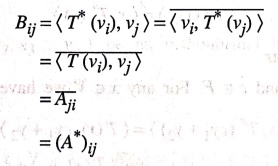
=
(A*)ij
Hence
B = A*
Theorem 5
Let A be an n×n matrix.
Then LA* = (LA)*.
Proof:
If
β is the standard ordered basis for Fn, then
[LA]β = A. Hence [(LA)*β]
= [LA]*β = A* = [L*A]β =, and so (LA)*
= LA*
Corollary:
Let
A and B be n×n matries. Then
(a)
(A+B)* = A*+B*
(b)
(cA)* = A* for all c ∈
F
(c)
(AB)* = B*A*
(d)
A** = A
(e)
I* =I
Theorem 6
Let V be a non−zero
finite dimensional inner product space. Then V has an orthonormal basis β.
Furthermore if β= { v1, v2, ... vn} and x ∈ V then x = i=1Σn
<x,vi>vi.
Proof:
Given
V is an finite dimensional inner product space.
Let
β0 be an ordered basis for V.
Then
by Gram Schmidt orthogonalization process, we can obtain an orthogonal set β'
of non zero vectors with span (β') = span (β0)
Since
β0 is a basis of V, span (β0) = V = span (β0').
By
normalizing each vector in β0', we obtain an orthonormal set β that
generates V.
Since
β has non−zero orthogonal vectors,
⇒ β is linearly
independent.
β
is an orthonormal basis for V.
(By
corollary) Let β = (v1, v2, …. vn}
Since
x ∈ V = span (β) and β is
an orthonormal set then x= i=1Σn <x,vi>vi.
Linear Algebra: UNIT III: Inner Product Spaces : Tag: maths, mathematics : - Adjoint of Linear Operator
Linear Algebra: UNIT III: Inner Product Spaces
Under Subject
Linear Algebra
MA25C02 2nd Semester | 2025 Regulation
Related Subjects

English Essentials II
EN25C02 2nd Semester | 2025 Regulation | 2nd Semester 2025 Regulation

Tamils and Technology தமிழர்களும் தொழில்நுட்பமும்
UC25H02 2nd Semester | 2025 Regulation | 2nd Semester 2025 Regulation
Linear Algebra
MA25C02 2nd Semester | 2025 Regulation
Transforms and its Applications
MA25C03 2nd Semester EEE Dept | 2025 Regulation | 2nd Semester 2025 Regulation

Applied Physics (CE) II
PH25C02 2nd Semester Civil, Agri Depts | 2025 Regulation | 2nd Semester 2025 Regulation
Applied Physics (CSIE) II
PH25C03 2nd Semester AIDS, CSE, IT, CSE(CY) Dept | 2025 Regulation | 2nd Semester 2025 Regulation
Applied Physics (EE) II
PH25C04 2nd Semester EEE Dept | 2025 Regulation | 2nd Semester 2025 Regulation

Applied Physics (ME) II
PH25C05 2nd Semester Mechanical Dept | 2025 Regulation | 2nd Semester 2025 Regulation

Applied Chemistry (CE) II
CY25C02 2nd Semester Civil Dept | 2025 Regulation | 2nd Semester 2025 Regulation

Applied Chemistry (ME) II
CY25C03 2nd Semester Mechanical Dept | 2025 Regulation | 2nd Semester 2025 Regulation

Electron Devices
EC25C01 2nd Semester ECE Dept | 2025 Regulation | 2nd Semester 2025 Regulation

Digital Principles and Computer Organization
CS25C06 2nd Semester AIDS, CSE, IT, CSE(CY) Dept | 2025 Regulation | 2nd Semester 2025 Regulation

Basic Electrical and Electronics Engineering
EE25C01 2nd Semester | 2025 Regulation | 2nd Semester 2025 Regulation

Basic Civil and Mechanical Engineering
GE25C01 2nd Semester EEE Dept | 2025 Regulation | 2nd Semester 2025 Regulation
Data Structures using CPlusPlus
CS25C05 2nd Semester ECE Dept | 2025 Regulation | 2nd Semester 2025 Regulation
Engineering Drawing
ME25C01 EEE, Mech, Agri, EEE Depts | 2025 Regulation | 2nd Semester 2025 Regulation
Data Structures and Algorithms
CS25C04 2nd Semester EEE Dept | 2025 Regulation

Circuits and Network Analysis
EC25C02 2nd Semester ECE Dept | 2025 Regulation | 2nd Semester 2025 Regulation

Engineering Mechanics
ME25C02 2nd Semester Mech, Civil, Agri Depts | 2025 Regulation | 2nd Semester 2025 Regulation
Object Oriented Programming (OOPs)
CS25C07 2nd Semester CSE, CSE(CY) Depts | 2025 Regulation | 2nd Semester 2025 Regulation