Linear Algebra: UNIT III: Inner Product Spaces
Inner Product Spaces : 2 Marks Important Questions With Answer
Linear Algebra
Linear Algebra: UNIT III: Inner Product Spaces: Important Two Marks Questions with Answers
INNER PRODUCT SPACEST
2 Marks Important
Questions with Answer
1. Define an inner product in vector
spaces.
Let
V be a vector space over F. An inner product on V is a function that assigns to
every ordered pair of vectors x & y in V, a scalar in F, denoted (x, y)
such that for all x, y, z in V, & all c in F, the following conditions
hold.
1.
<x+z,y> = <x, y> + <z, y>
2.
<cx, y> = c<x, y>
3.  = <y, x>, where the bar denotes complex conjugate.
4.
<x, x> > 0 if x≠0.
Note
(i)
For Real numbers (ie F=R), <x,y> = <y, x>
(ii)
< nΣi=1 aivi,y > = nΣi=1
ai<viy> where ai, ∈ F.
2. Given that U= (2,−3, 6) and V=
(8, 2,−3). Find UV?
Solution:
U.V (16−6−18) = −8.
U.V exists.
Suppose
that U= (1, −3, 0, 5) & V= (3, 6, 4).
Here
U.V doesn't exist. Because U is an 1×4 and V is an 1×3 structures.
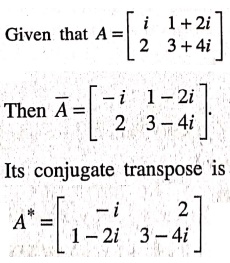
3. Given that A = 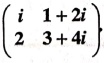 . Find the
conjugate transpose.
. Find the
conjugate transpose.
Solution:
4. Show that in F3, the
vectors (1, 1, 0), (1, − 1, 1), (− 1, 1, 2) are orthogonal. Are they
orthonormal?
Solution:
Let
x=(1,1,0); y=(1,−1, 1); z=(−1, 1, 2)
<x,y>
= 1−1+0=0;
<x,
z> = −1+1+0;
<y,
z> = −1−1+2=0
x, y, z are mutually orthogonal vectors
||
x || = √<x, x> = √[(1)2 + (1)2 + (0)2] =
√2 ≠ 1
||
y || = √<x, y> = √[(1)2 + (1)2 + (1)2] =
√3 ≠ 1.
||
z || = √[(− 1)2 + (1)2 + (2)2 = √6 ≠ 1
The
vectors are not orthonormal. If the normalize the vectors in the set, we obtain
the orthonormal set as
{(
1/√2, 1/√2, 0 ), ( 1/√3, −1/√3, 1/√3 ), ( −1/√6, −1/√6, 2/√6 ) }
5. Let (a, b) = (c, d) = (0, 1) ∈ R2. Prove that < (a, b), (c, d) > = ac –
bd is not an inner product.
Solution:
It
is given that (a, b) = (c, d) = (0, 1) ∈
R2
Also
given that < (a, b), (c, d) > = ac − bd.
< (0, 1), (0, 1) > = (0)(0) − (1)(1) = −1.
Hence
< (0, 1), (0, 1) > = − 1 < 0.
This
is a contradiction to the hypothesis <x, x> > 0 if x ≠ 0.
It is
not an inner product on R2.
6. Let β be a basis for a finite
dimensional inner product space. If <x, z> = <y,z> for all z ∈ β then prove that x=y.
Solution:
Given
that β is a basis and also it is given that <x, y> = <y, z>.
Now
we have to prove that x=y
For
all z ∈ β, <x, z> = <y,
z>
<x, z> ‒ <y, z> = 0
<x−y,
z> = 0
Here
x−y=0 and z = 0. Since z ∈
B, the vector z ≠ 0
x−y = 0 ⇒ z
≠0.
Hence
x−y = 0 ⇒ x=y.
7. Let V=R2 and S = {(1,
0), (0, 1)}. Check whether S is orthonormal basis or not.
Solution:
Let
V=R2.
Define
|| (a, b) ||= Max {|a|, |b|}
(i)
|| (a, b) || = Max {|a|,|b|} ≥ 0
(ie)
|| (a, b) || = 0 if a=0 and b=0
(ii)
|| c (a, b) || = Max {|ca|, | cb|}
=
Max { |c||a|, |c||b|}
=
|c| . Max {|a||b|}
=
| c | ||(a, b)||
(iii)
|| (a, b), (c, d) || = || (a+c), (b+d) ||
=
Max { |a+c|, |b+d| }
≤
Max { |a|+|c|, |b|+|d| }
≤
Max { |a|,|b|} + Max{|c|,|d||}
Since
all the three norm conditions are satisfied,
|| (a, b) || = Max {|a|,|b|} is a norm.
8. Let V=Fn and A ∈ Mm×n(F). Prove that <x, Ay> =
<A*x,y> for all x, y ∈ V.
Solution:
Given
that V=Fn and A ∈
Mm×n (F).
By
the definition of the standard inner product, we have
<x,
y> = y*x
<x, Ay> = (Ay)*x
=
y*A*x
=
<A*x, y>
<x, Ay> = <A* x, y>
9. Let V be an inner product space.
Let x and y be orthogonal vectors in V. Prove that ||x+y||2 = ||x||
+ ||y||2.
Solution:
Since
x and y are orthogonal, <x, y> =0
Then <y, x>==0
||
x + x||2 = <x+y, x+y>
=
<x, x + y> + <y, x+y>
=
<x, x> + <x,y> + <y, x> + <y,y>
=
<x, x> + <y, y>
( <x, y> = 0 = <y, x>
)
||
x + x||2 = || x ||2 + || y ||2
10. Prove that || x + y ||2
+ || x − y ||2 = 2|| x ||2 + 2|| y ||2 for all
x, y ∈ V.
Solution:
|| x + y ||2 + || x − y ||2
= < x + y, x+y> + <x−y, x−y>
= <x,x+y> + <y, x+y> + <x, x−y>
− <y, x−y>
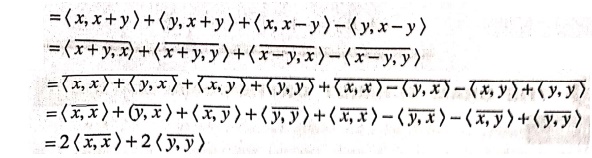
= 2||x||2 + 2||y||2
|| x +
y ||2 + || x − y ||2 = 2|| x ||2 + 2||y||2
for all x, y ∈
V.
11. Let V be an inner product space.
Prove that || x || − || y || ≤ || x − y || for all x, y ∈ V.
Solution:
By
the concept of triangle inequality,
We
have ||x|| − ||y|| = || x−y+y || − || y ||
≤ ||x−y|| + ||y|| − ||y||
≤ ||x−y ||
| || x || − || y || | ≤ || x−y || for all x,
y ∈ V.
12. Let R2 have the
weighted Euclidean inner product defined as <u, v> = 2u1v1
+ 3u2v2 and let u = (1, 1), v = (3, 2), w = (0, −1).
Compute the value of <u + v, 3w>.
Solution:
Given
that
<
u, v> = 2u1v1 + 3u2v2
u+v = (1, 1)+(3,2) = (4, 3) and 3w = 3(0,−1) =
(0,−3)
<u+v, 3w> = 2(4)(0) + 3(3)(−3) = 0+(−27)
= −27
13. Let V=R2. Define T
(a, b) = (2a + b, a − 3b) and x = (3, 5). Evaluate T* for V=R2.
Solution:
Let α= {(1, 0), (0, 1)} be the standard basis
for V=R2.
It
is given that T(a, b) = (2a + b, a − 3b)
T(1, 0) = (2 (1) +0, 1−3 (0)) = (2, 1)
T(0, 1) = (2 (0)+1, 0−3 (1)) = (1,−3)
Therefore T = 
Since
V=R2 is real [T]α = [T]*α
The
adjoint operator T* at x=(3, 5) is defined as follows.
[T*(x)]α
= [T*]α [x]α = [T]*α [x]α
= [T]α [x]α
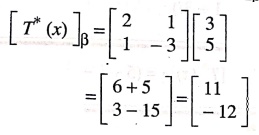
T* at x = (3, 5) is T*(x) = (11, ‒12)
14. Verify the Cauchy−Schwarz
inequality for x = (1,−1,3) and y = (2, 0, −1).
Solution:
We
know that the Cauchy Schwarz inequality is
│< x, y> | ≤ ||x|| ||y||
|
x ⋅ y | = | (1, − 1, 3) .
(2, 0, − 1) | = | 2+0−3| = |−1| = 1
|| x || = √[(1)2 + (−1)2
+ (3)2] = √[1+1+9] = √11.
|| y || = √[(2)2 + (0)2
+ (− 1)2] = √[4 + 0 + 1] = √5
| <
x, y> | ≤ ||x|| ||y||
1 ≤ √11.√5
1 ≤ √55
Cauchy − Schwarz inequality is satisfied.
15. Show that the following set is a
basis for R4.
S = {(2, 3, 2, − 2), (1, 0, 0, 1),
(− 1, 0, 2, 1), (− 1, 2, − 1, 1) }.
Solution:
Let
v1 = (2,3,2,−2), v2 = (1, 0, 0, 1), v3 = (−1,
0, 2, 1) and v4= (−1, 2, 1, 1). The set S has 4 non zero vectors. We
can show that S is a basis for R4 by showing that it is an
orthogonal set as follows.
v1.v2
= 2+0 +0−2=0
v1.v3
=−2+0+4−2=0
v1.v4
=−2+6−2−2=0
v2.v3
= −1+0+0+1=0
v2.v4
=−1+0+0+1=0
v2.v4
=1+0−2+1=0
So
S is orthogonal and since orthogonal sets are linearly independent it is a
basis for R4.
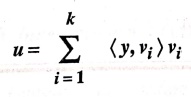
16. State the projection theorem in
vector spaces.
Let
W be a finite dimensional subspace of an inner product space V and let y ∈ V. Then there exists
unique vectors u ∈
W and z ∈ W┴ such that y=u+z.
Furthermore, if {v1, v2, ..., vk } is an
orthonormal basis for W, then
17. Define g: R2 → R by g
(a1, a2) = 2a1+a2. Prove that
g is a linear transformation.
Solution
Let
β = {e1, e2} and let y=g(e1)e1 + g(e2)е2
=
2e1 + e2 = (2, 1)
Then
g(a1, a2) = < (a1, a2), (2, 1)
> = 2a1 + a2
18. Let T be the linear operator on
C2 defined by T(a1, a2)=(2ia1+3a2, a1−a2)
If
β is the standard ordered basis for C2, then find the adjoint.
Solution
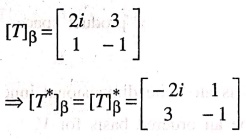
Here T*(a1, a2)
= (−2ia1 + a2, 3a1−a2)
19. Let A ∈ Mm×n(F). Then prove that the rank (A*A) = rank (A).
Proof:
By
the dimension theorem, we need to show that, for x ∈ Fn, we have
A*Ax=0 if and only if Ax=0. Cleanly, Ax=0 ⇒
A* Ax=0. `So assume that A*Ax=0. Then
0 = <A*Ax, x>ν = <Ax, A** x>μ
= <Ax, Ax>μ ⇒
Ax=0.
20. If A is an m×n matrix such that
rank (A)= n, then prove that A*A is invertible.
Proof:
Let
A be an m×n matrix and y ∈
Fm. Define W= { Ax: x ∈
Fn };
(i.e) W=R(LA). Then there exists a
unique vector in W that is closest to y. Call this vector Ax0 where
x0 ∈
Fn. Then || Ax0 − y || ≤ || Ax−y || for all x ∈ Fn. So x0
has the property that E = || Ax0−y || is minimal.
Linear Algebra: UNIT III: Inner Product Spaces : Tag: maths, mathematics : Linear Algebra - Inner Product Spaces : 2 Marks Important Questions With Answer
Linear Algebra: UNIT III: Inner Product Spaces
Under Subject

Linear Algebra
MA25C02 2nd Semester | 2025 Regulation
Related Subjects

English Essentials II
EN25C02 2nd Semester | 2025 Regulation | 2nd Semester 2025 Regulation

Tamils and Technology தமிழர்களும் தொழில்நுட்பமும்
UC25H02 2nd Semester | 2025 Regulation | 2nd Semester 2025 Regulation
Linear Algebra
MA25C02 2nd Semester | 2025 Regulation

Transforms and its Applications
MA25C03 2nd Semester EEE Dept | 2025 Regulation | 2nd Semester 2025 Regulation

Applied Physics (CE) II
PH25C02 2nd Semester Civil, Agri Depts | 2025 Regulation | 2nd Semester 2025 Regulation

Applied Physics (CSIE) II
PH25C03 2nd Semester AIDS, CSE, IT, CSE(CY) Dept | 2025 Regulation | 2nd Semester 2025 Regulation
Applied Physics (EE) II
PH25C04 2nd Semester EEE Dept | 2025 Regulation | 2nd Semester 2025 Regulation

Applied Physics (ME) II
PH25C05 2nd Semester Mechanical Dept | 2025 Regulation | 2nd Semester 2025 Regulation

Applied Chemistry (CE) II
CY25C02 2nd Semester Civil Dept | 2025 Regulation | 2nd Semester 2025 Regulation

Applied Chemistry (ME) II
CY25C03 2nd Semester Mechanical Dept | 2025 Regulation | 2nd Semester 2025 Regulation

Electron Devices
EC25C01 2nd Semester ECE Dept | 2025 Regulation | 2nd Semester 2025 Regulation

Digital Principles and Computer Organization
CS25C06 2nd Semester AIDS, CSE, IT, CSE(CY) Dept | 2025 Regulation | 2nd Semester 2025 Regulation

Basic Electrical and Electronics Engineering
EE25C01 2nd Semester | 2025 Regulation | 2nd Semester 2025 Regulation

Basic Civil and Mechanical Engineering
GE25C01 2nd Semester EEE Dept | 2025 Regulation | 2nd Semester 2025 Regulation

Data Structures using CPlusPlus
CS25C05 2nd Semester ECE Dept | 2025 Regulation | 2nd Semester 2025 Regulation
Engineering Drawing
ME25C01 EEE, Mech, Agri, EEE Depts | 2025 Regulation | 2nd Semester 2025 Regulation

Data Structures and Algorithms
CS25C04 2nd Semester EEE Dept | 2025 Regulation

Circuits and Network Analysis
EC25C02 2nd Semester ECE Dept | 2025 Regulation | 2nd Semester 2025 Regulation

Engineering Mechanics
ME25C02 2nd Semester Mech, Civil, Agri Depts | 2025 Regulation | 2nd Semester 2025 Regulation

Object Oriented Programming (OOPs)
CS25C07 2nd Semester CSE, CSE(CY) Depts | 2025 Regulation | 2nd Semester 2025 Regulation