Linear Algebra: UNIT III: Inner Product Spaces
Inner Products and Norms: Definition, Theorem
Important Theorems for Engineering Maths or Mathematics - Inner Products and Norms: Definition, Theorem
INNER PRODUCTS AND
NORMS
Many
geometric notations such as angle, length and perpendicularity in R2
and R3 may be extended to real and complex vector spaces. All of
these concepts are related to inner product.
Definition: Inner
product
Let
V be a vector space over F. An inner product on V is a function that assigns to
every ordered pair of vectors x & y in V, a scalar in F, denoted <x, y>
such that for all x, y, z in V, & all c in F, the following conditions
hold.
1.
<x+z,y> = <x, y> + <z, y>
2.
<cx, y> = c<x, y>
3.
 = <y, x>, where the bar denotes complex conjugate.
4.
<x, x> > 0 if x≠0.
Note
(i)
For Real numbers (ie F=R), <x,y> = <y, x>
(ii)
<  aivi,y > = ai<vi,y> where ai, ∈ F.
Standard inner product
of Fn
For
x = (a1, a2, ... an) and y = (b1, b2, ... bn) in Fn.
Let
us define (x, y) = ai i
= α11 + α22 + ... + αnn.
i
= α11 + α22 + ... + αnn.
This
standard inner product is usually called the dot product and is denoted by x.y
instead of <xy>.
Definition: Norm
Let
V be an inner product space. For x ∈
V we define the norm or length of x by || x || = √[<x, x>].
Definition
Let
A ∈ Mm×n(F). We
define the conjugate transpose or adjoint of A to be the n×m matrix A* such
that (A*)ij =  for all i, j.
Definition
A
vector space V over F endowed with a specific inner product is called an inner
product space. If F=C, it is called as V a complex inner product space. Whereas
if F=R it is called as V a real inner product space.
If
V has an inner product <x, y> and W is a sub space of V, then W is also
an inner product space when the same function <x, y> is restricted to the
vectors x, y ∈
W.
Definition: Dot product
Let
U (u1, u2, … un) & V = (v1, v2,
…. vn) then the dot product of UV is defined as U.V.
U.V = u1v2
+ v2.v2 + …. + unvn
U.V=0
⇒ U & V are
perpendicular vectors.
Theorem 1
Let V be a inner
product space, then for x,y,z ∈
V & c ∈
F, the following statements are true:
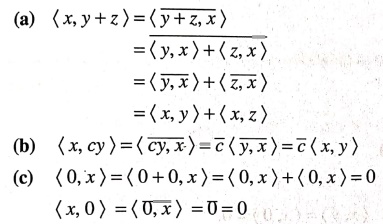
(a) <x,y+z> =
<x, y> + <x, z>
(b) <x, cy> =  <x,y>
<x,y>
(c) <x, 0> =
<0,x> = 0
(d) <x, x> = 0 if
and only if x = 0
(e) If <x,y> =
<x, z> for all x ∈ V
then y = z
Proof:
(d)
<x, x> = 0 iffx=0
Let
x=0, then <x, x> = <0,0>> = 0
By
condition <x, x> > 0 if x ≠ 0
Obviously
<x, x> = 0 iff x=0
(e)
Assume <x, y> = <x, z>, for all x ∈ V
Consider
<x,y−z> = <x,y> − <x, z>
=
0 for all x ∈
V
Take
x=y−z; <y−z,y−z> = 0
y−z=0 ⇒ y=z
If
x ≠ y−z; then either x=0 (or) y‒z=0
y = z.
Theorem 2
Let V be an inner
product space over F then for all x,y ∈
V & c ∈ F
the following statements are true.
(a) ||cx|| = |c| ||x||
(b) || x || = 0 if and
only if x = 0
(c) | <x,y> | ≤ ||x||
||y || (Cauchy − Schwarz inequality)
(d) || x+y|| ≤ ||x|| + ||
y || (Triangle inequality)
Proof
(a)
|| cx || = √<cx, cx>
||
cx ||2 = < cx, cx >
= c<x,x>
||
cx ||2 = |c|2 ||x||2
||
cx || = | c | || x ||
(b)
|| x || = 0 if and only if x=0
|| x || =0
√[<x,
x>] =0
<x, x> = 0
⇒ x=0
since
<x, x> > 0 if x ≠ 0.
(c)
| <x, y> | ≤ ||x|| ||y||
If
y=0 then ||y||=0 & <x, y> = <x, 0> = 0.
The
inequality holds true.
Assume
that y≠0 and for any c ∈
F, then || x − cy ||2 ≥ 0
0
≤ || x−cy ||2
≤
<x−cy, x−cy>
=<x,
x−cy> + <−cy, x−cy>
=
<x,−cy> + <x, x> + <−cy, x> + <cy, cy>
=
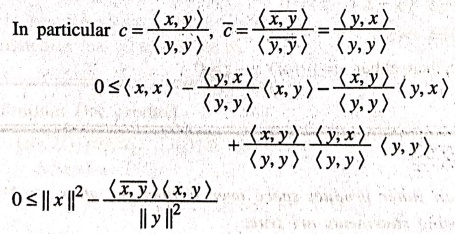
<x,x> −<x,y> − c<y, x> + <y,y>
0 ≤ ||x||2 ||y||2 − |
< x, y> |2
| <x, y> |2 ≤ ||x||2
||y||2
( | <x, y> | ≤ ||x|| ||y|| )
(d)
|| x + y || ≤ ||x|| + ||y||
|| x + y ||2 = <x + y, x + y>
= <x, x + y> + <y, x+y>
= <x,x> + <x, y> + <y, x> +
<y,y>
=
|| x ||2 + || y ||2 + < x, y> + < >
>
=
||x||2 + ||y||2 + 2Re<x, y>
≤ ||x||2 + ||y||2 + 2||x||
||y||
||x+y||2 = ([[ x || + || y ||)2
||x+y|| ≤
[[ x || + || y ||
Definition:
Let
V = Fn. If x = (a1, a2, a3, ... an) then
|| x || = || (a1, a2, a3, a4, ... an) || = 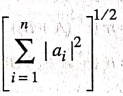 is the Euclidean definition of length. If n=1 then we have || a || =
|a|.
is the Euclidean definition of length. If n=1 then we have || a || =
|a|.
Linear Algebra: UNIT III: Inner Product Spaces : Tag: maths, mathematics : - Inner Products and Norms: Definition, Theorem
Linear Algebra: UNIT III: Inner Product Spaces
Under Subject
Linear Algebra
MA25C02 2nd Semester | 2025 Regulation
Related Subjects

English Essentials II
EN25C02 2nd Semester | 2025 Regulation | 2nd Semester 2025 Regulation

Tamils and Technology தமிழர்களும் தொழில்நுட்பமும்
UC25H02 2nd Semester | 2025 Regulation | 2nd Semester 2025 Regulation
Linear Algebra
MA25C02 2nd Semester | 2025 Regulation

Transforms and its Applications
MA25C03 2nd Semester EEE Dept | 2025 Regulation | 2nd Semester 2025 Regulation

Applied Physics (CE) II
PH25C02 2nd Semester Civil, Agri Depts | 2025 Regulation | 2nd Semester 2025 Regulation
Applied Physics (CSIE) II
PH25C03 2nd Semester AIDS, CSE, IT, CSE(CY) Dept | 2025 Regulation | 2nd Semester 2025 Regulation
Applied Physics (EE) II
PH25C04 2nd Semester EEE Dept | 2025 Regulation | 2nd Semester 2025 Regulation

Applied Physics (ME) II
PH25C05 2nd Semester Mechanical Dept | 2025 Regulation | 2nd Semester 2025 Regulation
Applied Chemistry (CE) II
CY25C02 2nd Semester Civil Dept | 2025 Regulation | 2nd Semester 2025 Regulation

Applied Chemistry (ME) II
CY25C03 2nd Semester Mechanical Dept | 2025 Regulation | 2nd Semester 2025 Regulation

Electron Devices
EC25C01 2nd Semester ECE Dept | 2025 Regulation | 2nd Semester 2025 Regulation

Digital Principles and Computer Organization
CS25C06 2nd Semester AIDS, CSE, IT, CSE(CY) Dept | 2025 Regulation | 2nd Semester 2025 Regulation

Basic Electrical and Electronics Engineering
EE25C01 2nd Semester | 2025 Regulation | 2nd Semester 2025 Regulation

Basic Civil and Mechanical Engineering
GE25C01 2nd Semester EEE Dept | 2025 Regulation | 2nd Semester 2025 Regulation
Data Structures using CPlusPlus
CS25C05 2nd Semester ECE Dept | 2025 Regulation | 2nd Semester 2025 Regulation
Engineering Drawing
ME25C01 EEE, Mech, Agri, EEE Depts | 2025 Regulation | 2nd Semester 2025 Regulation
Data Structures and Algorithms
CS25C04 2nd Semester EEE Dept | 2025 Regulation

Circuits and Network Analysis
EC25C02 2nd Semester ECE Dept | 2025 Regulation | 2nd Semester 2025 Regulation

Engineering Mechanics
ME25C02 2nd Semester Mech, Civil, Agri Depts | 2025 Regulation | 2nd Semester 2025 Regulation
Object Oriented Programming (OOPs)
CS25C07 2nd Semester CSE, CSE(CY) Depts | 2025 Regulation | 2nd Semester 2025 Regulation