Linear Algebra: UNIT III: Inner Product Spaces
The Gram Schmidt Orthogonalization: Theorems Part 1 - Example Solved Problems
Important Example Solved Problems - Engineering Maths or Mathematics - The Gram Schmidt Orthogonalization: Theorems Part 1 - Example Solved Problems
THE GRAM
SCHMIDT ORTHOGONALIZATION
THEOREMS PART 1
WORKED EXAMPLE PROBLEMS
Example 1
Let {(1, 1, 0), (1 − 1, 1), (− 1, 1, 2)} be an
orthogonal set then orthonormal set is { 1/√2(1, 1, 0), 1/√3 (1, − 1, 1), 1/√6(−
1, 1, 2) } both are basis of R3. Let x=(2, 1, 3) ∈ R3. Express x as a
linear combination of orthogonal set S & orthonormal set.
Solution:
By T Theorem 1. We have
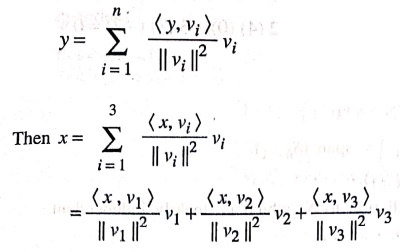
⇒ x as a linear combination
at the basis vectors are
a1 =
1/√2 (2+1) = 3/√2
a2
=
1/√3 (2‒1+1) = 4/√3
a3
=
1/√6 (‒2+1+6) = 5/√6
(2, 1, 3) = [(2+1)/2] (1,1,0) + 4/3 (1,−1,1) + 5/6 (−1,1,2)
which
is a linear combination of orthogonal set.
x = kΣi=1 < x, vi>
vi
=
<x, v1> v1 + <x, v2>v2
+ <x, v3>v3
(2, 1, 3) = 3/2 (1, 1, 0) + 4/3 (1, − 1, 1) +
5/6 (− 1, 1, 2)
Example 2
Let R2 have
the weighted Euclidean inner product defined as <u, v> =2u1v1
+ 3u2v2 and let u = (1, 1), v = (3,2), w = (0,− 1).
Compute the value of (u+v, 3w).
Solution:
Given
that
<
u, v> = 2u1v1 + 3u2v2
u+v = (1, 1)+(3,2) = (4, 3) and 3w = 3(0,−1) =
(0,−3)
<u+v, 3w> = 2(4)(0) + 3(3)(−3) = 0+(−27)
= −27
Example 3
Let P2 have
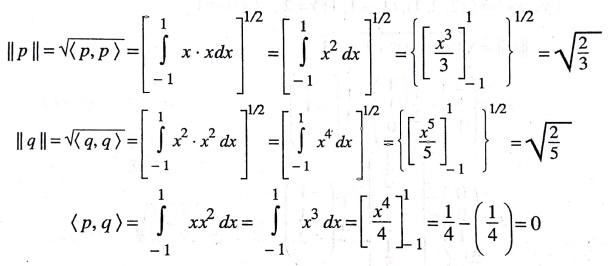
the inner product <p,q> = -1ʃ1 p(x) q(x) dx. Find the angle between p and q,
where p=x and q=x2 with respect to the inner product on P2.
Solution:
Let
<p,q> = -1ʃ1
p(x) q(x) dx where p =x and q=x2.
Let
p =x and q = x2.
Example 4
Consider V=R3.
Let y1 = (1, 1, 0), y2
= (2, 0, 1), y3 = (2, 2, 1). Check {y1y2,y3} is linearly independent,
using Gram schmidt process. Compute orthogonal vectors from {y1, y2,y3}.
Solution:
|Δ| =  = ‒2 ≠ 0
{y1,
y2, y3} is linearly independent.
Let
{x1, x2, x3}
be the orthogonal set.
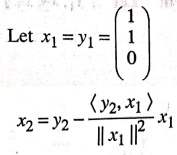
<y2, x1> = < (2, 0, 1), (1, 1, 0) > = 2+0+0=2 and
||x1|| = √[12+12+02]
= √2
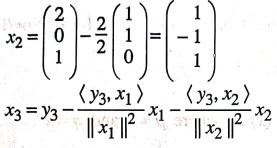
<y3, x1> = < (2, 2, 1), (1, 1, 0) > = 2 +2 = 4
<y3, x2> = < (2,
2, 1), (1, 1, 1) > = 2−2+1=1
||x2||
= √[12 + (−1)2 + 1 ]
=
√3
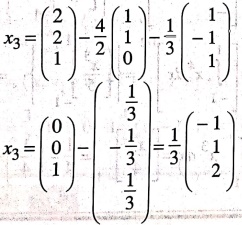
(x1,
x2, x3) is an orthogonal set.
Example 5
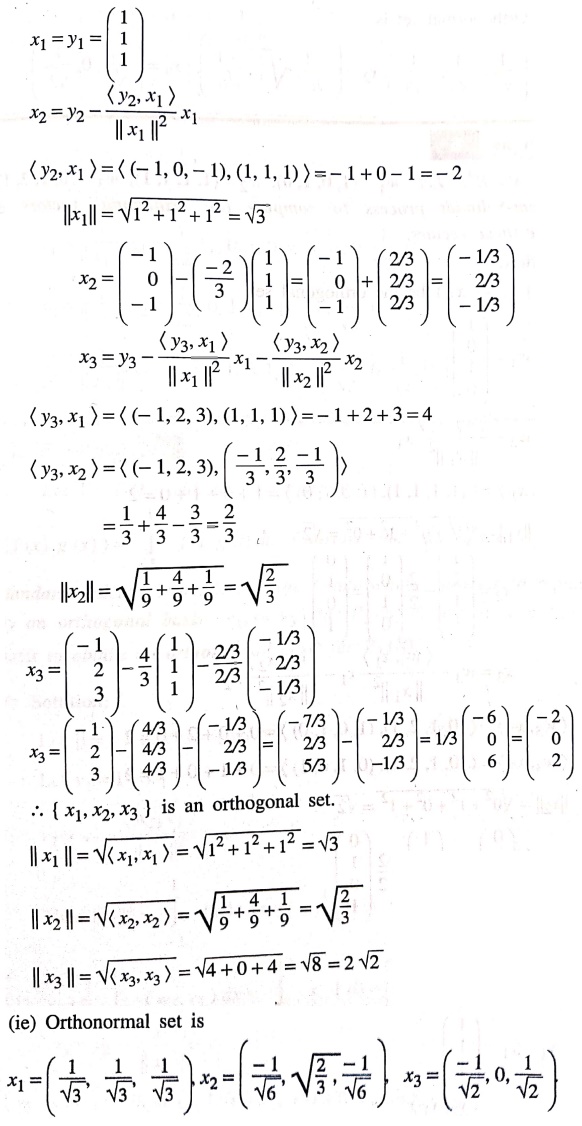
Let y1 = (1, 1, 1); y2
= (−1, 0, −1); y3=(−1, 2, 3). Check {y1 y2 y3} is linearly independent
using Gram−Schmidt process. Compute orthogonal vectors from {y1, y2,
y3}
Solution:
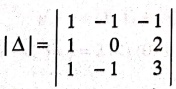 = 4 ≠ 0
Given
{y1, y2, y3} is linearly independent. Let { x1, x2, x3
} be orthogonal set.
Example 6
Let V=R4,
Let w1 = (1, 0, 1, 0), w2 = (1, 1, 1, 1), w3 =
(0, 1, 2, 1). Use Gram−Schmidt process to compute the orthogonal vectors &
normalize these vectors.
Solution:
Let { x1, x2, x3} be the orthogonal set.
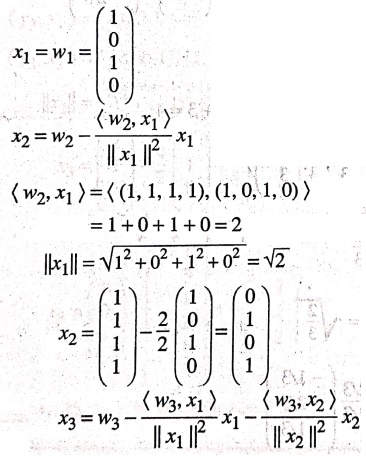
<w3, x1> = < (0, 1, 2, 1), (1, 0, 1, 0) > =0+0+2+0=2
<w3, x2> = < (0,
1, 2, 1), (0, 1, 0, 1) > =0+1+0+1=2
||x2||
= √[02 + 12 + 02 + 12] = √2
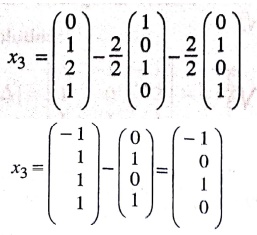
{x1, x2, x3}
is an orthogonal set.
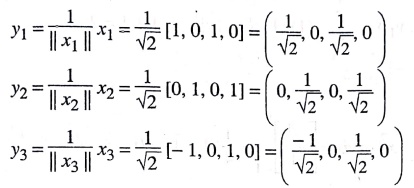
|| x1||
= √2; ||x2|| = √2; ||x3|| = √2
Orthonormal
set is {y1, y2, y3} where
Example 7
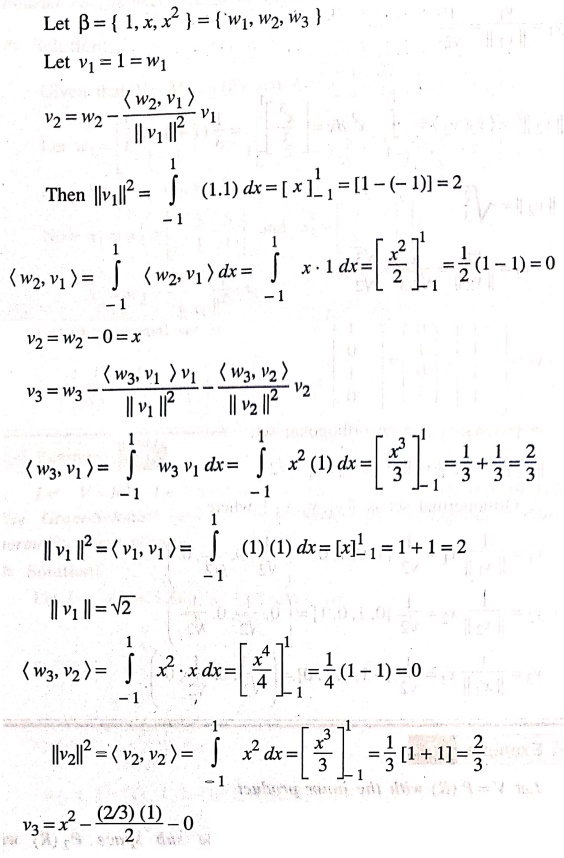
Let V=P (R) with the
inner product < f(x),g(x) > = -1ʃ1
f(t)g(t) dt. Consider the sub space P2(R)
with standard ordered basis β. Use the Gram−Schmidt process to replace β by an
orthogonal basis {v1, v2, v3 } for P2(R)
& use those orthogonal basis to obtain an orthonormal basis for P2(R).
Solution:
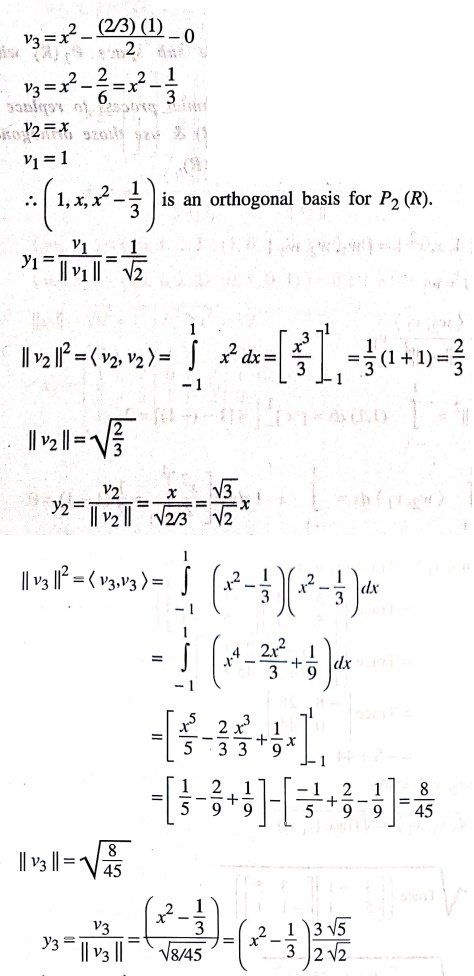
{y1,
y2, y3} is an orthonormal basis for P2(R).
Example 8
Let V=M2×2(R).
Let S =  Use Gram−Schmidt process to compute the orthogonal
vectors and normalize these vectors. Also compute the Fourier coefficients
related to basis.
Use Gram−Schmidt process to compute the orthogonal
vectors and normalize these vectors. Also compute the Fourier coefficients
related to basis.
Solution:
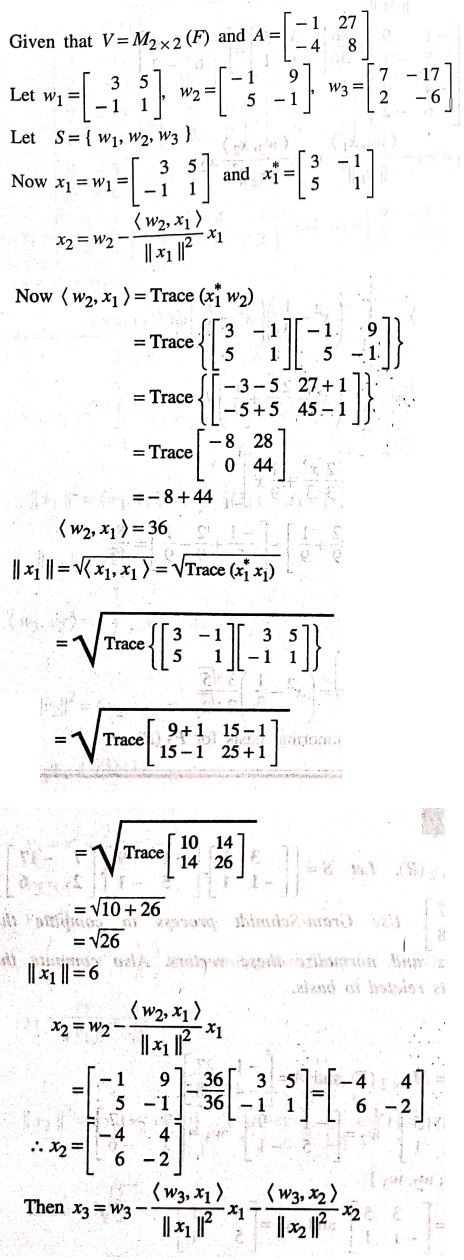
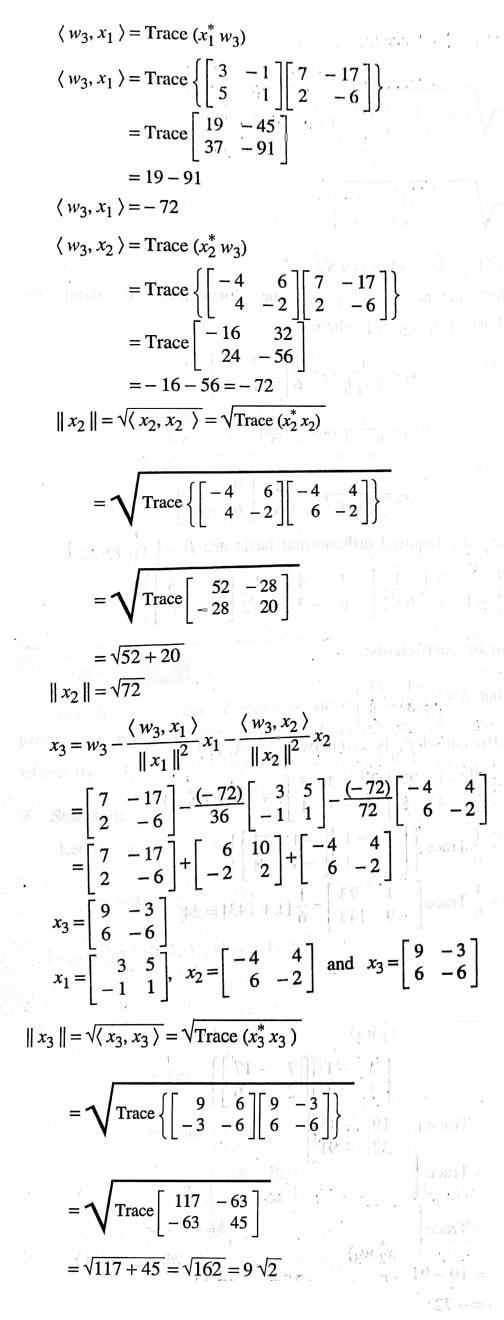
Now
the vectors x1, x2,
x3 can be normalized to obtain the orthonormal basis {y1, y2, y3}
where
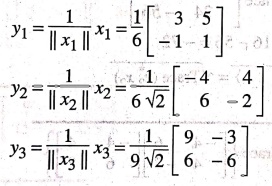
Therefore,
the required orthonormal basis are B = { y1,
y2, y3 }

To
find Fourier coefficients:
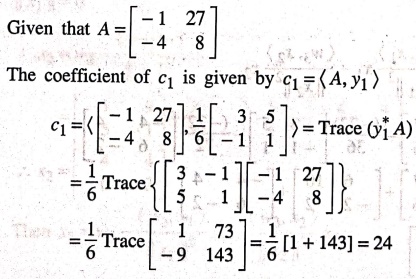
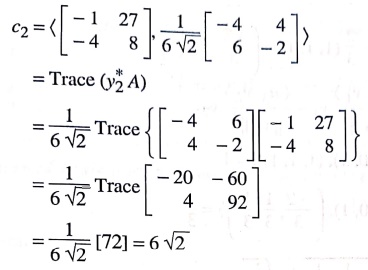
The
coefficient of c2 is given by c2 = <A, y2>
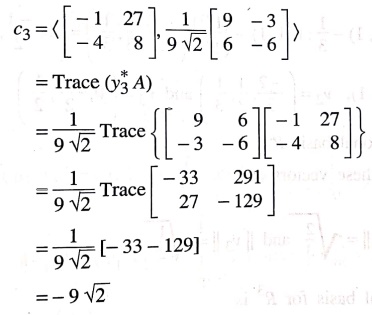
The
coefficient of c3 is given by c3 =(A, y3)
Example 9
Let R3 have
the Euclidean inner product. Use Gram−Schmidt process to transform the basis {u1,
u2, u3} into an orthonormal basis, where u1 =
(1, 1, 1), u2 = (0, 1, 1) and u3 = (0, 0, 1).
Solution:
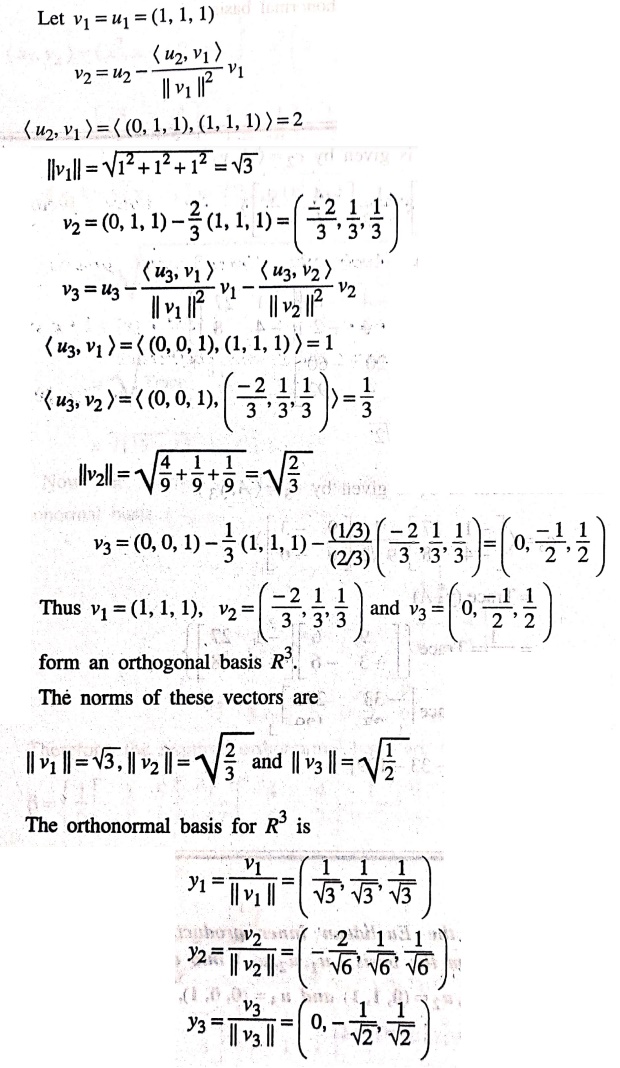
β = {y1, y2, y3}
is the orthonormal basis.
Example 10
Let the vector space P2
have the inner product <p,q> = 0ʃ1 p(x) q(x) dx.
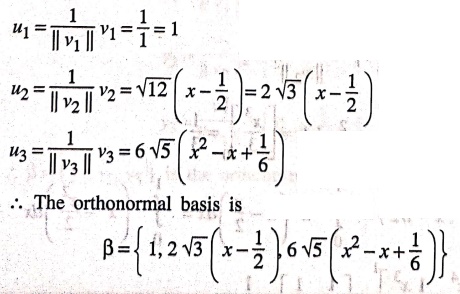
Apply the Gram−Schmidt process to transform the basis S={u1, u2,
u3}={1,x,x2} and h(x)=1+x into an orthonormal basis and
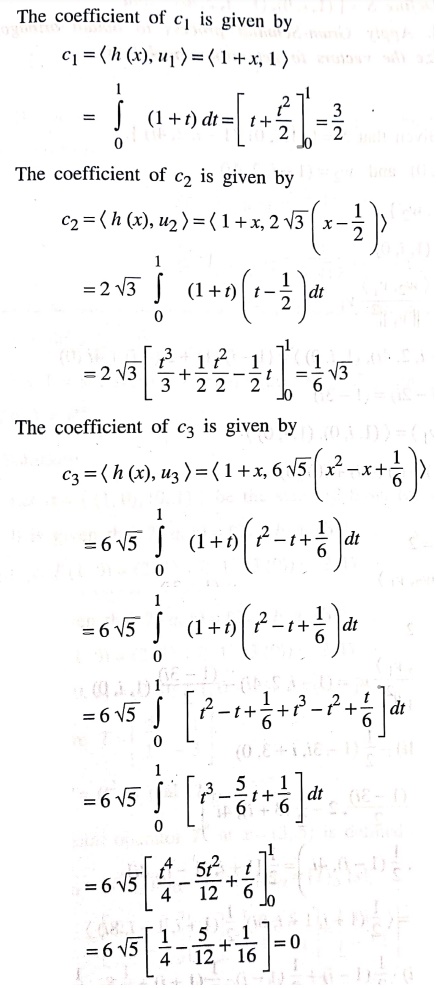
compute the Fourier coefficients.
Solution:
Let
S = { u1, u2, u3 } = { 1, x, x2 }
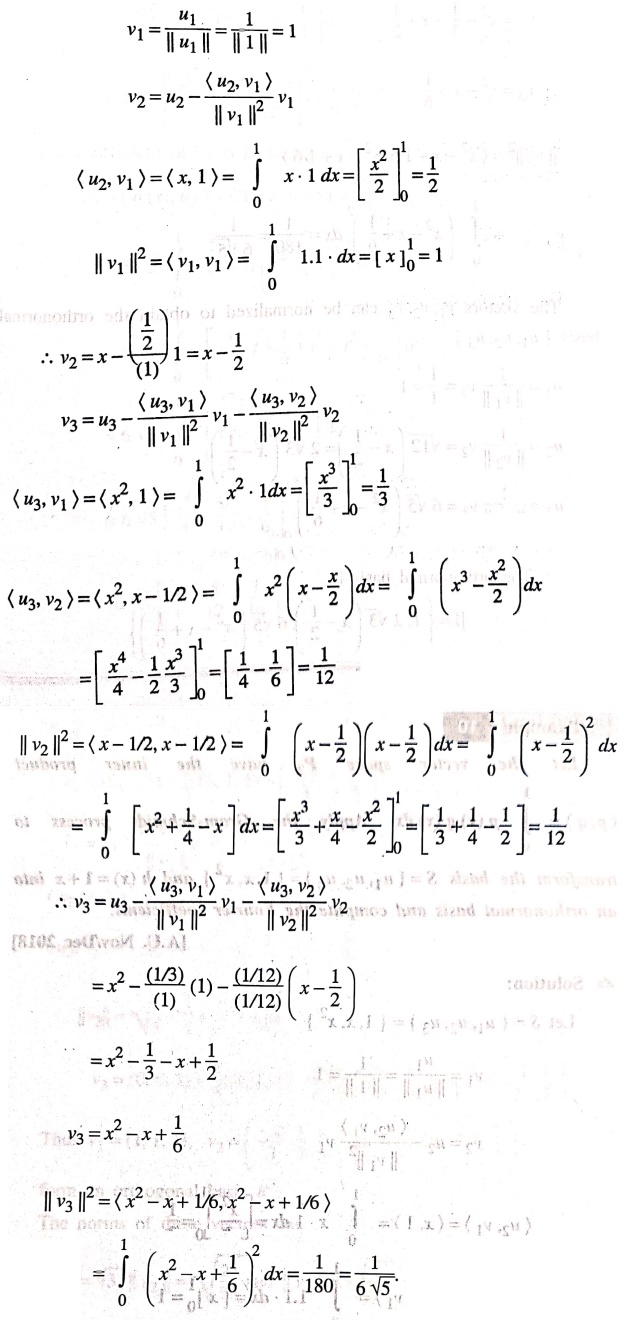
The
vectors v1, v2, v3 can be normalized to obtain
the orthonormal basis { u1, u2, u3 }.
To
find the Fourier coefficients
It
is given that h(x) = 1+x
Example 11
Let V=R3.
Define S={(1, i, 0), (1−i, 2, 4i)} and x= {3+i, 4i, −4}. Apply Gram−Schmidt
process to obtain orthogonal basis and normalize the vectors to get orthonormal
basis.
Solution:
Let
V=R3, Given that S= {(1, i, 0), (1‒i, 2, 4i) }.
Let
w1 = (1, i, 0) and w2 = (1−i, 2, 4i)
S={w1, w2},
Let
v1 =w1 = (1, i, 0)
v2 = w2 ‒ { <w2,v1>/||v1||2}v1
< w2, v1> = <
(1 − i, 2, 4i), (1, i, 0) > = (1 − i) (1) + 2(− i) + 4i (0)
=
(1−i−2) = (1−3i)
||v1||2
= < v1, v1> = < (1, i, 0), (1, i, 0) >
=
(1)(1) + (i)(− i) + (0)(0)
= 1−i2
=
1+1=2
v2 = w2 ‒ { <w2,v1>/||v1||2}v1
=
(1 − i, 2, 4i) ‒ (1-3i)/2 (1,i, 0)
= (1 − i, 2, 4i) ‒ 1/2(1-3i, i+3, 0)
v2
= ( 1/2(1+i), 1/2(1‒i), 4i )
=
½ [ 1+i, (1‒i), 8i ]
||v2||2
= <v2,v2> = < 1/2(1+i, 1‒i, 8i), ½(1+i, 1‒i, 8i)
>
=
[ 1/2(1+i) . 1/2(1‒i) + 1/2(1‒i) . 1/2(1+i)
1/2(8i) . 1/2(‒8i) ]
=
[ 1/4[1-i2] + 1/4(1-i2) + 1/4.64(-i2) ]
=
[ 1/2 + ½ + 16 ]
=
17
The
vectors v1 and v2 can be normalized to obtain the orthonormal
basis {y1, y2
}.
y1 =
( 1/||v1|| ) v1 = 1/√2 (1,i,0)
y2 =
( 1/||v2|| ) v2 = 1/2√17 (1+i,1‒i,8i)
Example 12
Let V=R2.
Define T (a, b) = (2a + b, a−3b) and x = (3, 5). Evaluate T* for V=R2.
Solution:
Let α= {(1, 0), (0, 1)} be the standard basis
for V=R2.
It
is given that T(a, b) = (2a + b, a − 3b)
T(1, 0) = (2 (1) +0, 1−3 (0)) = (2, 1)
T(0, 1) = (2 (0)+1, 0−3 (1)) = (1,−3)
Therefore
T = 
Since
V=R2 is real [T]α = [T]*α
The
adjoint operator T* at x=(3, 5) is defined as follows.
[T*(x)]α
= [T*]α [x]α = [T]*α [x]α
= [T]α [x]α
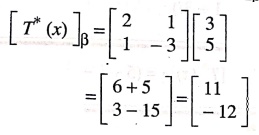
T* at x = (3, 5) is T*(x) = (11, ‒12)
Linear Algebra: UNIT III: Inner Product Spaces : Tag: maths, mathematics : - The Gram Schmidt Orthogonalization: Theorems Part 1 - Example Solved Problems
Linear Algebra: UNIT III: Inner Product Spaces
Under Subject
Linear Algebra
MA25C02 2nd Semester | 2025 Regulation
Related Subjects

English Essentials II
EN25C02 2nd Semester | 2025 Regulation | 2nd Semester 2025 Regulation

Tamils and Technology தமிழர்களும் தொழில்நுட்பமும்
UC25H02 2nd Semester | 2025 Regulation | 2nd Semester 2025 Regulation
Linear Algebra
MA25C02 2nd Semester | 2025 Regulation
Transforms and its Applications
MA25C03 2nd Semester EEE Dept | 2025 Regulation | 2nd Semester 2025 Regulation

Applied Physics (CE) II
PH25C02 2nd Semester Civil, Agri Depts | 2025 Regulation | 2nd Semester 2025 Regulation
Applied Physics (CSIE) II
PH25C03 2nd Semester AIDS, CSE, IT, CSE(CY) Dept | 2025 Regulation | 2nd Semester 2025 Regulation
Applied Physics (EE) II
PH25C04 2nd Semester EEE Dept | 2025 Regulation | 2nd Semester 2025 Regulation

Applied Physics (ME) II
PH25C05 2nd Semester Mechanical Dept | 2025 Regulation | 2nd Semester 2025 Regulation
Applied Chemistry (CE) II
CY25C02 2nd Semester Civil Dept | 2025 Regulation | 2nd Semester 2025 Regulation

Applied Chemistry (ME) II
CY25C03 2nd Semester Mechanical Dept | 2025 Regulation | 2nd Semester 2025 Regulation

Electron Devices
EC25C01 2nd Semester ECE Dept | 2025 Regulation | 2nd Semester 2025 Regulation

Digital Principles and Computer Organization
CS25C06 2nd Semester AIDS, CSE, IT, CSE(CY) Dept | 2025 Regulation | 2nd Semester 2025 Regulation

Basic Electrical and Electronics Engineering
EE25C01 2nd Semester | 2025 Regulation | 2nd Semester 2025 Regulation

Basic Civil and Mechanical Engineering
GE25C01 2nd Semester EEE Dept | 2025 Regulation | 2nd Semester 2025 Regulation
Data Structures using CPlusPlus
CS25C05 2nd Semester ECE Dept | 2025 Regulation | 2nd Semester 2025 Regulation
Engineering Drawing
ME25C01 EEE, Mech, Agri, EEE Depts | 2025 Regulation | 2nd Semester 2025 Regulation
Data Structures and Algorithms
CS25C04 2nd Semester EEE Dept | 2025 Regulation

Circuits and Network Analysis
EC25C02 2nd Semester ECE Dept | 2025 Regulation | 2nd Semester 2025 Regulation

Engineering Mechanics
ME25C02 2nd Semester Mech, Civil, Agri Depts | 2025 Regulation | 2nd Semester 2025 Regulation
Object Oriented Programming (OOPs)
CS25C07 2nd Semester CSE, CSE(CY) Depts | 2025 Regulation | 2nd Semester 2025 Regulation