Linear Algebra: UNIT III: Inner Product Spaces
The Gram Schmidt Orthogonalization: Theorems Part 1
Important Theorems for Engineering Maths or Mathematics - The Gram Schmidt Orthogonalization: Theorems Part 1
THE GRAM
SCHMIDT ORTHOGONALIZATION
THEOREMS PART 1
Theorem 1
Let
V be an inner product space and S = { v1, v2, ... vk}
be an orthogonal subset of V consisting of non−zero vectors. If y ∈ span(S) then y = 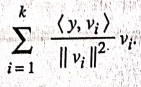 .
.
Solution:
Let
y ∈ span (S).
Then
y = kΣi=1 aivi, ai ∈ F; 1≤i≤k,
We
have <y, vj> = < kΣi=1
aivi, vj >
=
kΣi=1 ai <vi,
vj >
Since
<vi, vj> = 0 if i ≠ j
<y,
vj> = aj <vj, vj> where i
= j.
=
aj ||vj||2
So
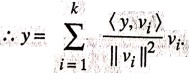
aj = <vj, vj> / ||vj||2
Theorem 2
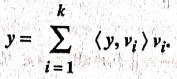
If
S is orthonormal & y ∈
span (S) then
Theorem 3
Let V be an inner
product space and let S be an orthogonal subset of V consisting of non−zero
vectors then S is linearly independent.
Solution:
Let
v1, v2, ... vk ∈ S, and kΣi=1 aivi
= 0.
By
previous theorem, with y = 0, we have
aj
= <y, vj> / ||vj||2
= <0,
vj> / ||vj||2
aj
= 0 for all j.
S is
linearly independent.
Definition
Fourier Coefficients:
Let β be an orthonormal subset of an inner product space V and let x ∈
V. We define the Fourier Coefficients of x relative to β to be the scalars <x,
y> where y ∈
β.
Theorem 4
Let V be an inner
product space and S = {w1, w2,… wn} be a
linearly independent subset of V. Define S' = {v1, v2,...
vn }.
where v1 = w1
and vk = 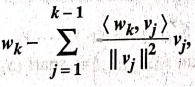 for 2≤k≤n.
Then S' is an
orthogonal set of non−zero vectors such that span (S') = span (S).
Proof:
The
proof is by mathematical induction on n, the number of vectors in S. For k = 1,
2, ... n, let Sk = { w1, w2, …., wk
}
If
n = 1, then S1 = S1',
since
S1 = {w1), S'1={v1} and w1
≠ 0 and v1 ≠ 0.
span (S1) = span (S1')
If
n=2, then S2 = {w1, w2}, S2' = {v1,
v2).
where
v1 = w1, v2 = w2 − 
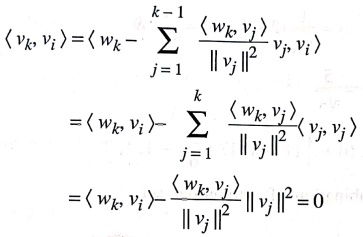
To
prove:
S2'
is orthogonal
The
set S2' = {v1, v2} is orthogonal.
Moreover
if v2 = 0 then
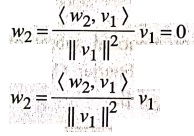
w2 is a linear combination of w1,
which is contradiction to S2 is linearly independent... v2
≠ 0.
S2' is an orthogonal set of non
zero vectors also,
span
(S2') = span (S2).
Assume
that the set S'k−1={v1, v2, ... vk−1}
is an orthogonal set of non−zero vectors & span (S'k−1) = span
(Sk−1).
To
prove:
Sk' = {v1, v2, ... vk−1, vk} is an orthogonal set of non−zero vectors where
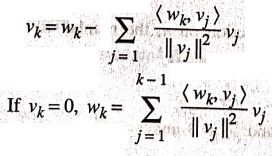
Wk
∈ span { v1, v2,
..., vk−1 }
span
(S'k−1) = span (Sk−1).
Wk
∈ span (Sk−1)
This
is a contradiction to Sk which is linearly independent.
vk
≠ 0
For
1 ≤ i ≤ k−1
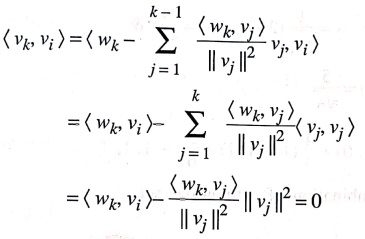
Hence
Sk is an orthogonal set of non−zero vectors also
span (Sk') ≤ span (Sk).
We
know that Sk is linearly independent set.
dim [ span (Sk') ] = dim [ span (Sk)
] = k.
span (S'K) = span (SK)
Linear Algebra: UNIT III: Inner Product Spaces : Tag: maths, mathematics : - The Gram Schmidt Orthogonalization: Theorems Part 1
Linear Algebra: UNIT III: Inner Product Spaces
Under Subject
Linear Algebra
MA25C02 2nd Semester | 2025 Regulation
Related Subjects

English Essentials II
EN25C02 2nd Semester | 2025 Regulation | 2nd Semester 2025 Regulation

Tamils and Technology தமிழர்களும் தொழில்நுட்பமும்
UC25H02 2nd Semester | 2025 Regulation | 2nd Semester 2025 Regulation
Linear Algebra
MA25C02 2nd Semester | 2025 Regulation
Transforms and its Applications
MA25C03 2nd Semester EEE Dept | 2025 Regulation | 2nd Semester 2025 Regulation

Applied Physics (CE) II
PH25C02 2nd Semester Civil, Agri Depts | 2025 Regulation | 2nd Semester 2025 Regulation
Applied Physics (CSIE) II
PH25C03 2nd Semester AIDS, CSE, IT, CSE(CY) Dept | 2025 Regulation | 2nd Semester 2025 Regulation
Applied Physics (EE) II
PH25C04 2nd Semester EEE Dept | 2025 Regulation | 2nd Semester 2025 Regulation

Applied Physics (ME) II
PH25C05 2nd Semester Mechanical Dept | 2025 Regulation | 2nd Semester 2025 Regulation
Applied Chemistry (CE) II
CY25C02 2nd Semester Civil Dept | 2025 Regulation | 2nd Semester 2025 Regulation

Applied Chemistry (ME) II
CY25C03 2nd Semester Mechanical Dept | 2025 Regulation | 2nd Semester 2025 Regulation

Electron Devices
EC25C01 2nd Semester ECE Dept | 2025 Regulation | 2nd Semester 2025 Regulation
Digital Principles and Computer Organization
CS25C06 2nd Semester AIDS, CSE, IT, CSE(CY) Dept | 2025 Regulation | 2nd Semester 2025 Regulation

Basic Electrical and Electronics Engineering
EE25C01 2nd Semester | 2025 Regulation | 2nd Semester 2025 Regulation

Basic Civil and Mechanical Engineering
GE25C01 2nd Semester EEE Dept | 2025 Regulation | 2nd Semester 2025 Regulation
Data Structures using CPlusPlus
CS25C05 2nd Semester ECE Dept | 2025 Regulation | 2nd Semester 2025 Regulation
Engineering Drawing
ME25C01 EEE, Mech, Agri, EEE Depts | 2025 Regulation | 2nd Semester 2025 Regulation
Data Structures and Algorithms
CS25C04 2nd Semester EEE Dept | 2025 Regulation

Circuits and Network Analysis
EC25C02 2nd Semester ECE Dept | 2025 Regulation | 2nd Semester 2025 Regulation

Engineering Mechanics
ME25C02 2nd Semester Mech, Civil, Agri Depts | 2025 Regulation | 2nd Semester 2025 Regulation
Object Oriented Programming (OOPs)
CS25C07 2nd Semester CSE, CSE(CY) Depts | 2025 Regulation | 2nd Semester 2025 Regulation