Linear Algebra: UNIT III: Inner Product Spaces
Inner Products and Norms: Example Solved Problems - Part 2
Important Example Solved Problems - Engineering Maths or Mathematics - Inner Products and Norms: Example Solved Problems - Part 2
INNER PRODUCTS AND
NORMS
Example Solved Problems
Example 5
For any non−zero
vector, x ∈
V prove that y = x / || x || is a vector such that || y || = 1.
Solution:
Consider
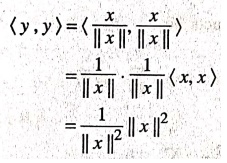
||y||2
= 1
||y||=
1
Note: The
process of multiplying a non−zero vector by the reciprocal of its length (norm)
is called normalising.
Example 6
Show that in F3,
the vectors (1,1,0), (1, −1, 1), (−1, 1, 2) are orthogonal. Are they
orthonormal? Justify.
Solution:
Let
x=(1,1,0); y=(1,−1, 1); z=(−1, 1, 2)
<x,y>
= 1−1+0=0;
<x,
z> = −1+1+0;
<y,
z> = −1−1+2=0
x, y, z are mutually orthogonal vectors
||
x || = √<x, x> = √[(1)2 + (1)2 + (0)2] =
√2 ≠ 1
||
y || = √<x, y> = √[(1)2 + (1)2 + (1)2] =
√3 ≠ 1.
||
z || = √[(− 1)2 + (1)2 + (2)2 = √6 ≠ 1
The
vectors are not orthonormal. If the normalize the vectors in the set, we obtain
the orthonormal set as
{(
1/√2, 1/√2, 0 ), ( 1/√3, −1/√3, 1/√3 ), ( −1/√6, −1/√6, 2/√6 ) }
Example 7
Let V=C3
with inner product <x,y> =x1 1+x22+x33
where x = (x1,x2, x3)
& y = (y1, y2,
y3).
Let x=(2,1+i, i), y =
(2−i, 2, 1+2i)
Compute (a) (x,y) (b)
|| x || & || y || (c) || x+y || (d) Verify Cauchy's inequality &
Triangle inequality.
Solution:
It
is given that <x, y> = x11+x22+x33
(a)
<x, y> = 2(2 −  ) + 2 (1 + i) + i(1 + 2)
=
2(2+i)+2(1+i)+i(1−2i)
=
4+2i+2+2i+i−2i2
=
4+2i+2i+2+i+2
=
8+5i
(b)
||y|| = √<y,y> =√[(2−i, 2, 1+2i) (2−i, 2, 1+2i)]
=
√[(2−i)  +2 (2) + (1 + 2i)
  ]
]
=
√[(2−i) (2+i) + 2(2) + (1+2i) (1‒2i)]
=
√[4+1+4+1+4] = √14
||
x || = √<xx>
√[(2,
1 + i, i) (2, 1 + i, i)] = √[(2)(2) + (1 + i)(1 + ) + i ()]
=
√[4 + (1 + i)(1 − i) – î2]
=
√[ 4+ (12 − i2) − i2 ] = √4+1+1+1 = √7
(c) ||x+y||2 = <x+y, x+y>
=
< (4−i, 3+i, 1+3i), (4−i, 3+ i, 1+3i) >
= (4−i) (4+i) + (3+ i)(3−i) + (1+3i) (1−3i)
=
(16−i2) + (9−i2) + (1−9i2) = 17+10+10 = 37
(d) (i) Cauchy's inequality"
Linear
Algebra
|
<x,y> | = |8+5i| = √[(8)2+(5)2] = √[64+25] = √89
||x||.||y||=
√7 . √14 = √98
√89 ≤ √98 verified.
(ii)
Triangle inequality
||
x + y || ≤ || x || + || y ||
√37 ≤ √7 + √14
6.08
≤ 6.39 verified
Example 8
Let (a, b) = (c, d) =
(0, 1) ∈
R2. Prove that <(a, b), (c, d)> = ac−bd is not an inner
product.
Solution:
It
is given that (a, b) = (c, d) = (0, 1) ∈
R2
Also
given that < (a, b), (c, d) > = ac − bd.
< (0, 1), (0, 1) > = (0)(0) − (1)(1) = −1.
Hence
< (0, 1), (0, 1) > = − 1 < 0.
This
is a contradiction to the hypothesis <x, x> > 0 if x ≠ 0.
It is
not an inner product on R2.
Example 9
Let β be a basis for a
finite dimensional inner product space. If <x,z> = <y,z> for all z ∈ β then prove that x=y.
Solution:
Given
that β is a basis and also it is given that <x, y> = <y, z>.
Now
we have to prove that x=y
For
all z ∈ β, <x, z> = <y,
z>
<x, z> ‒ <y, z> = 0
<x−y,
z> = 0
Here
x−y=0 and z = 0. Since z ∈
B, the vector z ≠ 0
x−y = 0 ⇒ z
≠0.
Hence
x−y = 0 ⇒ x=y.
Example 10
Let V=R2.
Define || (a, b) || = Max { | a |, |b| } for (a, b) ∈ V. Prove that it is a norm on
vector space V.
Solution:
Let
V=R2.
Define
|| (a, b) ||= Max {|a|, |b|}
(i)
|| (a, b) || = Max {|a|,|b|} ≥ 0
(ie)
|| (a, b) || = 0 if a=0 and b=0
(ii)
|| c (a, b) || = Max {|ca|, | cb|}
=
Max { |c||a|, |c||b|}
=
|c| . Max {|a||b|}
=
| c | ||(a, b)||
(iii)
|| (a, b), (c, d) || = || (a+c), (b+d) ||
=
Max { |a+c|, |b+d| }
≤
Max { |a|+|c|, |b|+|d| }
≤
Max { |a|,|b|} + Max{|c|,|d||}
Since
all the three norm conditions are satisfied,
|| (a, b) || = Max {|a|,|b|} is a norm.
Example 11
Let A and B be n×n
matrices and let c be a scalar.
Then prove that (A +
cB)* = A*+

Solution:
Given
that A and B are n×n square matrices and c be any scalar.
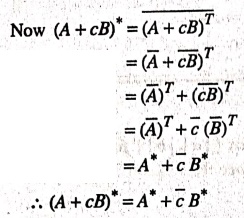
Now
to prove (A + cB)* = A* + B*, let us consider the conjugate transpose
of the square matrix A is A*.
(A*)ij=
Example 12
Let V=R2 and
S = {(1, 0), (0, 1)}. Check whether S is orthonormal basis or not.
Solution:
Let
x=(1, 0) and y = (0, 1).
<x, y> = (1)(0)+(0)(1)=0+0=0.
|x||=√<x,x>
= √1 = 1
||
y || = √<y,y> = √1 = 1
Here
||x|=|| y ||= 1.
S is an orthonormal basis
Example 13
Let S =
{ ,
, } Verify S is orthonormal basis or not.
Solution:
Let
x= and y=
To
prove S is basis
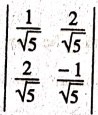
= –1/5 – 4/5 = −1 ≠ 0
S is linearly independent.
Dimension
of R2 = V is 2.
So
S is maximally linearly independent set.
S is a basis.
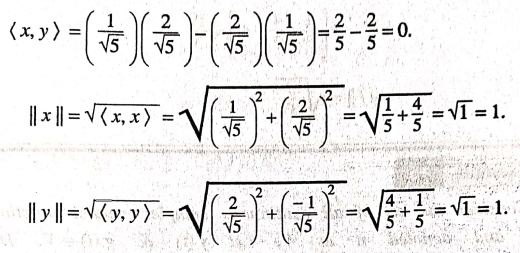
S
is an orthonormal basis
Example 14
Let V be the vector
space of polynomial with inner product given by <f,g> = 0ʃ1
f(t)g(t) dt. Let f(t) = t + 2, g(t) = t2 – 2t − 3.
Find <f,g> &
||ƒ||.
Solution:
Given
that <f,g> = 0ʃ1
f(t) g(t) dt
f(t)
g(t) = (t + 2) (t2 − 2t − 3) = t3−7t−6
<
f, g> = 0ʃ1 (t3 − 2t −
3) dt = [ t4/4 − 7t2/2 – 6t]10 = [
¼ − 7/2 − 6]
<
f, g> = − 37 / 4.
We
know that ||f|| = √<ƒ,ƒ>
< f,
f> = 0ʃ1 (t
+ 2)2 dt = 0ʃ1 (t2 + 4t + 4) dt
=
[ t3/3 + 4t2/2 + 4t]10
=
[ 1/3 + 4/2 + 4] = 19/3
||f||
= √(19/3)
Example 15
Consider the set of all
continuous complex valued function in [0, 1] and denoted it as V. Let f (t)
& g (t) ∈
V. Define <f(t), g(t)> = 0ʃ1 f(t)  dt. Verify the conditions of inner product space.
Solution:
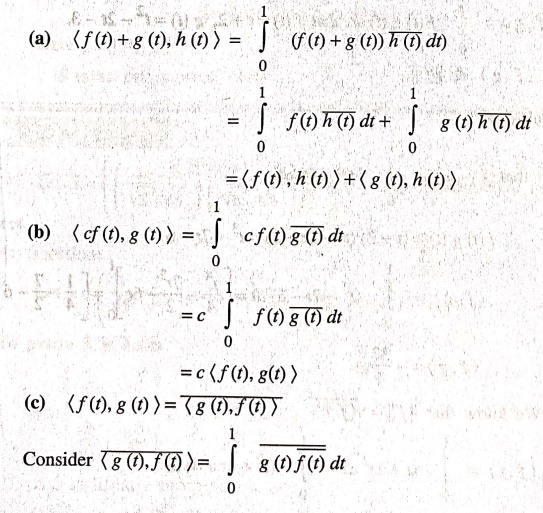
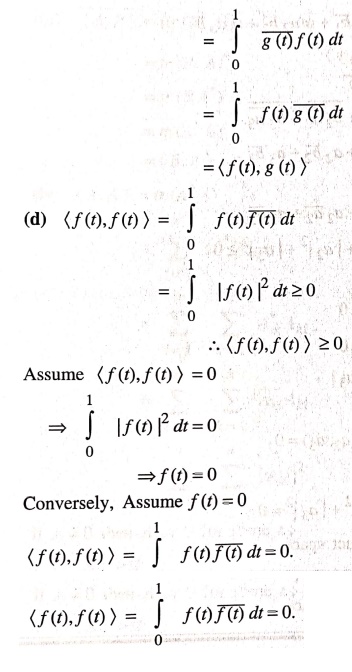
Example 16
Let V=C3
where C is the set of complex numbers. Defined by <x,y> a1 1+a22+a33 where x = (a1, a3, a3) & y
= (b1, b2, b3). Verify the inner
product space.
1+a22+a33 where x = (a1, a3, a3) & y
= (b1, b2, b3). Verify the inner
product space.
Solution:
Let
x, y, z ∈ V where z= (c1,
c2, c3)
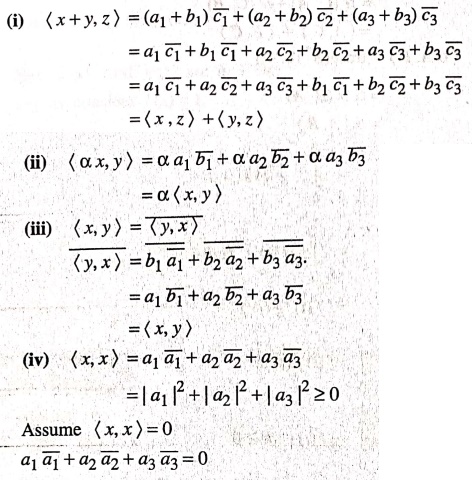
⇒│a1│= 0 = |a2| = |a3|
⇒ x=0.
Conversely
x=0, (a1, a2, a3)
= 0
⇒ a1=a2=a3 = 0
<x,
x> = |a1|2 +
|a2|2 + |a3|2 = 0
V is an inner product space.
Example 17
Let V=Mn×n(F)
and define <A, B> = trace (B*A) for A, B ∈
V. Verify whether V is an inner product space or not.
Solution:
Let
A, B, C, ∈
V
(i)
<A+B, C> = trace (C* (A+B))
=
tr (C*A + C*B)
=
tr (C*A) + tr (C*B)
=
<A, C> + <B, C>
(ii)
<αA, B> = trace (B*(αA))
=
α tr (B*A)
=
α<A, B>
(iii)  = [tr (B*A)]* .
  =A*ij
=A*ij
=
tr (B*A)*
=
tr (BA*)
=
tr (A*B)
=
<B,A>
(iv)
<A, A> = tr (A*A)
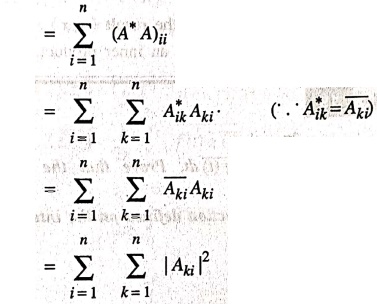
If
A ≠ 0 then Aki ≠ 0 for some ki.
<A,A>
> 0
Example 18
Prove that <f(x), g(x)> = 0ʃ1
f '(t) g(t) dt on P (R), is not an inner
product on the given vector space.
Solution:
Given
that < f(x), g(x) > = 0ʃ1
f '(t)g(x) dt
Here
f(x) and g(x) are in P (R).
Let
us consider f(x) = 1
Given
that < f(x), g(x) > = 0ʃ1
f '(t) g(t) dt
<
f(x), f(x) > = 0ʃ1 f '(t)f(t)
dt
=
0ʃ1 (0)(1) dt =
0 (f '(x)=0)
This
result is contradiction with the result <x, x> > 0 if x ≠ 0.
Hence
the given statement is not an inner product.
Example 19
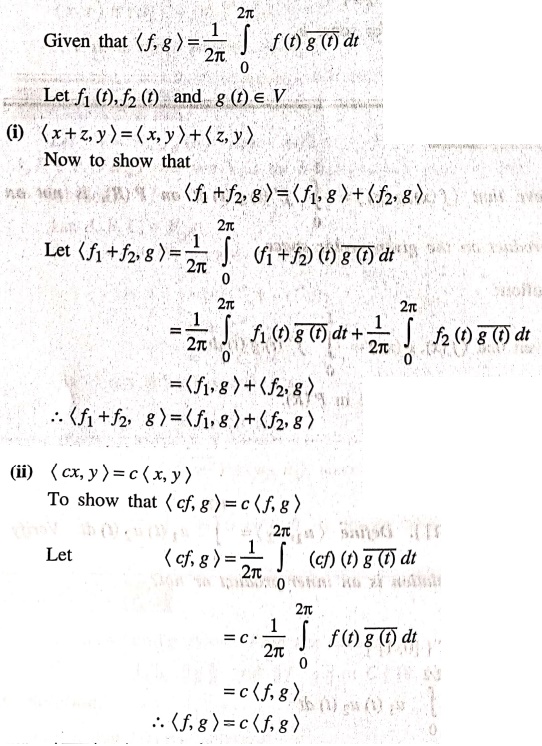
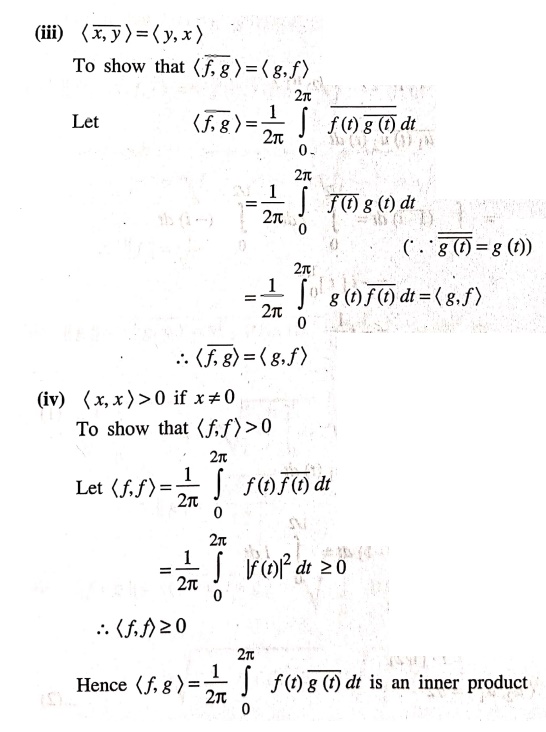
Let <f,g> =1/2π 0ʃ2π f(t) dt. Prove that the vector
space in continuous complex valued function defined on the interval [0, 2π] is
an inner product.
Solution:
Example 20
Let V = C{([0,1]).
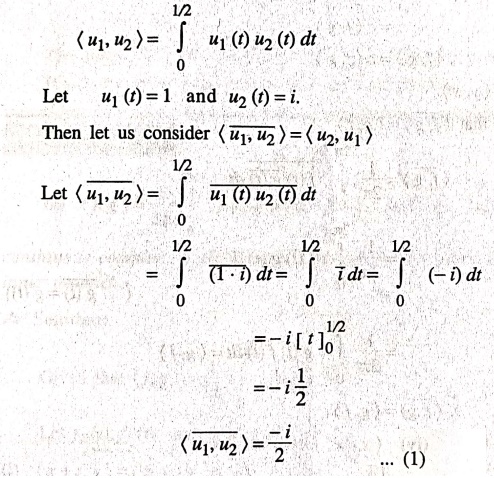
Define <u1,u2> = 0ʃ1/2 u1(t)u2
dt. Verify whether the given relation is an inner product or not ?
Solution:
Let
V = C { [0, 1] }
Now
let <u2,u1> = 0ʃ1/2 u2(t)
• u1(t) dt
=
0ʃ1/2 (i.1) dt = 0ʃ1/2 i dt
=
i[t]1/20
=
i.[1/2]
<u2, u1> = i/2
From
equations (1) & (2) we have
< >
≠ <u2, u1>,
since ‒i/2 ≠ i/2
>
≠ <u2, u1>,
since ‒i/2 ≠ i/2
<u1, u2> = 0ʃ1/2 u1(t)u2(t)
dt is not an inner product.
Example 21
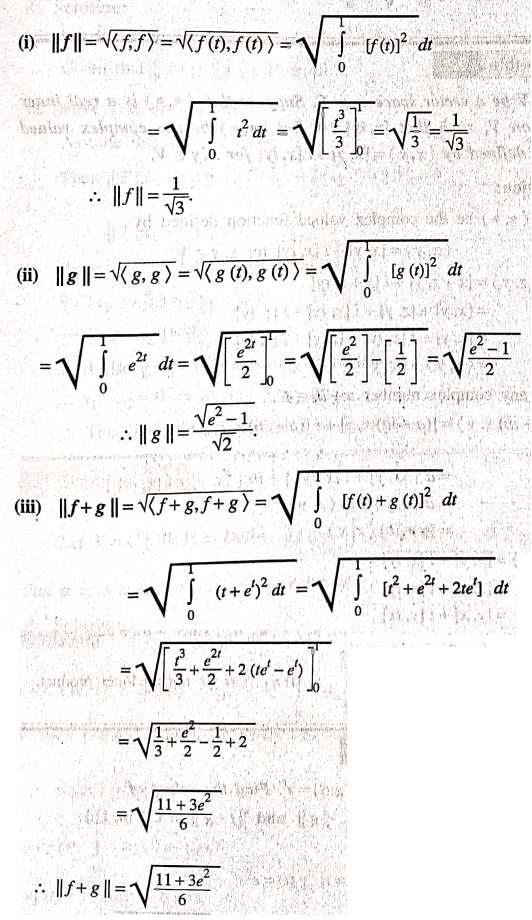
Let f(t) = t and g(t) = et. Find
the values of ||f||, |g|| and ||f+g || in C{ [0, 1]}.
Solution:
Given that f(t) = t and g(t) = et.
Example 22
Let V be a vector space
over C. Suppose that <•,•> is a real inner product on V, such that [x,
ix] = 0. Let <•,•> be the complex valued function defined by <x,y>
= [x, y]+i[x, iy] for x,y ∈
V.
Solution:
Let
<•,•> be the complex valued
function defined by
<x, y> = [x, y]+i[x, iy] for x, y ∈ V.
(i)
<x+z,y> = [x + z, y] + i[x + z, iy]
=
[x, y] + [z, y] + i[x, iy] + i[z, iy]
=
[x, y] + i[x, iy] + [z, y] + i[z, iy]
=
<x, y> + <z, y>
(ii)
For any complex number a+ib ∈
C.
<
(a+ib) x, y > = [(a+ib)x, y] + i [(a+ib)x, iy]
=
[ax, y] + [ibx, y] + i[ax, iy] + i[ibx, iy]
=
a { [x, y]+i [x, iy]) } + ib { [x, y]+i [x, iy]}
=
a<x,y> + ib<x,y>
=
(a+ib) <x, y>
(iii) 
=
[x, y] − i[x, iy]
=
[y, x] + i[y, ix]
=
<y, x>
(iv) For x ≠ 0
<x, x> = [x, x] + i[x, ix]
=
[x, x] + 0
(since
[x, ix] = 0)
≥
0
<x,
y> = [x, y] + i[x, iy] is an inner product
Example 23
Let T be a linear
operator on an inner product space V and let || T(x) || = || x || for all x.
Prove that T is one−to−one.
Solution:
Let
V be the vector space and T be a linear operator on V.
Given
that || T(x) || = || x || for all x.
To
prove T is one to one
Assume
that T(x1) = T (x2)
Then
|| T(x1−x2) || = ||T(x1)− T(x2)|| = ||0|| = 0
( T(x1)=T(x2) )
||T(x1−x2) ||= 0
Since
||T(x)|| = ||x|| for all x ∈
V
|| T(x1
= x2) || = || x1−x2
||
⇒ || x1−x2
|| = 0.
And
also || x || = 0 if and only if x = 0.
x1−x2=0 ⇒ x1 = x2.
The
given linear operator T is one−to−one.
Example 24
Let V=C {[0,1]}. Define
||ƒ|| = 0ʃ1 |f(t)|
dt for all f ∈ V. Prove that it is a norm on the
given vector space V.
Solution:
Given
that V = C { [0, 1] }
Defined function is ||f|| = 0ʃ1 |f(t)| dt
(i) ||f||
= 0ʃ1 |f(1)|dt
≥ 0 and ||f|| is equal to zero if and
only if all the values of f are in
[0, 1] is zero.
(ii)
||af|| = 0ʃ1 |af(t)| dt = 0ʃ1 |a|
|f(t)| dt
=
|a| 0ʃ1 |f(t)|
dt
=
|a| || ƒ ||
(iii)
||f+ g || = 0ʃ1 |
(f+g)(t) | dt = 0ʃ1 |
f(t)+g(t) | dt
≤
0ʃ1 [ |f(t)| + |g(t)| ] dt
=
0ʃ1 |f(t)| dt +
0ʃ1 |g(t)| dt
=
|| f || + ||g||
Since
all the axioms of the norm are satisfied,
||f||
= 0ʃ1 | f(t) |
dt is a norm on the given vector space V.
Example 25
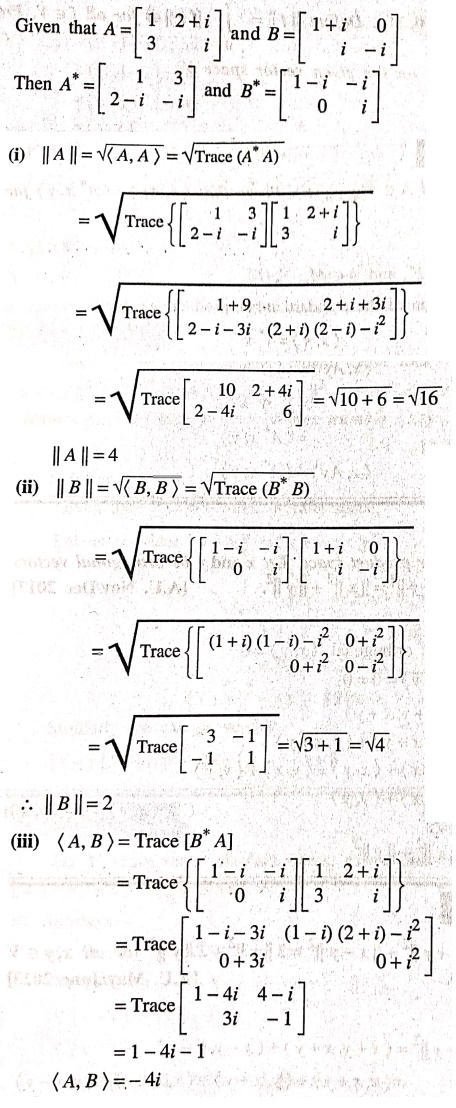
Let 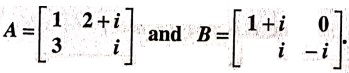 . Use Frobenius inner product to find ||A||, || B|| and <A, B>.
Solution:
Example 26
Let V=Fn and
A ∈
Mm×n(F). Prove that <x, Ay> = <A* x, y> for all x,y ∈ V.
Solution:
Given
that V=Fn and A ∈
Mm×n (F).
By
the definition of the standard inner product, we have
<x,
y> = y*x
<x, Ay> = (Ay)*x
=
y*A*x
=
<A*x, y>
<x, Ay> = <A* x, y>
Example 27
Let V be an inner
product space. Let x and y be orthogonal vectors in V. Prove that || x + y ||2
= || x ||2 + || y ||2.
Solution:
Since
x and y are orthogonal, <x, y> =0
Then
<y, x>= =0
=0
|| x + x||2 = <x+y, x+y>
=
<x, x + y> + <y, x+y>
=
<x, x> + <x,y> + <y, x> + <y,y>
=
<x, x> + <y, y>
( <x, y> = 0 = <y, x>
)
||
x + x||2 = || x ||2 + || y ||2
Example 28
Prove that || x+y ||2
+ || x − y ||2 = 2|| x ||2 + 2|| y ||2 for all
x,y ∈
V (Parallelogram law).
Solution:
|| x + y ||2 + || x − y ||2
= < x + y, x+y> + <x−y, x−y>
= <x,x+y> + <y, x+y> + <x, x−y>
− <y, x−y>
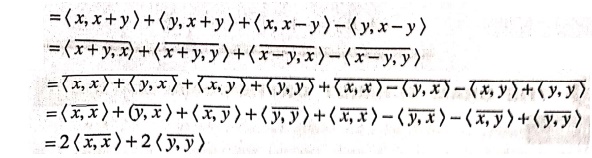
= 2||x||2 + 2||y||2
|| x +
y ||2 + || x − y ||2 = 2|| x ||2 + 2||y||2
for all x, y ∈
V.
Example 29
Let V be the inner
product space. Prove that
||x + y||2 =
||x||2 ± 2Re<x, y> + ||y||2 for all x,y ∈ V. Here Re (x, y) denotes the real
part of the complex number (x,y).
Solution:
Given
that V is the inner product space,
Let
us consider ||x+y||2 = <x+y, x + y>
=
<x, x+y> + <y, x+y>
=
<x, x> + <x, y> + <x,y> + <y,y>
=
||x2|| + <x, y> + + || y ||2
=
||x||2 + 2Re < x,y> + ||y||2
||
x + y ||2 = ||x||2 + 2Re<x, y> + ||y||2
Similarly
we can prove that
||
x − y ||2 = || x ||2 − 2Re < x, y > + || y ||2.
Example 30
Let V be an inner
product space. Prove that ||x||−||y|| ≤ ||x−y|| for all x,y ∈ V.
Solution:
By
the concept of triangle inequality,
We
have ||x|| − ||y|| = || x−y+y || − || y ||
≤ ||x−y|| + ||y|| − ||y||
≤ ||x−y ||
| || x || − || y || | ≤ || x−y || for all x,
y ∈ V.
Linear Algebra: UNIT III: Inner Product Spaces : Tag: maths, mathematics : - Inner Products and Norms: Example Solved Problems - Part 2
Linear Algebra: UNIT III: Inner Product Spaces
Under Subject

Linear Algebra
MA25C02 2nd Semester | 2025 Regulation
Related Subjects

English Essentials II
EN25C02 2nd Semester | 2025 Regulation | 2nd Semester 2025 Regulation

Tamils and Technology தமிழர்களும் தொழில்நுட்பமும்
UC25H02 2nd Semester | 2025 Regulation | 2nd Semester 2025 Regulation
Linear Algebra
MA25C02 2nd Semester | 2025 Regulation

Transforms and its Applications
MA25C03 2nd Semester EEE Dept | 2025 Regulation | 2nd Semester 2025 Regulation

Applied Physics (CE) II
PH25C02 2nd Semester Civil, Agri Depts | 2025 Regulation | 2nd Semester 2025 Regulation

Applied Physics (CSIE) II
PH25C03 2nd Semester AIDS, CSE, IT, CSE(CY) Dept | 2025 Regulation | 2nd Semester 2025 Regulation

Applied Physics (EE) II
PH25C04 2nd Semester EEE Dept | 2025 Regulation | 2nd Semester 2025 Regulation

Applied Physics (ME) II
PH25C05 2nd Semester Mechanical Dept | 2025 Regulation | 2nd Semester 2025 Regulation

Applied Chemistry (CE) II
CY25C02 2nd Semester Civil Dept | 2025 Regulation | 2nd Semester 2025 Regulation

Applied Chemistry (ME) II
CY25C03 2nd Semester Mechanical Dept | 2025 Regulation | 2nd Semester 2025 Regulation

Electron Devices
EC25C01 2nd Semester ECE Dept | 2025 Regulation | 2nd Semester 2025 Regulation

Digital Principles and Computer Organization
CS25C06 2nd Semester AIDS, CSE, IT, CSE(CY) Dept | 2025 Regulation | 2nd Semester 2025 Regulation

Basic Electrical and Electronics Engineering
EE25C01 2nd Semester | 2025 Regulation | 2nd Semester 2025 Regulation

Basic Civil and Mechanical Engineering
GE25C01 2nd Semester EEE Dept | 2025 Regulation | 2nd Semester 2025 Regulation

Data Structures using CPlusPlus
CS25C05 2nd Semester ECE Dept | 2025 Regulation | 2nd Semester 2025 Regulation
Engineering Drawing
ME25C01 EEE, Mech, Agri, EEE Depts | 2025 Regulation | 2nd Semester 2025 Regulation

Data Structures and Algorithms
CS25C04 2nd Semester EEE Dept | 2025 Regulation

Circuits and Network Analysis
EC25C02 2nd Semester ECE Dept | 2025 Regulation | 2nd Semester 2025 Regulation

Engineering Mechanics
ME25C02 2nd Semester Mech, Civil, Agri Depts | 2025 Regulation | 2nd Semester 2025 Regulation

Object Oriented Programming (OOPs)
CS25C07 2nd Semester CSE, CSE(CY) Depts | 2025 Regulation | 2nd Semester 2025 Regulation