Applied Physics I: Chapter 10: Applied Optics - Lasers
Applications of laser: welding, drilling and cutting
Let us discuss some of the basic applications of laser in industry.
APPLICATIONS OF LASER:
WELDING, DRILLING & CUTTING
Let
us discuss some of the basic applications of laser in industry.
Laser Heat Treatment
We
know laser is a light beam of very high intensity, directionality and
coherence. So, when laser light is focused on a particular area, even of
micrometer size, for a very longer time, then that particular area alone will
be heated and the other area will remain as such. This is called thermal
effect (or) Laser heat treatment. In
this process the light energy is converted into heat energy.
Instrumentation technique
Principle
The
technique of laser heat treatment is
used in Engineering applications like surface hardening, coating, glazing,
alloying, cutting, welding, drilling and perforating holes in the materials and
hence this process is called material
processing. In general ruby laser, Nd‒YAG Laser and CO2 laser
are used for this purpose.
Instrumentation
The
instrumentation for materials processing consists of a laser source to produce
laser beam, shutter to control the intensity of the laser beam and an assembly
of lenses to effectively focus the laser onto the specimen as shown in Fig.
10.21.

Apart
from these instrumentation, separate control arrangements are made for removing
the molten materials, smokes, fumes etc., with the help of a shielding gas jet,
which consist of the assisting gases such as air, N2, O2,
Ar etc. The powder feeder is used to feed the metal powder, wherever necessary.
Processing
Laser
source is switched ON. The light reflected by the plane mirror is made to pass
through the shutter. The intensity of the laser beam is controlled by the
shutter and the controlled laser beam is allowed to fall on the focussing lens
assembly. This lens assembly focusses the light effectively onto the window and
is made to incident on the specimen.
Now
the specimen gets heated, giving rise to smokes, fumes and molten materials.
These smokes, fumes and the molten materials are removed immediately by blowing
the assisting gas from the shielding gas jet and this inturn. makes the laser
beam to continuously fall on the specimen, thereby increasing the cutting rate.
Thus the materials can be drilled, cut, put holes etc. using this technique,
effectively and easily.
In
case of alloying, cladding, molding, welding etc. the power feeder will be used
to spray the metal power over the specimen, during the focussing of laser beam
onto the specimen.
Applications
Laser
in Microelectronics
Laser
plays a vital role in micro‒electronic applications, such as making photo masks
(photo sensitive substrates on ICs), writing/ reading CDs and DVDs, designing
thin film circuits, etc. as follows.
(i)
Thin film technology
As
the laser beam is highly directional, these beams are used to trim off a
portion of metal (or) semiconductor film deposited on the dielectric substrate,
by evaporation technique. Also, we can itch any number of microcomponents over
the dielectric substrate to form an IC. Thus, by using as accurately controlled
laser beam we can prepare thin‒film circuits including resistors, capacitors,
etc.
(ii)
CD/DVD
High
power laser is used to write the data in the CD/DVD by creating pits (0's) and
lands (1's) and low power laser can be used to read the data.
Laser Cutting
Laser
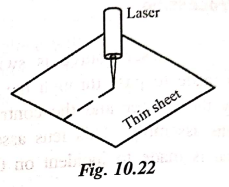
is used as a tool to cut thin metal sheets by properly focusing the laser onto
any particular area to be cut, for a longer time. Thus due to thermal effect
the sheet is cut as shown in Fig. 10.22.
Laser Drilling and perforating holes
The
same technique as used for cutting will be adopted for drilling and perforating
holes, even upto 0.2 to 0.5 μm of thickness.
Thus,
using thermal effect, with extremely high precision we can drill or perforate
holes in any desired position.
Laser Welding
We
know in ordinary welding process heat will be made to fall on the area to be
welded, so that the material in that area will go to molten state. This on
cooling will join the material. In this process the heat will spread all over
the surroundings and will affect the other areas of the material and hence the
material gets damaged.
To
avoid this difficulty, laser is used for welding. Due to its high
directionality, it is focused onto that particular area alone, even of very
small size and the other area remains unaffected. Thus due to thermal effect
the parts can be welded. This process is also called Micro‒Welding.
Advantages of Material Processing
1)
There is no damage to the materials.
2)
Time consumption is less
3)
There is no need of machining after the processing i.e., after welding we can
use the materials directly.
4)
There is no need of vacuum, as needed in electron beam material processing.
Applied Physics I: Chapter 10: Applied Optics - Lasers : Tag: Applied Physics : - Applications of laser: welding, drilling and cutting
Applied Physics I: Chapter 10: Applied Optics - Lasers
Under Subject
Applied Physics I
PH25C01 1st Semester | 2025 Regulation | 1st Semester 2025 Regulation
Related Subjects

English Essentials I
EN25C01 1st Semester | 2025 Regulation | 1st Semester 2025 Regulation

தமிழர் மரபு - Heritage of Tamils
UC25H01 1st Semester | 2025 Regulation | 1st Semester 2025 Regulation
Applied Calculus
MA25C01 Maths 1 M1 - 1st Semester | 2025 Regulation | 1st Semester 2025 Regulation
Applied Physics I
PH25C01 1st Semester | 2025 Regulation | 1st Semester 2025 Regulation

Applied Chemistry I
CY25C01 1st Semester | 2025 Regulation | 1st Semester 2025 Regulation
Makerspace
ME25C04 1st Semester | 2025 Regulation | 1st Semester 2025 Regulation
Computer Programming C
CS25C01 1st Semester | 2025 Regulation | 1st Semester 2025 Regulation
Computer Programming Python
CS25C02 1st Semester | 2025 Regulation | 1st Semester 2025 Regulation
Fundamentals of Electrical and Electronics Engineering
EE25C03 1st Semester | 2025 Regulation | 1st Semester 2025 Regulation
Introduction to Mechanical Engineering
ME25C03 1st Semester | 2025 Regulation | 1st Semester 2025 Regulation

Introduction to Civil Engineering
CE25C01 1st Semester Civil Department | 2025 Regulation | 1st Semester 2025 Regulation
Essentials of Computing
CS25C03 1st Semester - AID CSE IT Department | 2025 Regulation | 1st Semester 2025 Regulation

Applied Physics I Laboratory
PH25C01 1st Semester practical Laboratory Manual | 2025 Regulation | 1st Semester Laboratory 2025 Regulation

Applied Chemistry I Laboratory
CY25C01 1st Semester practical Laboratory Manual | 2025 Regulation | 1st Semester Laboratory 2025 Regulation

Computer Programming C Laboratory
CS25C01 1st Semester practical Laboratory Manual | 2025 Regulation | 1st Semester Laboratory 2025 Regulation

Computer Programming Python Laboratory
CS25C02 1st Semester practical Laboratory Manual | 2025 Regulation | 1st Semester Laboratory 2025 Regulation
Engineering Drawing
ME25C01 EEE Mech Dept | 2025 Regulation | 2nd Semester 2025 Regulation

Basic Electronics and Electrical Engineering
EE25C04 1st Semester ECE Dept | 2025 Regulation | 2nd Semester 2025 Regulation