Digital Principles and Computer Organization: Chapter 4: Combinational Circuits
Binary Subtractor
Half, Full Subtractor
Questions: 1. Define half subtractor and full subtractor. 2. Design a half-subtractor combinational circuit to produce the outputs. Difference and borrow. 3. Explain the operation of a half subtractor with the help of logic diagram and truth table. 4. Write the logic expressions for the difference and borrow of a half subtractor. 5. Realize full-subtractor using K-map. 6. Write an expression for borrow and difference in a full subtractor circuit. 7. Design full-subtractor circuit and draw necessary truth tables. 8. Explain how full subtractor can be designed by using two half subtractor circuits. Draw the circuit diagram.
Binary Subtractor
•
The subtraction consists of four possible elementary operations, namely,
0
– 0 = 0
0
– 1 = 1 with 1 borrow
1
– 0 = 1
1
– 1 = 0
•
In all operations, each subtrahend bit is subtracted from the minuend bit. In
case of second operation the minuend bit is smaller than the subtrahend bit,
hence 1 is borrowed. Just as there are half and full–adders, there are half and full–subtractors.
1. Half Subtractor
•
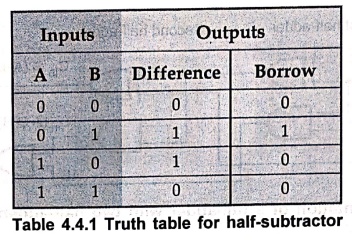
A half–subtractor is a combinational circuit that subtracts two–bits and
produces their difference. It also has an output to specify if a 1 has been
borrowed. Let us designate minuend bit as A and the subtrahend bit as B. The
result of operation A – B for all possible values of A and B is tabulated in
Table 4.4.1.
•
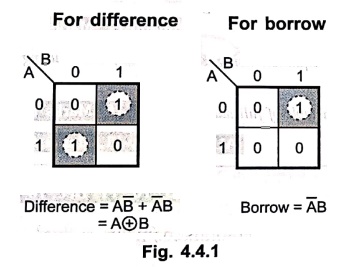
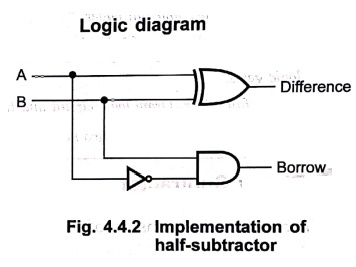
As shown in Table 4.4.1, half–subtractor has two input variables and two output
variables. The Boolean expression for the outputs of half–subtractor can be determined
as follows.
K–map simplification
for half–subtractor
Logic diagram
Limitations of half–subtractor :
In
multidigit subtraction, we have to subtract two bits along with the borrow of
the previous digit subtraction. Effectively such subtraction requires
subtraction of three bits. This is not possible with half–subtractor.
Example: 1
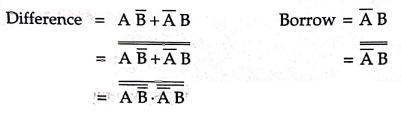
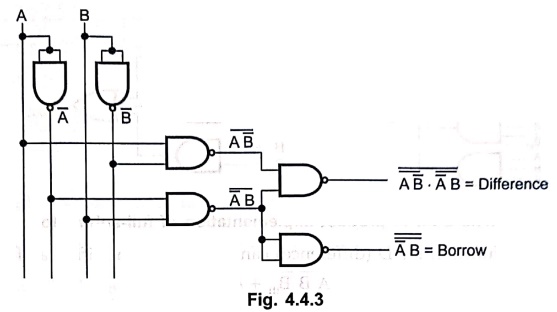
Draw half subtractor
using NAND gates.
Solution :
For
half subtractor :
Implementation :
2. Full–Subtractor
•
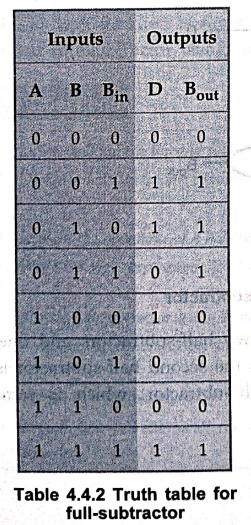
A full–subtractor is a combinational circuit that performs a subtraction
between two bits, taking into account borrow of the lower significant stage.
This circuit has three inputs and two outputs. The three inputs are A, B and Bin
denote the minuend, subtrahend and previous borrow, respectively. The two
outputs, D and Bout, represent the difference and output borrow,
respectively. Table 4.4.2 shows the truth table for full–subtractor.
K–map simplification of D and Bout
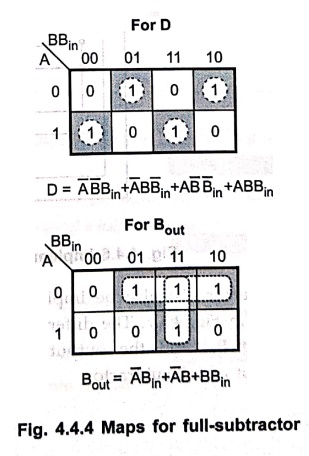
Bout
= ĀBin+ĀB+BBin
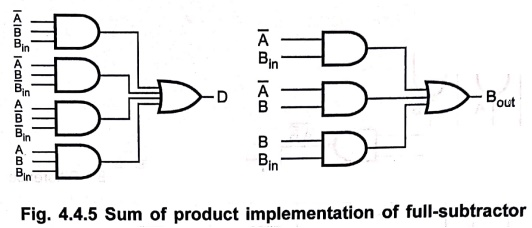
Logic diagram
•
The Boolean function for D (difference) can be further simplified as follows :
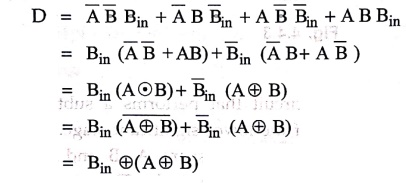
With
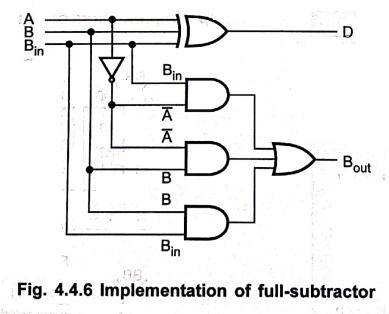
this simplified Boolean function circuit for full–subtractor can be implemented
as shown in Fig. 4.4.6.
A
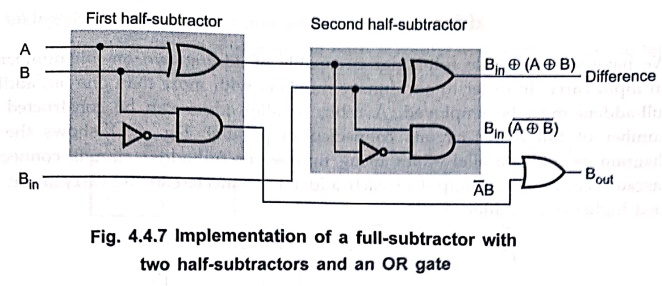
full subtractor can also be implemented with two half–subtractors and one OR
gate, as shown in Fig. 4.4.7. The difference output from the second half–subtractor
is the exclusive–OR of Bin and the output of the first half–subtractor,
which is same as difference output of full–subtractor.
The
borrow output for circuit shown in Fig. 4.4.6 can be given as,
Bout
= ĀBin + ĀB + BBin
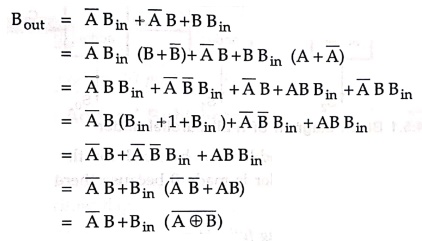
This
Boolean function is same as borrow out of the full–subtractor. Therefore, we
can implement full–subtractor using two half–subtractors and OR gate.
Review Questions
1. Define half
subtractor and full subtractor.
2. Design a half–subtractor
combinational circuit to produce the outputs. Difference and borrow.
3. Explain the
operation of a half subtractor with the help of logic diagram and truth table.
4. Write the logic
expressions for the difference and borrow of a half subtractor.
5. Realize full–subtractor
using K–map.
6. Write an expression
for borrow and difference in a full subtractor circuit.
7. Design full–subtractor
circuit and draw necessary truth tables.
8. Explain how full
subtractor can be designed by using two half subtractor circuits. Draw the
circuit diagram.
Digital Principles and Computer Organization: Chapter 4: Combinational Circuits : Tag: : Half, Full Subtractor - Binary Subtractor
Digital Principles and Computer Organization: Chapter 4: Combinational Circuits
Under Subject
Digital Principles and Computer Organization
CS25C06 2nd Semester AIDS, CSE, IT, CSE(CY) Dept | 2025 Regulation | 2nd Semester 2025 Regulation
Related Subjects

English Essentials II
EN25C02 2nd Semester | 2025 Regulation | 2nd Semester 2025 Regulation

Tamils and Technology தமிழர்களும் தொழில்நுட்பமும்
UC25H02 2nd Semester | 2025 Regulation | 2nd Semester 2025 Regulation
Linear Algebra
MA25C02 2nd Semester | 2025 Regulation
Applied Physics (CSIE) II
PH25C03 2nd Semester AIDS, CSE, IT, CSE(CY) Dept | 2025 Regulation | 2nd Semester 2025 Regulation
Digital Principles and Computer Organization
CS25C06 2nd Semester AIDS, CSE, IT, CSE(CY) Dept | 2025 Regulation | 2nd Semester 2025 Regulation

Basic Electrical and Electronics Engineering
EE25C01 2nd Semester | 2025 Regulation | 2nd Semester 2025 Regulation
Python for Data Science
AD25201 2nd Semester AIDS Dept | 2025 Regulation | 2nd Semester 2025 Regulation

Re-Engineering for Innovation
ME25C05 2nd Semester | 2025 Regulation | 2nd Semester 2025 Regulation
Python for Data Science - Laboratory
AD25201 2nd Semester AIDS Dept | 2025 Regulation | 2nd Semester 2025 Regulation