Digital Principles and Computer Organization: Chapter 4: Combinational Circuits
Fast Multiplication - Bit Pair Recoding
To speed-up the multiplication process in the Booth's algorithm a technique called bit-pair recoding is used. It is also called modified Booth's algorithm.
Fast Multiplication –
Bit Pair Recoding
•
To speed–up the multiplication process in the Booth's algorithm a technique
called bit–pair recoding is used. It is also called modified Booth's algorithm. It halves the maximum number of
summands.
•
In this technique, the Booth–recoded multiplier bits are grouped in pairs. Then
each pair is represented by its equivalent single bit multiplier reducing total
number of multiplier bits to half.
•
For example pair (+ 1 −1) is equivalent to the pair (0 +1). That is, instead of
adding −1 times multiplicand at shifted position i to +1 times the multiplicand
at position i + 1, the same result is obtained by adding +1 times multiplicand
at position i. Similarly, (+1 0) is equivalent to (0 +2), (−1 +1) is equivalent
to (0-1) and so on.
•
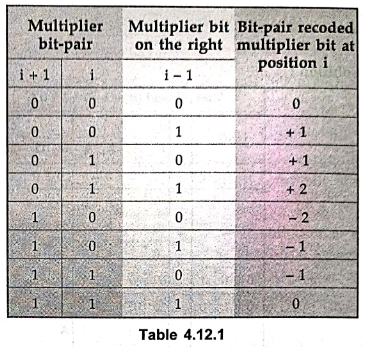
By replacing pairs with their equivalents we can get bit-pair multiplier. But
instead of deriving bit-pair recoded multiplier from Booth recoded multiplier
one can directly derive it from original multiplier. The bit-pair recoding of
multiplier can be directly derived from Table 4.12.2. Table 4.12.2 shows the
bit-pair code for all possible multiplier bit options.
Example 1
Find the bit-pair code for multiplier.
1
1 0 1 0.
Solution
By
referring table we can derive bit-pair code as follows:

Example 2
Multiply given signed 2's complement
numbers using bit-pair recoding
A=110101 multiplicand
(−11)
B=011011 multiplier
(+27)
Solution:
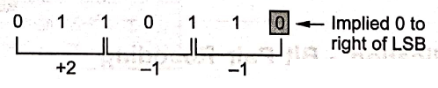
Let us find the bit-pair code for multiplier.
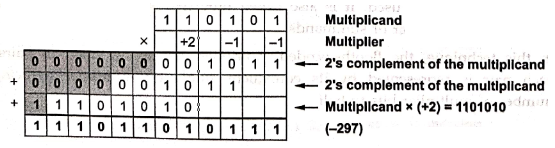
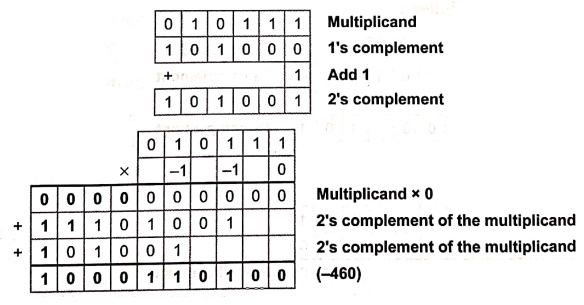
Multiplication:
Multiplicand X + 2 = Left shift multiplicand by 1 bit = 1101010.
Example: 3
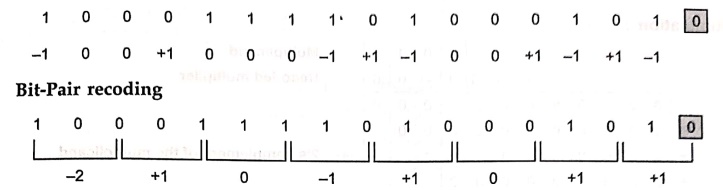
Give the Booth's
recoding and bit–pair recoding of the number.
1 0 0 0 1 1 1 1 0 1 0 0
0 1 0 1.
Solution : Booth's
recoding
Example: 4
Multiply the following
pair of signed 2's complement numbers using bit–pair recoding of the
multipliers : A = 010111, B = 101100.
Solution :
A
= 0 1 0 1 1 1 Multiplicand
(+ 23)
B
= 1 0 1 1 0 0 Multiplier
(– 20)
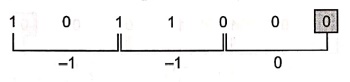
Let
us find the bit–pair code for multiplier
Multiplication :
Example: 5
Explain Booth's
algorithm to multiply the following pair of signed two's complement numbers :
A = 110011 multiplicand
B = 101100 multiplier
Also, implement the
above using bit–pair Recoding and explain how it achieves faster
multiplication.
Solution :

Multiplication :
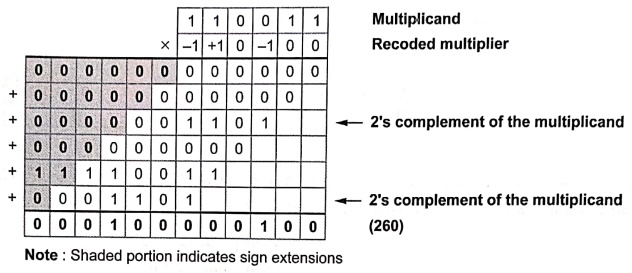
Note :
Shaded portion indicates sign extensions
Implementation with Bit–Pair
recoding
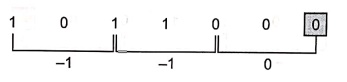
Bit–pair recoding for
multiplier :
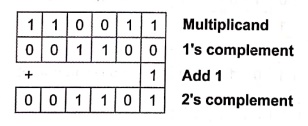
Multiplication :
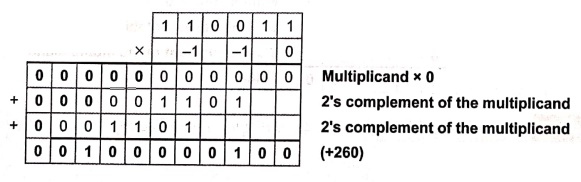
The
Booth's algorithm may need the summation at each step and number of steps
required in Booth's algorithm are equal to length of multiplier in bits. The
bit–pair recoding halves the maximum number of summations. Hence it achieves
faster multiplication.
Example: 6
Solve the following
using bit–pair recoding method.
Multiplicand = 01111
(15) Multiplier 10110 (–10)
Solution :
Bit–pair recoding of
multiplier :
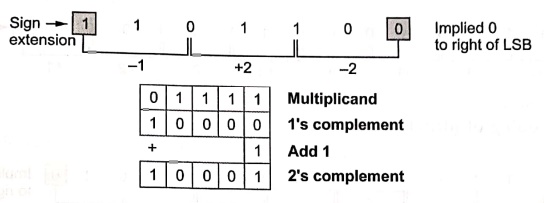
Multiplicand
× (+2) = Shift left multiplicand by 1 bit =
011110
Multiplicand
× (–2) = Shift left 2's complement multiplicand by 1 bit = 100010
Multiplication :
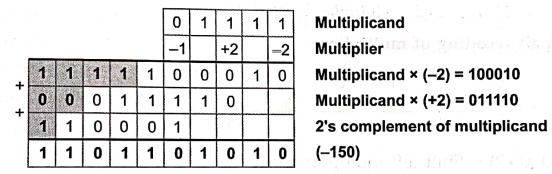
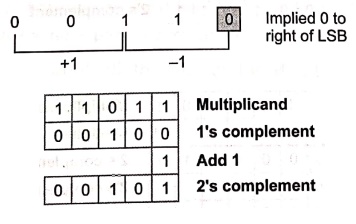
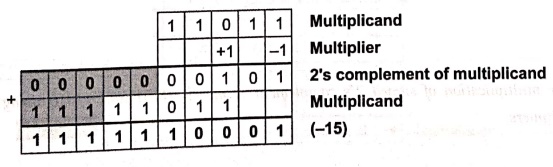
Example: 7
Solve the following
multiplication using bit pair recoding technique
Multiplicand =
11011 Multiplier = 0011
Solution :
Bit–pair recoding :
Multiplication :
Example: 8
Bit pair recode
multipliers : (110110101111001)2 and (0101101010010101)2
Solution :
Bit pair recoding of
(110110101111001)2

Bit
pair recoding of (0101101010010101)2

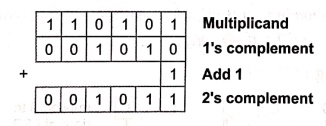
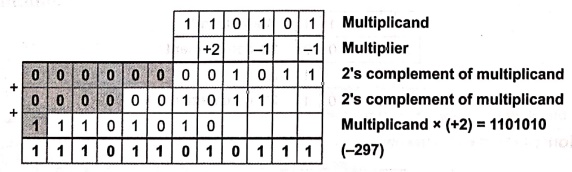
Example: 9
Solve the following
using bit–pair recoding method :
Multiplicand = 110101
and Multiplier = 011011
Solution:
Bit–pair recoding of
multiplier :

Multiplicand
× (+2) = Shift left multiplicand by 1–bit = 1101010
Multiplication :
Review Question
1. Illustrate multiplication of signed 2's complement numbers 01101 and 11010 using bit–pairing of the multipliers.
Digital Principles and Computer Organization: Chapter 4: Combinational Circuits : Tag: : - Fast Multiplication - Bit Pair Recoding
Digital Principles and Computer Organization: Chapter 4: Combinational Circuits
Under Subject
Digital Principles and Computer Organization
CS25C06 2nd Semester AIDS, CSE, IT, CSE(CY) Dept | 2025 Regulation | 2nd Semester 2025 Regulation
Related Subjects

English Essentials II
EN25C02 2nd Semester | 2025 Regulation | 2nd Semester 2025 Regulation

Tamils and Technology தமிழர்களும் தொழில்நுட்பமும்
UC25H02 2nd Semester | 2025 Regulation | 2nd Semester 2025 Regulation
Linear Algebra
MA25C02 2nd Semester | 2025 Regulation
Applied Physics (CSIE) II
PH25C03 2nd Semester AIDS, CSE, IT, CSE(CY) Dept | 2025 Regulation | 2nd Semester 2025 Regulation
Digital Principles and Computer Organization
CS25C06 2nd Semester AIDS, CSE, IT, CSE(CY) Dept | 2025 Regulation | 2nd Semester 2025 Regulation

Basic Electrical and Electronics Engineering
EE25C01 2nd Semester | 2025 Regulation | 2nd Semester 2025 Regulation

Python for Data Science
AD25201 2nd Semester AIDS Dept | 2025 Regulation | 2nd Semester 2025 Regulation

Re-Engineering for Innovation
ME25C05 2nd Semester | 2025 Regulation | 2nd Semester 2025 Regulation
Python for Data Science - Laboratory
AD25201 2nd Semester AIDS Dept | 2025 Regulation | 2nd Semester 2025 Regulation