Applied Physics CSIE II: UNIT IV: Quantum Computing
Bloch Sphere
Concept, Construction, Representation, Explanation, Inference | Quantum Computing

The Bloch sphere is a geometric representation of qubit states in terms of points on the surface of a unit sphere.
BLOCH SPHERE
Concept
The
Bloch sphere is a geometric representation of qubit states in terms of points
on the surface of a unit sphere. Many operations on single qubits that are
commonly used in quantum information processing can be neatly described with
the Block sphere picture.
Construction
The
Bloch sphere is an imaginary sphere (similar to the sphere constructed in
density of states) and has a unit radius. (i.e., r=1). Fig.4.3 shows a qubit
represented as a Bloch sphere. The arrow on the sphere represents the state of
the qubit.
Its
north and south poles are selected to represent the basis states |0> and |1>,
respectively; the other locations are superpositions of |0> and |1>.
While the state of a classical bit can either be the north or the south pole of
the equator, a qubit can be any point on the sphere.
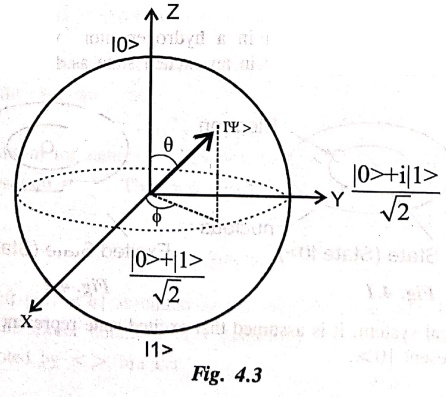
The Bloch sphere representation
The
Bloch sphere allows the state of a qubit to be represented using unit spherical
coordinates with polar angle θ and the azimuth angle ϕ.
The
Bloch sphere representation of a qubit is
|Ψ>=cos(θ/2)| 0 > +eiϕsin(θ/2)|
1> …………(1)
Where
0≤
θ≤π and 0≤ϕ≤2π
Here,
the normalization constraint is |Ψ|2 =1
..
Equation (1) shall be written as
i.e,
|Ψ|2 = |cos(θ/2)|2 +
|sin(θ/2)|2 = 1
Note
that
(i)
When θ = 0 then, |Ψ > = |0> and
(ii)
When θ = π then, |Ψ > = |1> regardless of ϕ.
Explanation
In
the Bloch sphere representation a qubit shall not only be in either the north
or the south pole of the sphere but also in states that are blend of these two
states.
In other words, a qubit
can exist in multiple states simultaneously. This is
basically the essence of the principle of superposition that happens because of
the wave nature of subatomic particles.
Qubits
can also work with the overlap of both 0 and 1 states. A quantum state in super
position can be written as a linear combination of |0> and |1>
|Ψ
>= α|0 >+ β|1>
…………(2)
Where
|Ψ> is the state of the qubit and |0> and |1> are the computational basis
states.
The
coefficients α and β are complex numbers and are called as probability
amplitudes.
If
a is the probability amplitude of 0 state, then the probability of qubit being
in 0 state is
αα* = |α|2
Where
α* is the complex conjugate of α.
However,
|α|2 + |β|2 = 1
The
quantum state Ψ in equation (2) can be written as a unit column vector in a two
dimensional complex plane spanned by the two basis states.
Example
Let
us consider a qubit with a two basis states, viz, |0> and 1> as shown in
Fig. 4.4.
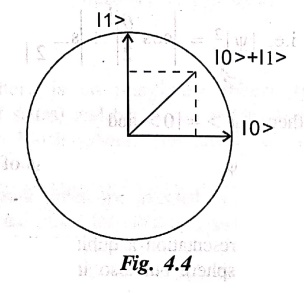
From
Fig. 4.4 We can see that the vectors |0> and 1> are orthogonal.
Here,
(i)
A qubit with state |0> is represented by the column vector 
i.e.,|0>= ........ (3)
(ii)
A qubit with state |1> is represented by the column vector 
i.e. | 1 >= ........ (4)
Thus, by substituting equation (3) and equation (4) in equation (2) we get
Ψ= α + β
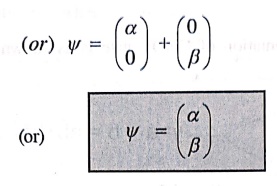
In
other words, an arbitary qubit state is represented by the vector 
Inference
(i)
As discussed, classical bit can only be in a single state, whereas, a qubit
cannot only be in one of the two discrete states, it can also exist
simultaneously in a blend of some of these states.
(ii)
The proportions of |0> and |1> in the blended states need not be equal
and can be arbitary.
(iii)
Thus an infinite number of possible combinations of |0> and |1> is
possible in a qubit, provided, the constraint |α|2 + |β|2
=1 is satisfied.
Conclusion
Thus,
we can conclude that, it is possible to store a vast amount of information on a
single qubit but it is impossible to retrieve the information. When the value
in a qubit is measured, it returns |0> with probability α2 or it
returns |1> with probability β2, and then the qubit assumes the
state just returned.
Applied Physics CSIE II: UNIT IV: Quantum Computing : Tag: Applied Physics : Concept, Construction, Representation, Explanation, Inference | Quantum Computing - Bloch Sphere
Applied Physics CSIE II: UNIT IV: Quantum Computing
Under Subject
Applied Physics (CSIE) II
PH25C03 2nd Semester AIDS, CSE, IT, CSE(CY) Dept | 2025 Regulation | 2nd Semester 2025 Regulation
Related Subjects

English Essentials II
EN25C02 2nd Semester | 2025 Regulation | 2nd Semester 2025 Regulation

Tamils and Technology தமிழர்களும் தொழில்நுட்பமும்
UC25H02 2nd Semester | 2025 Regulation | 2nd Semester 2025 Regulation
Linear Algebra
MA25C02 2nd Semester | 2025 Regulation
Applied Physics (CSIE) II
PH25C03 2nd Semester AIDS, CSE, IT, CSE(CY) Dept | 2025 Regulation | 2nd Semester 2025 Regulation
Digital Principles and Computer Organization
CS25C06 2nd Semester AIDS, CSE, IT, CSE(CY) Dept | 2025 Regulation | 2nd Semester 2025 Regulation

Basic Electrical and Electronics Engineering
EE25C01 2nd Semester | 2025 Regulation | 2nd Semester 2025 Regulation

Python for Data Science
AD25201 2nd Semester AIDS Dept | 2025 Regulation | 2nd Semester 2025 Regulation

Re-Engineering for Innovation
ME25C05 2nd Semester | 2025 Regulation | 2nd Semester 2025 Regulation

Python for Data Science - Laboratory
AD25201 2nd Semester AIDS Dept | 2025 Regulation | 2nd Semester 2025 Regulation