Applied Physics CSIE II: UNIT IV: Quantum Computing
Quantum Computing: Two Marks Important Questions and Answers
Applied Physics
Anna University Part A Two Marks Important Questions and Answers - Applied Physics CSIE II: UNIT IV: Quantum Computing
Applied
Physics CSIE II:
UNIT IV:
Quantum Computing
IMPORTANT PART A
QUESTIONS AND ANSWERS
1. Define Quantum
cellular Automata.
A
Quantum Cellular Automata consist of an array of quantum device cells in a
locally interconnected architectures.
2. Distinguish between
classical bit and Quantum bit.
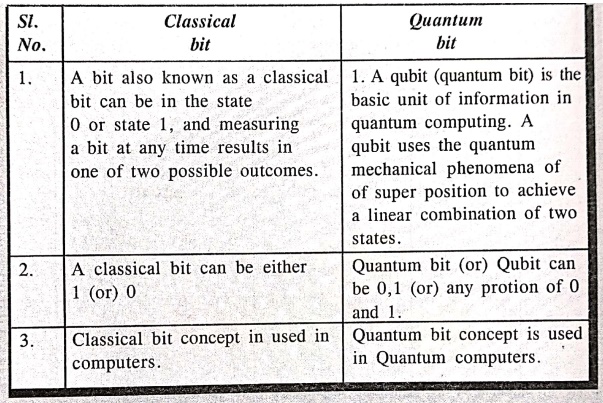
Classical
bit
1.
A bit also known as a classical bit can be in the state 0 or state 1, and
measuring a bit at any time results in one of two possible outcomes.
2.
A classical bit can be either 1 (or) 0
3.
Classical bit concept in used in computers.
Quantum
bit
1.
A qubit (quantum bit) is the basic unit of information in quantum computing. A
qubit uses the quantum mechanical phenomena of of super position to achieve a
linear combination of two states.
2.
Quantum bit (or) Qubit can be 0,1 (or) any protion of 0 and 1.
3.
Quantum bit concept is used in Quantum computers.
3. What is meant by
Quantum states?
The
quantum state of a system is described by a complex function Ψ, which depends
on the coordinate x and on time
i.e.,
Quantum state = Ψ(x,t)
The
wave function encodes all the information about the system. We know |Ψ(x,t)|2dx
is the probability of finding the position of the particles and yields a result
in the interval x→x+dx.
3. What are Quantum
states?
Quantum
gates are operations that manipulate qubits using reversible, matrix‒based
transformations and allow quantum computing to perform tasks impossible for
classical computers.
4. Define Pauli gates?
Pauli
gates are the three fundamental single‒qubit quantum gates: X, Y, and Z.
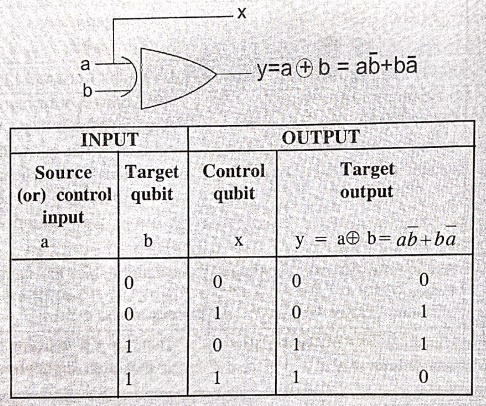
5. Draw the symbol and
write the truth table for CNOT gate.
The
Symbolic representation of CNOT gate is as shown below.
6. List out the
advantages of Quantum computing over classical computing.
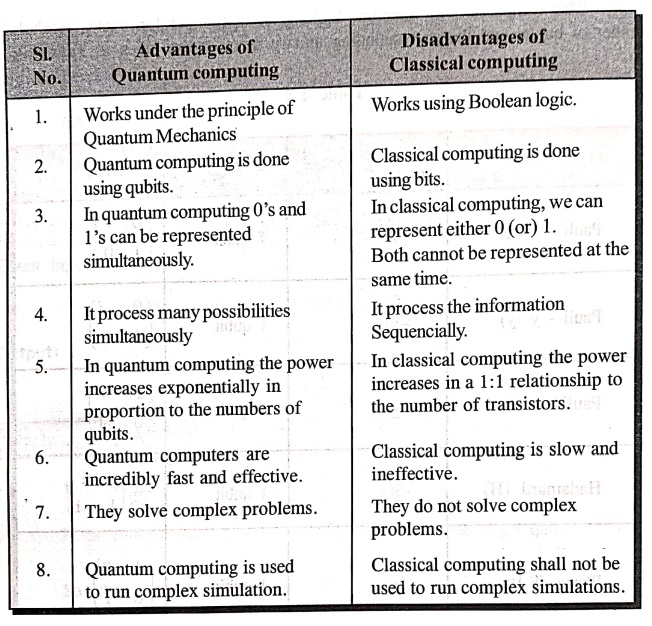
Advantages
of Quantum computing
i.
Works under the principle of Quantum Mechanics
ii.
Quantum computing is done using qubits.
iii.
In quantum computing 0's and 1's can be represented simultaneously.
iv.
It process many possibilities simultaneously
v.
In quantum computing the power increases exponentially in proportion to the
numbers of qubits.
vi.
Quantum computers are incredibly fast and effective.
vii.
They solve complex problems.
viii.
Quantum computing is used to run complex simulation.
Disadvantages
of Classical computing
i.
Works using Boolean logic.
ii.
Classical computing is done using bits.
iii.
In classical computing, we can represent either 0 (or) 1. Both cannot be
represented at the same time.
iv.
It process the information Sequencially.
v.
In classical computing the power increases in a 1:1 relationship to the number
of transistors.
vi.
Classical computing is slow and ineffective.
vii.
They do not solve complex problems.
viii.
Classical computing shall not be used to run complex simulations.
7. Give any four
applications of Quantum Computing.
Some
of the applications of quantum computing is listed below. viz.
(i)
Quantum computing is used in Artificial intellegence and Machine learning.
(ii)
It plays a vital role in drug design & development.
(iii)
They are applied in cyber security and cryptography.
(iv)
Quantum Computing is used in weather forecasting.
(v)
They are also used in logistics optimisation, financial modelling etc.,
(vi)
In research developments, they are used in computational sciences research.
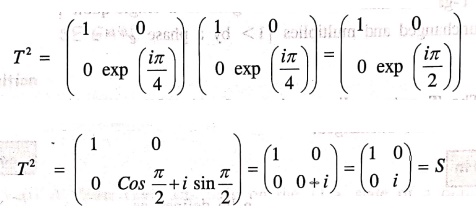
8. Prove T2
= S
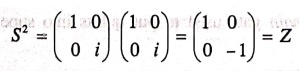
8. Prove S2
= Z
Applied Physics CSIE II: UNIT IV: Quantum Computing : Tag: Applied Physics : Applied Physics - Quantum Computing: Two Marks Important Questions and Answers
Applied Physics CSIE II: UNIT IV: Quantum Computing
Under Subject
Applied Physics (CSIE) II
PH25C03 2nd Semester AIDS, CSE, IT, CSE(CY) Dept | 2025 Regulation | 2nd Semester 2025 Regulation
Related Subjects
English Essentials II
EN25C02 2nd Semester | 2025 Regulation | 2nd Semester 2025 Regulation

Tamils and Technology தமிழர்களும் தொழில்நுட்பமும்
UC25H02 2nd Semester | 2025 Regulation | 2nd Semester 2025 Regulation
Linear Algebra
MA25C02 2nd Semester | 2025 Regulation
Applied Physics (CSIE) II
PH25C03 2nd Semester AIDS, CSE, IT, CSE(CY) Dept | 2025 Regulation | 2nd Semester 2025 Regulation
Digital Principles and Computer Organization
CS25C06 2nd Semester AIDS, CSE, IT, CSE(CY) Dept | 2025 Regulation | 2nd Semester 2025 Regulation

Basic Electrical and Electronics Engineering
EE25C01 2nd Semester | 2025 Regulation | 2nd Semester 2025 Regulation
Python for Data Science
AD25201 2nd Semester AIDS Dept | 2025 Regulation | 2nd Semester 2025 Regulation

Re-Engineering for Innovation
ME25C05 2nd Semester | 2025 Regulation | 2nd Semester 2025 Regulation
Python for Data Science - Laboratory
AD25201 2nd Semester AIDS Dept | 2025 Regulation | 2nd Semester 2025 Regulation