Applied Physics CSIE II: UNIT IV: Quantum Computing
Multiple Qubits
Concept, States, Explanation
Multiple qubits are termed as the combination of many qubits and their quantum state, which in turn will lead to many complex amplitudes.
MULTIPLE QUBITS
Concept
Multiple
qubits are termed as the combination of many qubits and their quantum state,
which in turn will lead to many complex amplitudes.
Explanation
Single
qubits are interesting, but individually they offer no computational advantage.
So, let us now look into how we can represent multiple qubits, and how these
qubits can interact with each other.
Quantum
information processing systems in general use multiple qubits. The state of
such a system can be described using a new vector space that takes into account
the interaction among the qubits.
This
vector space is generated by using a special operation known as tensor product.
The tensor product is denoted by the symbol  . The tensor product
combines the smaller vector spaces of the individual qubits and forms a bigger
space.
. The tensor product
combines the smaller vector spaces of the individual qubits and forms a bigger
space.
We
know, a single bit has two possible states and a qubit state has two complex
amplitudes viz., 1 and 0. Similarly two bits will have four possible states
i.e.,
Qubits:
00 01 10 11
States: (1) (2) (3) (4)
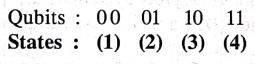
To
describe the state of two qubits, we require four complex amplitudes, i.e, A
two‒qubit system has four basis states. These basis states are constructed from
the single‒qubit basis |0>, |1> using the following rule
│u>│v>=│u>|v>=│uv> ………….(1)
Where
u and v are tensor product of two vectors, given by (u,v) ε (0,1)
Here
ε meaning is "IT TENDS TO:
For
instance, if the states of the two qubits are given by
|
Ψ1 > = α0 |0 > + α1 | 1> …………..(2)
and
| Ψ2 > = β0 |0 > + β1 | 1> …………..(2)
Then
the state of composite system is
|
Ψ> = | Ψ1>| Ψ2> ………(4)
Substituting
equation (2) and (3) in equation (4), we get
|
Ψ > = ( α0 |0 > + α1 | 1>) ( β0
|0 > + β1 | 1>)
………..(5)
Using
the rule prescribed in equation (1), we can write equation (5) as
| Ψ > = α0β0 |0 >
|0 > + α0β1|0>|1> + α1β0 |1>
|0 > + α1β1|1>|1> ………..(5)
States: (1) (2) (3) (4)
From
equation (6), we can see that a two‒qubit system has four basis states i.e.,
 …….. (7)
1st State:
The
first state in the two - qubit system, i.e., |0> |0> indicates
that the first qubit is in state |0> and the second qubit is also in state
|0>.
2nd state:
For
the second state, in the two‒qubit system, i.e., |0> |1>, we
can see that the first qubit is in state |0> and the second qubit is in
state |1> etc.,
Similarly
we can describe the 3rd and 4th states.
Now
by, using the rule as in equation (1), we can write equation (6) as
|
Ψ > = α0β0 |00 > + α0β1|01> + α1β0 |10> + α1β1|11> ………..(8)
It
should be noted, that every two‒qubit state cannot be seperated into two single‒qubit
states. So, we can take α0β0 as C0; α0β1
as C1; α1β0 as C2; and α1β1
as C3 etc.,
In
general, the state of a two‒qubit system i.e., equation (8) has the form
|
Ψ > = C0|00 > + C1|01>
+ C2|10> + C3|11> ………..(9)
where
|C0|2
+ |C1|2 + |C2|2
+ |C3|2 = 1
Multiple qubits
Thus,
a collection of n qubits, which is referred to as a quantum register of size
'n' is called multiple qubits. An n‒qubit register has 2n basis
states, each of the form
|
C0 | C1 ……….| Cn-1, with Ci
ε [0,1].
A
basis state can be represented by a number 0 to 2n‒1.
Example
For
example, the binary state 1001 (which is equal to the decimal number 9) in a
quantum register of size 4 is denoted by |9>4.
A
quantum register of 'n' qubits can be in any superposition of 2n states.
i.e.,
C0|0> + C1|1> + C2|2> + …….. + Cnn-1|2n-1>
If
we have n qubits, we need to keep track of 2n complex amplitudes.
Thus, these vectors grow exponentially with the number of qubits. This is the
reason quantum computers with large numbers of qubits are so difficult to
simulate.
Note:
A moderm laptop can easily simulate a general quantum state of around 20
qubits, but simultating 100 qubits is too difficult for the largest super
computers.
Applied Physics CSIE II: UNIT IV: Quantum Computing : Tag: Applied Physics : Concept, States, Explanation - Multiple Qubits
Applied Physics CSIE II: UNIT IV: Quantum Computing
Under Subject
Applied Physics (CSIE) II
PH25C03 2nd Semester AIDS, CSE, IT, CSE(CY) Dept | 2025 Regulation | 2nd Semester 2025 Regulation
Related Subjects

English Essentials II
EN25C02 2nd Semester | 2025 Regulation | 2nd Semester 2025 Regulation

Tamils and Technology தமிழர்களும் தொழில்நுட்பமும்
UC25H02 2nd Semester | 2025 Regulation | 2nd Semester 2025 Regulation
Linear Algebra
MA25C02 2nd Semester | 2025 Regulation
Applied Physics (CSIE) II
PH25C03 2nd Semester AIDS, CSE, IT, CSE(CY) Dept | 2025 Regulation | 2nd Semester 2025 Regulation
Digital Principles and Computer Organization
CS25C06 2nd Semester AIDS, CSE, IT, CSE(CY) Dept | 2025 Regulation | 2nd Semester 2025 Regulation

Basic Electrical and Electronics Engineering
EE25C01 2nd Semester | 2025 Regulation | 2nd Semester 2025 Regulation
Python for Data Science
AD25201 2nd Semester AIDS Dept | 2025 Regulation | 2nd Semester 2025 Regulation

Re-Engineering for Innovation
ME25C05 2nd Semester | 2025 Regulation | 2nd Semester 2025 Regulation
Python for Data Science - Laboratory
AD25201 2nd Semester AIDS Dept | 2025 Regulation | 2nd Semester 2025 Regulation