Basic Electronics and Electrical Engineering: Chapter 7: Basics of Power Systems
Fuse
The electrical equipment are designed to carry a particular rated value of current under normal conditions.
FUSE
The electrical
equipment are designed to carry a particular rated value of current under
normal conditions. Under abnormal conditions such as short circuits, overload,
or any fault; the current rises above this value, damaging the equipment and
sometimes resulting in fire hazard. Fuses come into operation under fault
conditions.
A fuse is short piece
of metal, inserted in the circuit, which melts when excessive current flows
through it and thus breaks the circuits. Under normal operating conditions it
designed to carry the full load current. If the current increases beyond this
designed value due to reasons mentioned above, the fuse melts, isolating the
power supply from the load.
(a) Desirable characteristics of a Fuse Element
The material used for
fuse wires must have the following characteristics
(1) Low melting point
e.g., tin, lead.
(ii) High conductivity
e.g., copper.
(iii) Free from
deterioration due oxidation e.g., silver.
(iv) Low cost e.g.,
tin, copper.
(b) Materials
Material used are tin
lead or silver having low melting points. Use of copper or iron is dangerous,
though tinned copper may be used.
(c) Types of Fuses
Fuses are classified
into following types
(i) Re‒wireable or kit‒Kat
fuse and
(ii) High rupturing
capacity (H.R.C) cartridge fuse
Re‒wireable or Kit‒Kat Fuse
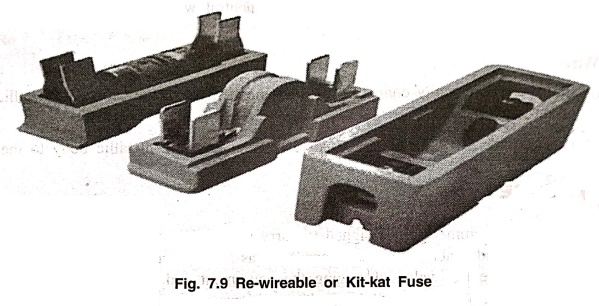
Re‒wireable fuse is
used where low values of fault current are to be interrupted. These fuses are
simple in construction, cheap and available up to a current rating of 200 A.
They are erratic in operation and their performance deteriorates with time. An
image of re‒wireable fuse is as shown in figure (7.9)
High Rupturing Capacity (HRC)
Cartridge Fuse
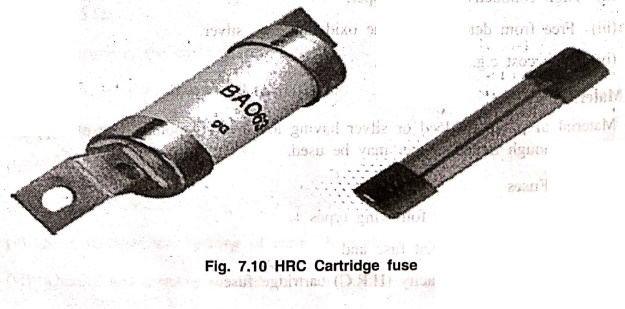
Figure (7.10) shown an
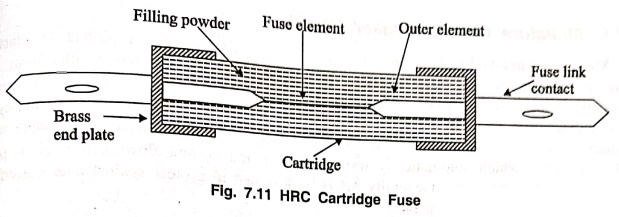
image of HRC cartridge fuse and the essential parts of a typical HRC cartridge
fuse. It consists of a heat resisting ceramic body having metal end‒caps to
which a silver current‒carrying element is welded. The space within the body
surrounding the elements is completely packed with a filling powder. The
filling material may be chalk, plaster of Paris, quartz or marble dust and acts
as an arc quenching and cooling medium. Therefore, it carries the normal
current without overheating Under normal loading conditions, the fuse element
is at a temperature below its melting point. When a fault occurs, the current
increases and the fuse element melts before the fault current reaches its first
peak. The heat produced in the process vaporizes the melted silver element.
The chemical reaction
between the silver vapors and the filling powder results in the formation of a
high resistance substance which helps in quenching the arc.
Basic Electronics and Electrical Engineering: Chapter 7: Basics of Power Systems : Tag: Basic Engineering : - Fuse
Basic Electronics and Electrical Engineering: Chapter 7: Basics of Power Systems
Under Subject

Basic Electronics and Electrical Engineering
EE25C04 1st Semester ECE Dept | 2025 Regulation | 2nd Semester 2025 Regulation
Related Subjects

English Essentials I
EN25C01 1st Semester | 2025 Regulation | 1st Semester 2025 Regulation

தமிழர் மரபு - Heritage of Tamils
UC25H01 1st Semester | 2025 Regulation | 1st Semester 2025 Regulation
Applied Calculus
MA25C01 Maths 1 M1 - 1st Semester | 2025 Regulation | 1st Semester 2025 Regulation
Applied Physics I
PH25C01 1st Semester | 2025 Regulation | 1st Semester 2025 Regulation

Applied Chemistry I
CY25C01 1st Semester | 2025 Regulation | 1st Semester 2025 Regulation
Makerspace
ME25C04 1st Semester | 2025 Regulation | 1st Semester 2025 Regulation
Computer Programming C
CS25C01 1st Semester | 2025 Regulation | 1st Semester 2025 Regulation
Computer Programming Python
CS25C02 1st Semester | 2025 Regulation | 1st Semester 2025 Regulation
Fundamentals of Electrical and Electronics Engineering
EE25C03 1st Semester | 2025 Regulation | 1st Semester 2025 Regulation
Introduction to Mechanical Engineering
ME25C03 1st Semester | 2025 Regulation | 1st Semester 2025 Regulation

Introduction to Civil Engineering
CE25C01 1st Semester Civil Department | 2025 Regulation | 1st Semester 2025 Regulation
Essentials of Computing
CS25C03 1st Semester - AID CSE IT Department | 2025 Regulation | 1st Semester 2025 Regulation

Applied Physics I Laboratory
PH25C01 1st Semester practical Laboratory Manual | 2025 Regulation | 1st Semester Laboratory 2025 Regulation

Applied Chemistry I Laboratory
CY25C01 1st Semester practical Laboratory Manual | 2025 Regulation | 1st Semester Laboratory 2025 Regulation

Computer Programming C Laboratory
CS25C01 1st Semester practical Laboratory Manual | 2025 Regulation | 1st Semester Laboratory 2025 Regulation

Computer Programming Python Laboratory
CS25C02 1st Semester practical Laboratory Manual | 2025 Regulation | 1st Semester Laboratory 2025 Regulation
Engineering Drawing
ME25C01 EEE Mech Dept | 2025 Regulation | 2nd Semester 2025 Regulation
Basic Electronics and Electrical Engineering
EE25C04 1st Semester ECE Dept | 2025 Regulation | 2nd Semester 2025 Regulation