Basic Electronics and Electrical Engineering: Chapter 7: Basics of Power Systems
Typical A.C Power System Scheme
1. Generating station 2. Primary transmission 3. Secondary transmission 4. Primary distribution 5. Secondary distribution
TYPICAL
A.C POWER SYSTEM SCHEME
The large network of
conductors between the power station and the consumers can be broadly divided
into two parts viz., transmission system and distribution system. Each part can
be further subdivided into two primary transmission, secondary transmission and
primary distribution and secondary distribution. Fig. 7.1 shows the layout of a
typical AC power supply scheme by a single line diagram.
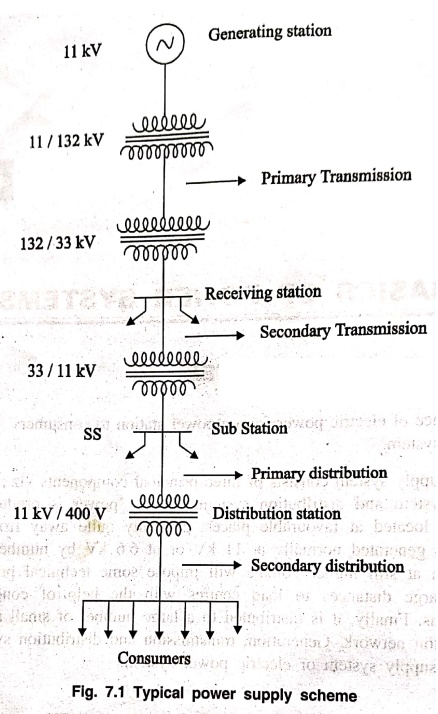
1. Generating station
Generating station in
which the electric power is produced by 3‒phase alternator operating in
parallel. The usual generation voltage is 11 kV. The power generated at the
generating stations is transmitted at higher voltage to the main load centres
for economy purpose.
2. Primary transmission
Generally the primary
transmission is carried at 66 kV, 132 kV, 220 kV or 400 kV. The electric power
at 132 kV is transmitted by 3‒phase, 3‒wire overhead system. This forms the
primary transmission. There are advantages when power is transmitted at high
voltages:
(i) The volume of
conductor material required is low.
(ii) For a given amount
of power transmitted, the current through the line is reduced, when the
transmission system voltage is high. This reduces the line losses and hence
efficiency of transmission is reduced.
(iii) As the current is
reduced the voltage in the line is reduced and hence the line regulation is
improved.
3. Secondary transmission
The primary
transmission line terminates at the receiving station. At the receiving
station, the voltage is reduced to 33 kV by step down transformers. From this
station, electric power is transmitted at 33 kV by 3‒phase, 3‒wire overhead
system to various sub‒stations located at the strategic points in the city.
This forms the secondary transmission.
4. Primary distribution
The secondary
transmission line terminates at the sub‒station where the voltage is reduced
from 33 kV to 11 kV, 3‒phase, 3‒wire system. The 11 kV lines run along the
important road sides of the city. This forms the primary distribution.
5. Secondary distribution
The electric power from
primary distribution line (11 kV) is delivered to distribution sub‒stations.
These sub‒stations are located near the consumers localities and step down the
voltage to 400 V, 3‒phase, 4‒wire system. The secondary distribution system
consists of feeders, distributors and service mains. Fig. 7.2 shows the
elements of low voltage distribution system. The distributors may be radial or
ring. Feeders (SC or SA) radiating from the distribution substation (DS) supply
power to the distributors (AB, BC, CD and DA). No consumers is given direct
connection from the feeders. Instead, the consumers are connected to the
distributors through their service mains.

Basic Electronics and Electrical Engineering: Chapter 7: Basics of Power Systems : Tag: Basic Engineering : - Typical A.C Power System Scheme
Basic Electronics and Electrical Engineering: Chapter 7: Basics of Power Systems
Under Subject

Basic Electronics and Electrical Engineering
EE25C04 1st Semester ECE Dept | 2025 Regulation | 2nd Semester 2025 Regulation
Related Subjects

English Essentials I
EN25C01 1st Semester | 2025 Regulation | 1st Semester 2025 Regulation

தமிழர் மரபு - Heritage of Tamils
UC25H01 1st Semester | 2025 Regulation | 1st Semester 2025 Regulation
Applied Calculus
MA25C01 Maths 1 M1 - 1st Semester | 2025 Regulation | 1st Semester 2025 Regulation
Applied Physics I
PH25C01 1st Semester | 2025 Regulation | 1st Semester 2025 Regulation

Applied Chemistry I
CY25C01 1st Semester | 2025 Regulation | 1st Semester 2025 Regulation
Makerspace
ME25C04 1st Semester | 2025 Regulation | 1st Semester 2025 Regulation
Computer Programming C
CS25C01 1st Semester | 2025 Regulation | 1st Semester 2025 Regulation
Computer Programming Python
CS25C02 1st Semester | 2025 Regulation | 1st Semester 2025 Regulation
Fundamentals of Electrical and Electronics Engineering
EE25C03 1st Semester | 2025 Regulation | 1st Semester 2025 Regulation
Introduction to Mechanical Engineering
ME25C03 1st Semester | 2025 Regulation | 1st Semester 2025 Regulation

Introduction to Civil Engineering
CE25C01 1st Semester Civil Department | 2025 Regulation | 1st Semester 2025 Regulation
Essentials of Computing
CS25C03 1st Semester - AID CSE IT Department | 2025 Regulation | 1st Semester 2025 Regulation

Applied Physics I Laboratory
PH25C01 1st Semester practical Laboratory Manual | 2025 Regulation | 1st Semester Laboratory 2025 Regulation

Applied Chemistry I Laboratory
CY25C01 1st Semester practical Laboratory Manual | 2025 Regulation | 1st Semester Laboratory 2025 Regulation

Computer Programming C Laboratory
CS25C01 1st Semester practical Laboratory Manual | 2025 Regulation | 1st Semester Laboratory 2025 Regulation

Computer Programming Python Laboratory
CS25C02 1st Semester practical Laboratory Manual | 2025 Regulation | 1st Semester Laboratory 2025 Regulation
Engineering Drawing
ME25C01 EEE Mech Dept | 2025 Regulation | 2nd Semester 2025 Regulation
Basic Electronics and Electrical Engineering
EE25C04 1st Semester ECE Dept | 2025 Regulation | 2nd Semester 2025 Regulation