Basic Electronics and Electrical Engineering: Chapter 7: Basics of Power Systems
Methods of Earthing
The various methods of earthing in common use are (i) Plate earthing (ii) Pipe earthing (iii) Rod earthing (iv) Strip or wire earthing
METHODS
OF EARTHING
The various methods of
earthing in common use are
(i) Plate earthing
(ii) Pipe earthing
(iii) Rod earthing
(iv) Strip or wire
earthing
1. Plate earthing
In this method either a
copper plate of 60 cm × 60 cm × 3.18 or GI plate of 60 cm × 60 cm × 6.35 is
used for earthing. The plate is buried into the ground not less than 3 m from
the ground level. The earth plate is embedded in alternate layers of coal and
salt for a thickness of 15 cm as shown in figure (7.6). In addition, water is
poured for keeping the earth's electrode resistance value below a maximum of 5 Ω.
The earth wire securely bolted to the earth plate.
A cement masonry
chamber is built with a cast iron cover for easy regular maintenance.

2. Pipe earthing
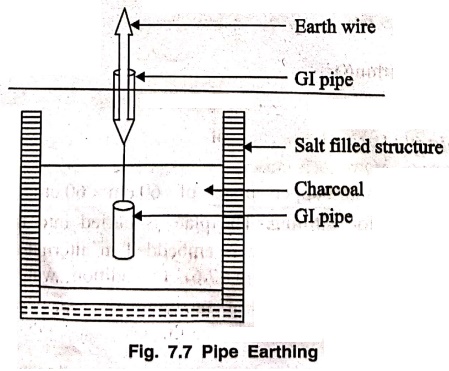
Earth electrode made of
a GI (galvanized iron) pipe of 38 mm in diameter and length of 2 m (depending on
the current) with 12 mm holes on the surface is placed upright at a depth of 4.75
cm in a permanently wet ground. To keep the value of the earth resistance at
the desired level, the area (15 cm) surrounding the GI pipe is filled with a
mixture of salt and coal. The efficiency of the earthing system is improved by
pouring water through the Funnel periodically. The GI earth wires of sufficient
cross‒sectional area are run through a 12.7 mm diameter pipe (at 60 cm below)
from the 19mm diameter pipe and secured tightly at the top‒as‒shown in figure
(7.7).
When compared to the
plate earth system the pipe earth system can carry larger leakage currents due
to larger surface area is in contact with the soil for given electrode size.
This system also enables easy maintenance as the earth wire connection is
housed at the ground levels.
3. Rod earthing
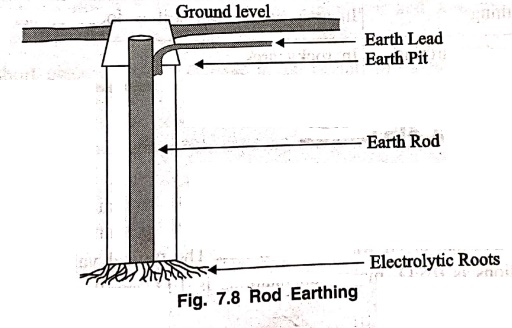
It is the same method
as pipe earthing, A copper rod of 12.5 cm (1/2 inch) diameter or 16 mm (0.6 in)
diameter of galvanized steel or hollow section 25 mm (1 inch) of GI pipe of
length above 2.5 m (8.2 ft) are buried upright in the earth manually or with
the help of a pneumatic, hammer. The length of embedded electrodes in the soil
reduces earth resistance of a desired value.
4. Strip or wire earthing
In this method of
earthing strip electrodes of cross‒section not less than 25 mm (1 in × 0.06 in)
is buried in a horizontal trenches of a minimum depth of 0.5 m. If copper with
a cross‒section of 25 mm × 4 mm (1 in × 0.15 in) is used and a dimension of 3.0
mm2 if it's a galvanized iron or steel.
If at all round
conductors are used, their cross‒section area should not be too small, say less
than 6.0 mm2 if it's a galvanized iron or steel. The length of the
conductor buried in the ground would give a sufficient earth resistance and
this length should not be less than 15 m. The electrodes shall be as widely
distributed as possible in a single straigth or circular trenches radiating
from a point. This type of earthing is used where the earth bed has a rocky
soil and excavation work is difficult.
Basic Electronics and Electrical Engineering: Chapter 7: Basics of Power Systems : Tag: Basic Engineering : - Methods of Earthing
Basic Electronics and Electrical Engineering: Chapter 7: Basics of Power Systems
Under Subject

Basic Electronics and Electrical Engineering
EE25C04 1st Semester ECE Dept | 2025 Regulation | 2nd Semester 2025 Regulation
Related Subjects

English Essentials I
EN25C01 1st Semester | 2025 Regulation | 1st Semester 2025 Regulation

தமிழர் மரபு - Heritage of Tamils
UC25H01 1st Semester | 2025 Regulation | 1st Semester 2025 Regulation
Applied Calculus
MA25C01 Maths 1 M1 - 1st Semester | 2025 Regulation | 1st Semester 2025 Regulation
Applied Physics I
PH25C01 1st Semester | 2025 Regulation | 1st Semester 2025 Regulation

Applied Chemistry I
CY25C01 1st Semester | 2025 Regulation | 1st Semester 2025 Regulation
Makerspace
ME25C04 1st Semester | 2025 Regulation | 1st Semester 2025 Regulation
Computer Programming C
CS25C01 1st Semester | 2025 Regulation | 1st Semester 2025 Regulation
Computer Programming Python
CS25C02 1st Semester | 2025 Regulation | 1st Semester 2025 Regulation
Fundamentals of Electrical and Electronics Engineering
EE25C03 1st Semester | 2025 Regulation | 1st Semester 2025 Regulation
Introduction to Mechanical Engineering
ME25C03 1st Semester | 2025 Regulation | 1st Semester 2025 Regulation

Introduction to Civil Engineering
CE25C01 1st Semester Civil Department | 2025 Regulation | 1st Semester 2025 Regulation
Essentials of Computing
CS25C03 1st Semester - AID CSE IT Department | 2025 Regulation | 1st Semester 2025 Regulation

Applied Physics I Laboratory
PH25C01 1st Semester practical Laboratory Manual | 2025 Regulation | 1st Semester Laboratory 2025 Regulation

Applied Chemistry I Laboratory
CY25C01 1st Semester practical Laboratory Manual | 2025 Regulation | 1st Semester Laboratory 2025 Regulation

Computer Programming C Laboratory
CS25C01 1st Semester practical Laboratory Manual | 2025 Regulation | 1st Semester Laboratory 2025 Regulation

Computer Programming Python Laboratory
CS25C02 1st Semester practical Laboratory Manual | 2025 Regulation | 1st Semester Laboratory 2025 Regulation
Engineering Drawing
ME25C01 EEE Mech Dept | 2025 Regulation | 2nd Semester 2025 Regulation
Basic Electronics and Electrical Engineering
EE25C04 1st Semester ECE Dept | 2025 Regulation | 2nd Semester 2025 Regulation