Computer Organization and Architecture: Chapter 6: Next Generation Computer Architecture
Graphics Processing Units (GPU)
Key Features, Architecture
Questions: 1. What is GPU? 2. State key features of GPU. 3. Explain the GPU architecture. 4. Give comparison between CPU and GPU.
Graphics
Processing Units (GPU)
•
A
GPU (Graphics Processing Unit) is a
specialized processor designed to handle parallel
processing tasks, primarily for rendering graphics in computers, gaming
consoles, and mobile devices.
•
Modern GPUs are also widely used for scientific computing, artificial intelligence (AI), machine learning (ML), and
cryptocurrency mining due to their ability to perform massive parallel
computations efficiently.
1. Key Features of a GPU
1. Specialized architecture for parallel processing capabilities
■
Unlike a CPU (Central Processing Unit),
which has a few powerful cores optimized for sequential processing, a GPU consists of thousands of smaller cores that execute multiple tasks
simultaneously.
■
Ideal for graphics rendering, deep
learning, simulations, and large‒scale data processing.
2. High‒speed computation
■
Designed to process multiple data
streams simultaneously, making it significantly faster than a CPU for tasks
like image processing, video rendering
and neural network training.
3. Memory bandwidth
■
GPUs have high memory bandwidth, allowing them to quickly access and process
large amounts of data.
■
Uses GDDR (Graphics Double Data Rate)
memory, which has higher bandwidth than traditional RAM to handle large
datasets quickly.
4. Optimized for Al and Deep Learning
■
Modern GPUs include Tensor Cores and RT
Cores (Ray Tracing Cores) for AI
acceleration and realistic graphics
rendering.
■
NVIDIA's CUDA and AMD's ROCm allow for general‒purpose GPU computing
(GPGPU), enabling non‒graphics
applications to leverage GPU power.
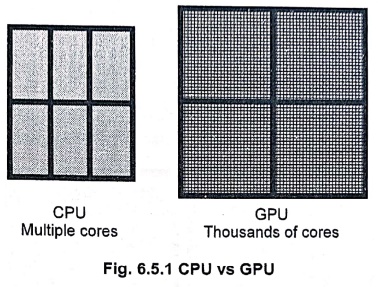
•
GPU computing offers unprecedented application performance by offloading
compute‒ intensive portions of the application to the GPU, while the remainder
of the code still runs on the CPU. From a user's perspective, applications
simply run significantly faster.
•
CPU + GPU is a powerful combination because CPUs consist of a few cores
optimized for serial processing, while GPUs consist of thousands of smaller,
more efficient cores designed for parallel performance. Serial portions of the
code run on the CPU while parallel portions run on the GPU.
2. Connection between CPU and GPU
•
Fig. 6.5.2 shows how a GPU is typically connected with a modern processor. A
GPU is an accelerator (or a co‒processor) that is connected to a host
processor.
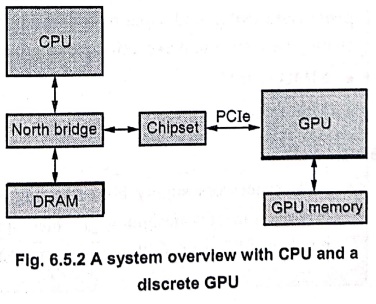
•
The host processor and GPU communicate to each other via PCI Express (PCIe)
that provides 4 Gbit/s (Gen 2) or 8 Gbit/s (Gen 3) interconnection bandwidth.
• This communication bandwidth often becomes one of the biggest bottlenecks; thus it is critical to offload the work to GPUs only if the benefits of using GPUS outweigh the offload cost.
3. GPU Architecture
•
Fig. 6.5.3 illustrates the major components of a general‒purpose graphics
processor.
• At a high level, the GPU architecture consists of several streaming multiprocessors (SMs), which are connected to the GPU's DRAM.
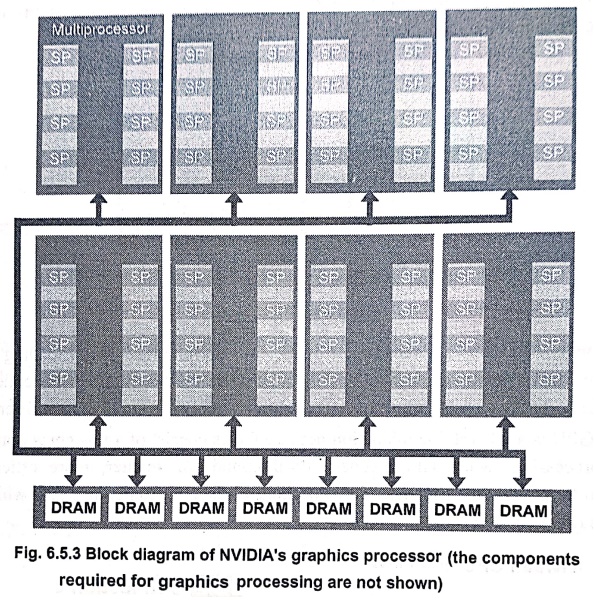
■
Each SM has a number of single‒instruction multiple data (SIMD) units, also
called stream processors (SPs), and
supports a multithreading execution mechanism. GPU architectures employ two
important execution paradigms :
■
SIMD / SIMT
■
Multithreading
SIMD / SIMT
■
GPU processors supply high Floating Point (FP) execution bandwidth, which is
the driving force for designing graphics applications. To make efficient use of
the high number of FP units, GPU architectures employ a SIMD or SIMT execution
paradigm.
■
In SIMD, one instruction operates on multiple data (i.e., only one instruction
is fetched, decoded and scheduled but on multiple data operands). Depending on
the word width, anywhere from 32, 64 or 128 FP operations may be performed by a
single instruction on current systems. This technique significantly increases system
throughput and also improves its energy‒efficiency.
Multithreading
■
The other important execution paradigm that GPU architectures employ is hardware multithreading.
■
GPU processors use fast hardware‒based context switching to tolerate long
memory and operation latencies.
■
The effectiveness of multithreading depends on whether an application can
provide a high number of concurrent threads.
■
Most graphics applications have this characteristics since they typically need
to process many objects (e.g. pixels, vertices, polygons) simultaneously.
■
In conventional CPU systems, thread context switching relatively much more
expensive : all program states, such as PC (Program Counter), architectural
registers and stack information, need to be stored by the operating system in
memory. However, in GPUs, the cost of thread switching is much lower due to
native hardware support of such process.
■
The degree of multithreading (the number of simultaneous hardware thread
contexts) is much lower in CPUs than in GPUs (e.g. two hyperthreads Vs.
hundreds of GPU thread).
4. GPU vs. CPU: Key Differences
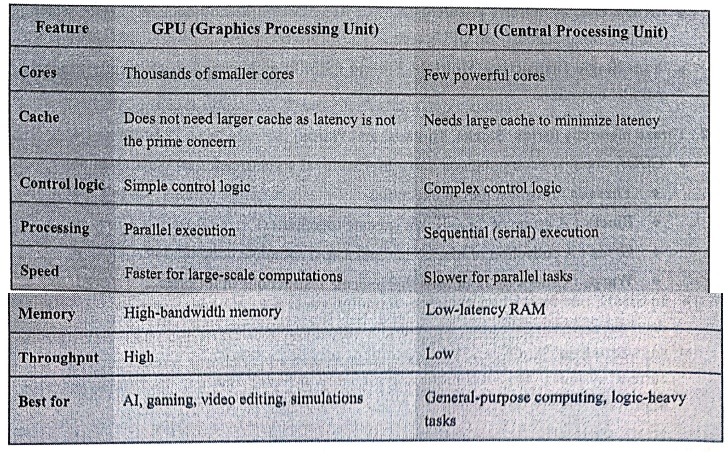
Review Questions
1. What is GPU?
2. State key features
of GPU.
3. Explain the GPU
architecture.
4. Give comparison
between CPU and GPU.
Computer Organization and Architecture: Chapter 6: Next Generation Computer Architecture : Tag: Computer : Key Features, Architecture - Graphics Processing Units (GPU)
Computer Organization and Architecture: Chapter 6: Next Generation Computer Architecture
Under Subject
Computer Organization and Architecture
CW25201 3rd Semester IT department. | 2025 Regulation | 3rd Semester 2025 Regulation
Related Subjects
Discrete Mathematics
MA25C14 3rd Semester CSE,IT,CY,AIDS departments. | 2025 Regulation | 3rd Semester 2025 Regulation
Data Structures
CS25C08 3rd Semester CSE,IT,CY,AIDS departments. | 2025 Regulation | 3rd Semester 2025 Regulation
Computer Organization and Architecture
CW25201 3rd Semester IT department. | 2025 Regulation | 3rd Semester 2025 Regulation
Object Oriented Programming
CS25C07 3rd Semester IT department. | 2025 Regulation | 3rd Semester 2025 Regulation
Web Technologies
IT25301 3rd Semester IT department. | 2025 Regulation | 3rd Semester 2025 Regulation
English Communication Skills Laboratory I
EN25C03 3rd Semester all department. | 2025 Regulation | 3rd Semester 2025 Regulation
Skill Development Course I
3rd Semester all department. | 2025 Regulation | 3rd Semester 2025 Regulation