Computer Organization and Architecture: Chapter 6: Next Generation Computer Architecture
Multicore Architectures
Classification, Configurations, Advantages, Challenges, Limitation
Questions: 1.What is a multicore processor ? 2. Why do modern systems prefer multicore processors instead of increasing clock speed? 3.Explain the classification of multicore architectures. 4.What is the difference between logical and physical cores? 5.What is a shared bus in multicore processors? 6.What is cache coherence? 7. What do UMA and NUMA stand for? 8. Define hyperthreading. 9. Explain hyperthreading architecture. 10. What is a classic multiprocessor system? 11. What is a true multicore processor? 12. Discuss the architecture and advantages of true multicore processor systems. 13. List any two advantages of multicore processors. 14. What are the challenges of multicore design?
Computer Organization and Architecture
Chapter 6.
Next
Generation Computer Architecture
Multicore
Architectures
•
As modern applications demand higher performance and energy efficiency,
computer designers increasingly rely on multicore
architectures. A multicore processor integrates two or more independent
processing units (cores) on a single chip. Each core is capable of executing
instructions simultaneously, enabling true parallelism within the processor.
•
Multicore systems improve performance not by increasing clock speed, but by
executing multiple threads or programs at the same time. This approach allows
better utilization of transistors, lower power consumption, and improved
throughput compared to single‒core processors.
1. Classification of Multicore Architectures
•
Multicore architectures can be classified based on several important design
factors:
1. Number
of processors (Cores) : This refers to the number of
processing units integrated into the system. A multicore processor may consist
of:
♦
Dual‒core processors → 2 cores
♦ Quad‒core processors → 4 cores
♦
Hexa‒core processors → 6 cores
♦
Octa‒core processors → 8 cores
♦
Higher counts (12, 16, 32+ cores) in servers and workstations.
More
cores allow more parallel tasks to run simultaneously, improving performance in
multitasking and multithreaded applications.
2.
Processor‒to‒Processor communication :
Cores
on a multicore chip must communicate and share data efficiently. Common
approaches include:
♦
Shared bus communication : All cores
communicate over a common bus. Effective for a small number of cores but
becomes a bottleneck as cores increase.
♦ Interconnect networks
: Advanced multicore chips use mesh, ring or crossbar networks for high‒speed
communication.
♦
Shared memory access : Cores
communicate by reading/writing to shared memory, making programming easier.
Efficient
communication is essential to avoid delays and maintain high throughput.
3. Cache
and Memory implementations : Memory design strongly
impacts multicore performance. Typical implementations include:
♦
Private L1/L2 Caches : Each core has
its own small, fast cache to store frequently used data.
♦
Shared Last‒Level Cache (LLC), usually
L3 : All cores can access a shared cache to improve data sharing.
♦
Cache coherence protocols (MESI, MOESI) :
Required to ensure all cores see a consistent view of memory.
Multicore
systems also use memory models like:
♦ UMA (Uniform Memory
Access) : All cores access memory at equal speed.
♦ NUMA (Non‒Uniform
Memory Access) : Access time depends on the location of
memory relative to the core.
4. I/O
bus and Front Side Bus (FSB) implementation
♦
Multicore processors must efficiently communicate with external memory and I/O
devices.
♦
Older systems used a Front Side Bus
(FSB) to connect the CPU to the memory controller. Modern processors use
faster interconnects such as:
o
Intel QuickPath Interconnect (QPI)
o
AMD infinity fabric
♦
These high‒speed links allow multiple cores to access memory and I/O without
bottlenecks.
2. Common Multicore and Multiprocessing Configurations
•
Fig. 6.1.1 describes three typical configurations used in modern systems. These
configurations differ in how processing units are organized.
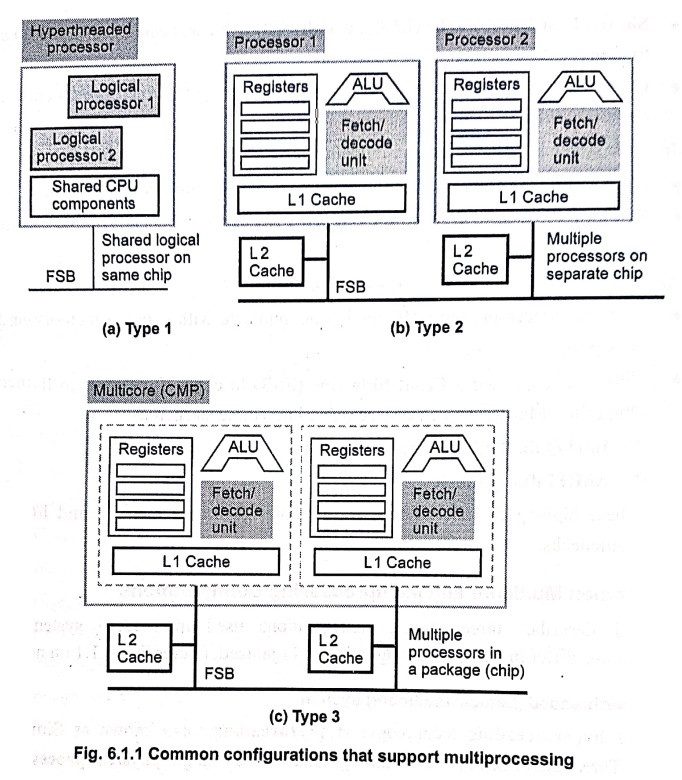
Type 1: Hyperthreaded (Logical multicore) system
■
It uses hyperthreading technology. Hyperthreading (also known as
Simultaneous Multi‒Threading or SMT) is a technology that allows a single physical processor to act like two or
more logical processors to the
operating system and application programs.
■ Logical vs. Physical :
In hyperthreaded technology, the multiple processors are logical instead of physical. The physical chip still contains only
one core.
■
Hardware duplication : The
architecture involves some duplication of internal hardware components, such as
register files and program counters, but not
enough to qualify as a separate, complete physical processor.
■ Function :
It allows the single core to execute instructions from multiple threads
concurrently by issuing instructions from different threads in the same clock
cycle, thereby hiding memory latency and boosting utilization of the execution
units.
■ Advantage : Increases instruction throughput without doubling physical hardware.
■
Limitation: Not true multicore ‒
performance gain is smaller than adding real cores.
Type 2: Classic multiprocessor system
■
A classic multiprocessor system
consists of two or more independent, Complete Processing Units (CPUs) that are
physically separate chips connected on a motherboard.
■
Physical separation :
Each processing unit is a separate
physical chip with its own dedicated hardware.
■
Tightly coupled : These systems are
considered tightly coupled because
all processors share a single common main memory and are controlled by a single
operating system.
■
Communication : They typically
communicate via a shared bus architecture (like the FSB) or a dedicated
interconnect. The challenge in these systems is maintaining cache coherence
across the separate chips.
■ Advantages :
♦ True parallel processing.
♦ Suitable for servers and scientific
computing.
■ Drawbacks :
♦ Higher cost and power usage.
♦ Communication overhead increases with more
processors.
Type 3 : True multicore processor system
■
A multicore system represents the
modern approach to multiprocessing, providing two or more complete processors (cores) integrated onto a single physical chip (die).
■ Integration : The
cores share the same silicon substrate and often share higher levels of the
cache hierarchy (e.g., L2 or L3 cache) and the memory interface.
■ Efficiency :
Integrating multiple cores onto one die offers significant advantages in power
consumption, communication latency and manufacturing costs compared to classic
multiprocessor systems. The short physical distance between cores allows for
very fast, low‒latency communication.
■ Advantages:
♦
Faster communication between cores compared to separate chips.
♦
Lower power consumption.
♦
Highly scalable and efficient.
■ Applications:
♦ Used in desktops, laptops, smartphones and
modern servers.
3. Advantages of Multicore Architectures
•
Multicore designs offer significant improvements in performance, efficiency and
design flexibility :
■
Parallelism : The most fundamental
advantage is the ability to execute multiple
tasks or threads simultaneously across different cores. This is true
parallelism, leading to substantial speed‒up for complex workloads.
■
Energy efficiency: By distributing
the workload across multiple cores, each operating fos at a lower clock speed, the overall system
can complete the task using significantly less power and generating less heat.
This improved power efficiency is
critical for mobile devices and data centers.
■
Scalability : Processors can be
scaled by simply integrating additional
cores onto the die without requiring a complete and major redesign of the
core microarchitecture itself.
■ Improved performance :
Multicore architectures deliver significant speed gains, especially for multithreaded applications that are
designed to divide their work, such as media processing, modern gaming,
scientific simulations and AI / machine learning tasks.
4. Challenges of Multicore Design
•
Implementing and utilizing multicore systems effectively introduces several
significant technical and programming challenges :
■
Software compatibility : The full
potential of multicore hardware can only be realized if programs are written to
use multiple threads, a concept known as parallel
programming. Many legacy programs and single‒threaded applications cannot
benefit from the additional cores.
■
Cache coherence overhead : Cores
typically have their own private caches (L1/L2). The system must employ complex
protocols (like MESI) to ensure memory
consistency (cache coherence) across all cores. This coherence maintenance
introduces overhead as cores must
constantly communicate and check the status of shared data blocks.
■
Synchronization and locking : When
multiple threads access and modify shared
data structures (like queues or
tables), they must coordinate their access to prevent data corruption. This
coordination involves using mechanisms like locks, semaphores, or mutexes. Implementing synchronization
correctly is difficult and can lead to performance bottlenecks (if locks are
held too long) or deadlocks (if threads wait indefinitely for each other).
■
Thermal management : Despite running
at lower individual clock speeds for efficiency, a large number of densely
packed cores on a single die still generates a high amount of total heat. Effective thermal management (cooling) is
essential to prevent performance throttling or damage to the chip.
Review Questions
1.What is a multicore
processor ?
2. Why do modern
systems prefer multicore processors instead of increasing clock speed?
3.Explain the
classification of multicore architectures.
4.What is the
difference between logical and physical cores?
5.What is a shared bus
in multicore processors?
6.What is cache
coherence?
7. What do UMA and
NUMA stand for?
8. Define
hyperthreading.
9. Explain
hyperthreading architecture.
10. What is a classic
multiprocessor system?
11. What is a true
multicore processor?
12. Discuss the architecture
and advantages of true multicore processor systems.
13. List any two
advantages of multicore processors.
14. What are the
challenges of multicore design?
Computer Organization and Architecture: Chapter 6: Next Generation Computer Architecture : Tag: Computer : Classification, Configurations, Advantages, Challenges, Limitation - Multicore Architectures
Computer Organization and Architecture: Chapter 6: Next Generation Computer Architecture
Under Subject
Computer Organization and Architecture
CW25201 3rd Semester IT department. | 2025 Regulation | 3rd Semester 2025 Regulation
Related Subjects
Discrete Mathematics
MA25C14 3rd Semester CSE,IT,CY,AIDS departments. | 2025 Regulation | 3rd Semester 2025 Regulation
Data Structures
CS25C08 3rd Semester CSE,IT,CY,AIDS departments. | 2025 Regulation | 3rd Semester 2025 Regulation
Computer Organization and Architecture
CW25201 3rd Semester IT department. | 2025 Regulation | 3rd Semester 2025 Regulation
Object Oriented Programming
CS25C07 3rd Semester IT department. | 2025 Regulation | 3rd Semester 2025 Regulation
Web Technologies
IT25301 3rd Semester IT department. | 2025 Regulation | 3rd Semester 2025 Regulation
English Communication Skills Laboratory I
EN25C03 3rd Semester all department. | 2025 Regulation | 3rd Semester 2025 Regulation
Skill Development Course I
3rd Semester all department. | 2025 Regulation | 3rd Semester 2025 Regulation